
Flashcards
MICR 223 lecture 1
Cards in this deck (32)
- 1define epidemiologyepidemiology is the study of the distribution of health-related states or events in specified populations, and the application of this study to the control of health problems
- 2what type of questions do epidemiologists askHow many?
who?
when?
where?
risk factors? - 3is every population equally likely to catch a disease, or equally likely to become very sick from a disease.......
- 4case study: how we came to understand the cause of microcephaly in Brazil and what to do about it main pointsmost regions use a chemical pesticide to treat drinking water in brazil
2014 - widespread switch from one pesticide (Tempos) to a second (Pyriproxyfen) due to mosquitos becoming resistant
2015 - reports of a large increase in microcephalic infants to WHO
epidemiologists collected prevalence data where this part of brazil had 14 municipalities and 11 of these used the new pesticide in their drinking water. the other 3 controlled mosquitoes by adding a biological mosquito control agent to water
if pyriproxyfen causes microcephaly, microcephaly rates should be much higher where pyriproxyfen is used and much lower were the biological reagent is used (i.e didn't get the expected rates)
results showed: microcephaly is equally likely with pyriproxyfen or biological larvicide. So pyriproxyfen does not cause microcephaly.
there was no statistically significant difference - 5why is it important to keep public health statistics?We need them for monitoring disease nationally and internationally, and for prevention strategies
- 6how can we try to prevent microcephaly caused by Zika?-mosquito control
-pregnant women must avoid exposure to Zika
-if Zika is transmitted between people, try reduce transmission
-prioritize vaccine development - 7why does it matter if the disease is infectious or not?prevention methods etc will be different
infectious diseases are harder to control due to spread
if environmental: remove toxin = problem solved - 8how do you tell if a disease is infectious or not?if you suspect environmental exposure rather than infectious disease, compare phenotype in groups with and without exposure
- 9can group B Strep cause meningitis? (GBS)yes
- 10how can GBS cause meningitis?1) Congenital - infection before birth (if GBS get into amnionic fluid)
2) Early onset - infection during delivery (inhalation - pneumonia or via umbilical cord) either of these can result in bloodstream infection/meningitis
3) Late onset (>1 week postnatal): rare! GBS from mother or someone else and meningitis common - 11how can we effectively prevent transmission to infants?could swab mothers to see if they are contaminant
-screen for maternal colonisation and treat GBS positive mothers with penicillin during labour
-neonatal intensive care measures successful in reducing mortality - 12define incidencenumber of new cases in a defined time period (%)
- 13define prevalencenumber of new + existing cases in a time period (%)
- 14define ratenumber of cases / total population (%)
- 15define morbiditynumber of fatal + nonfatal cases (%)
- 16define case fatality ratenumber of fatal cases / total cases (%)
- 17define morbiditynumber of fatal cases / total population (%)
- 18how are incidence, prevalence, morbidity and mortality similar and different?similar - may all be normalised by population, size and time
different - what they are describing - 19define carriage / colonisation ratenumber carrying disease / number tested
- 20define transmission ratenumber of exposed who are infected / total number exposed
- 21define distributionhow is an infectious disease distributed according to geography, season, SES, or other demographic parameters?
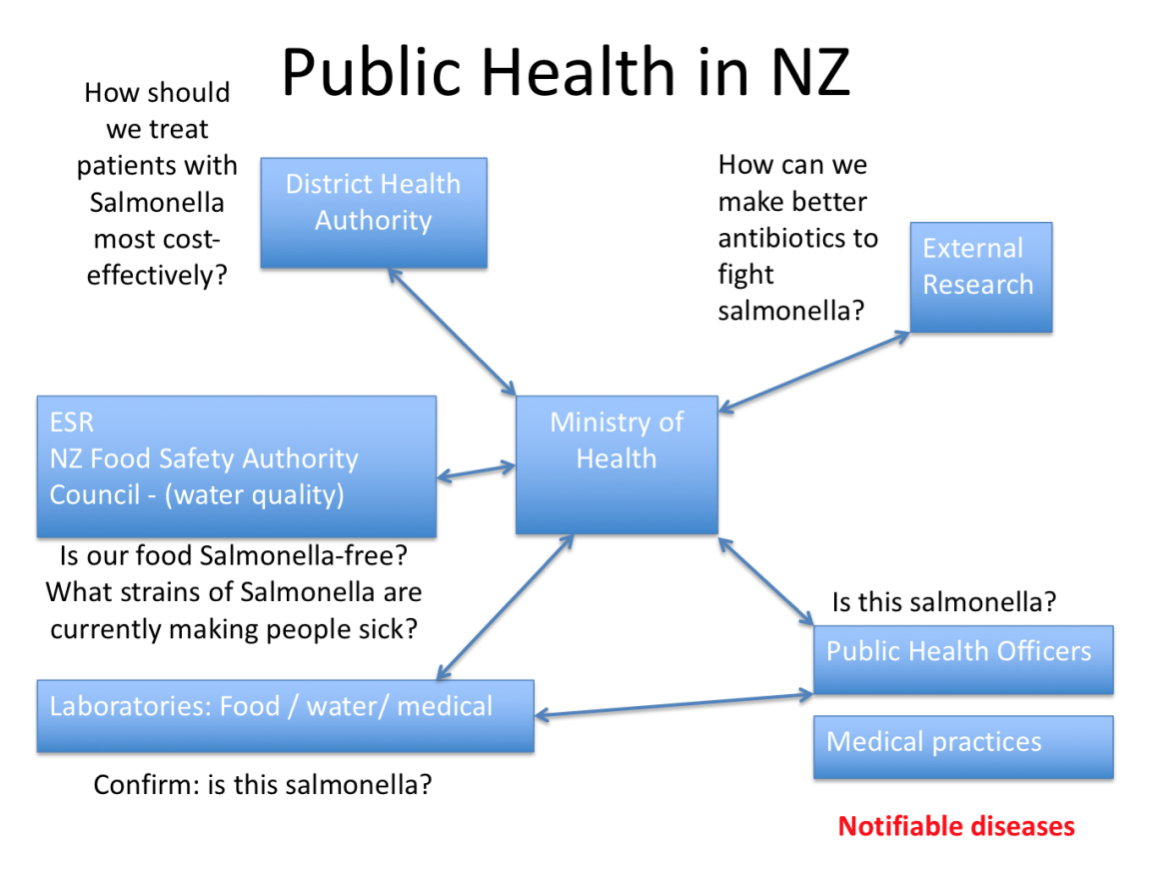
- 22what public health branches receive information on notifiable diseases? "is this salmonella"public health officers
medical practices - 23what do we do with data that goes to the public health branches?analyse mortality, morbidity, and other epi data to create policy:
-how will we control the disease?
-do we need to legislative changes?
-do we need to increase surveillance? - 24draw a flowchart of the public health branches in NZ
- 25When did Ignaz Semmelweis demonstrate that the incidence of puerperal fever could be reduced by washing hands with chlorinated solutions?1847
- 26When and what did John Snow discover?In 1854 he traced the source of an outbreak of cholera to a single point source
- 27In what years did Louis Paster propose the germ theory of disease?1860-1864
- 28What years did Joseph Lister discover antiseptics?1865-1867
- 29When did Koch formulate his postulates1884
- 30When did Alexander Fleming discover Penicillin?1928
- 31what percent of mothers are asymptomatic10-30%
- 32Describe the cell morphology of group b strepGram positive cocci in chains