
Flashcards
Syntax
Cards in this deck (26)
- 1Language 1o1Arrangement of words and phrases to create well formed sentences in a language
language is not stimulus dependent, arbitrary, discrete (utterances are analysable into smaller units) productive (infinite combinations) and recursive (infinite sentences)
Acquistion with easy, no formal lessons needed, unconcious process - 2Physical BasicsFaculty of Language (FL)
component of the mind and organ of the body that gives rise to language on the basis of UG
Universal Grammar (UG)
theory of initial state of FL
genetic endowment of FL
"All humans come equipped with a set of linguistic principles and parameters"
Priciples and Parameters
universal principle and linguistic foundation in the human genome (for grammatical learning) - 3ConstituentsA group of words that function together as a unit
How can we check which elements are constituents?
Tests:
Coordination Condition: Only constituents of the same type can be coordinated
"(The students) (read syntax books) (in the library)"
Substitution
"(They) read syntax books in the library"
Preposing
"(Syntax books) are what the students read in the library" - 4Word classes and basic PrinciplesLexical:
Nouns, Verbs, Adjectives, Prepositions, Adverbs
Functional:
Determiner
Complementizers
Auxiliary
Headedness Principle:
Every non terminal node in a syntactic structure is a projection fo a head.
(mostly the left hand element n + v = np)
Binarity Principle
Every non terminal node is binary branching. - 5Mergetaking two elements (from the lexicon) and merging them together
is a recursive process: the output of an operation is the input of the same operation, infinite merge operations - 6EPP (Extended Projection Principle)A TP needs an Intermediate Projection and a Maximal Projection
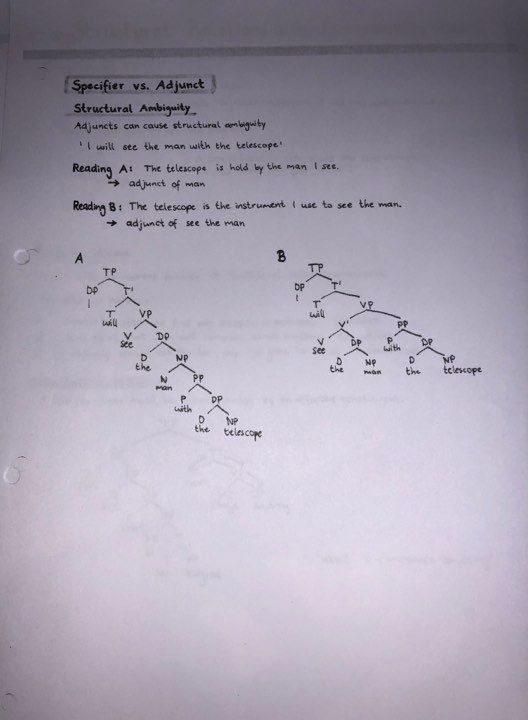
Every English sentence needs a Subject, to serve as the Maximal Projection from a Tbar to a TP (Subject Specifier Position) - 7Specifier vs Adjunct
- 8Structural Relations (CCommand and Polarity Items)
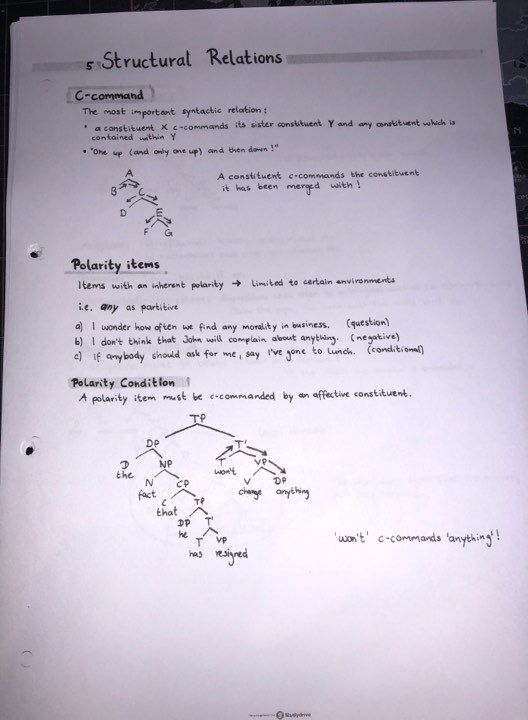
- 9Binding ConditionA bound constituent must be c commanded by an appropriate antecedent
Usually r(eferential) expressions, John the pope and Pronouns bind anaphors - 10Binding Principle AAnaphors must be bound in their local domain (in the clause the anaphor is embedded in)
- 11Binding Principle BPronouns must be free (unique) in their local domain (just one pronoun in a sentence)
- 12Binding Principle CAn R expression must be free (unique) in the overall structure containing it. No 2x The teacher in a sentence/phrase
- 13Finite Phraseusually carries a tense auxiliary (have, should, do...) that carries grammatical information or a null Aff. that lowers the information through affix hopping on the complement
every NP is a DP
every sentence needs a TP with an intermediate and maximal projection with the dp as the specifier position
every sentence is a cp - 14Nonfinite Phrase(1) for clauses (null D und Null C)
(2) control clauses (understood subject in the embedded clause, introduced by an overt or covert CP as PRO
tense auxiliary overt or covert as affix hopping or not)
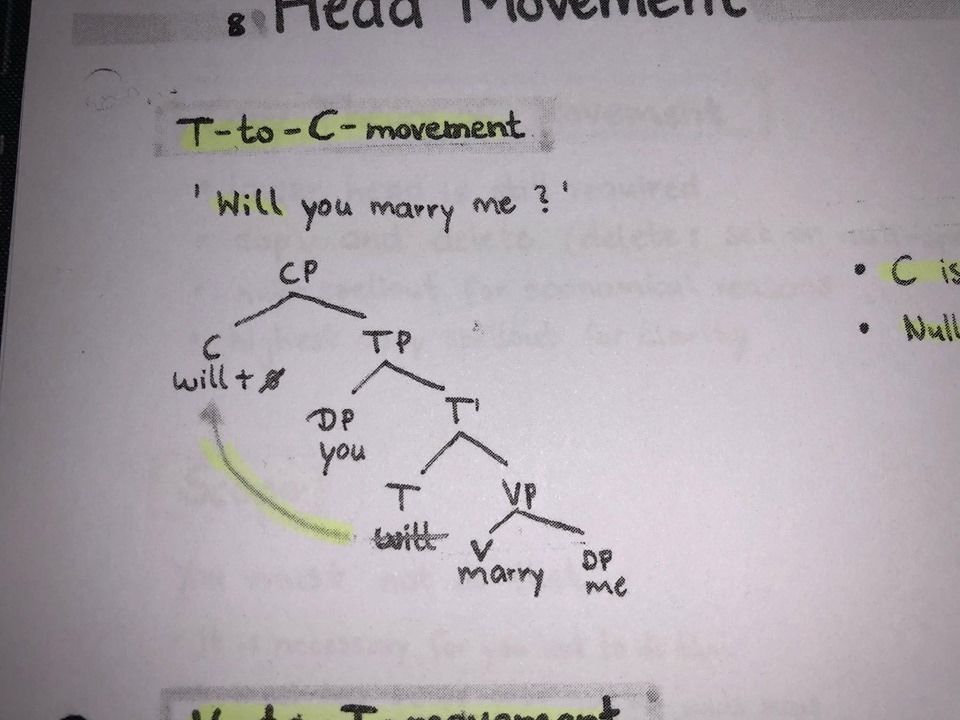
(3) ECM (No C layer in the embedded clause with a accusative marked subject in SPEC TP, mostly two place predicates - 15T-to-C MovementC is a strong head which attracts T, Null affix in C (which needs a tense feature)
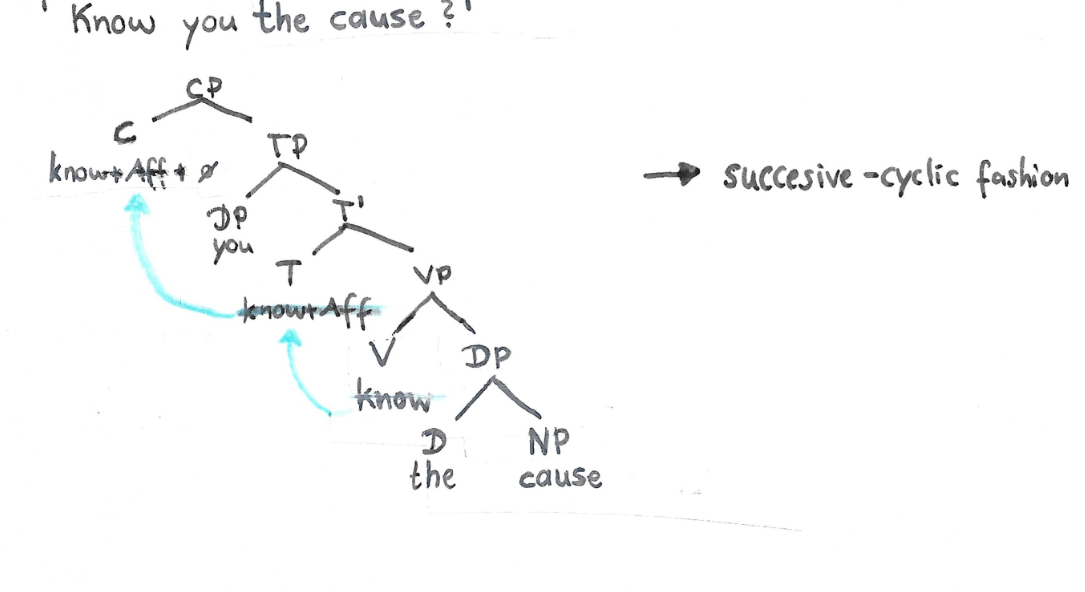
- 16V-To-T Movementstrong affix in T, only possible in Elizabethan English
- 17Auxiliary Raisingonly "be" and "have" allow Aux-to-T Movement
AuxP are: Be, Can, Could, Should, Do, Have, May, Might, Must, Shall, Will, Would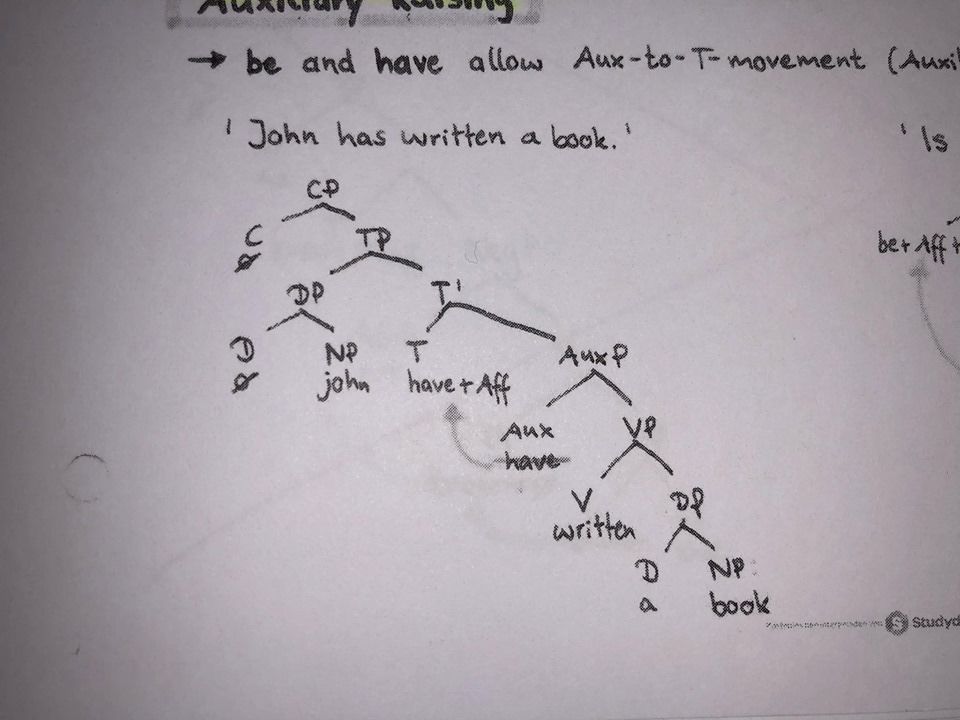
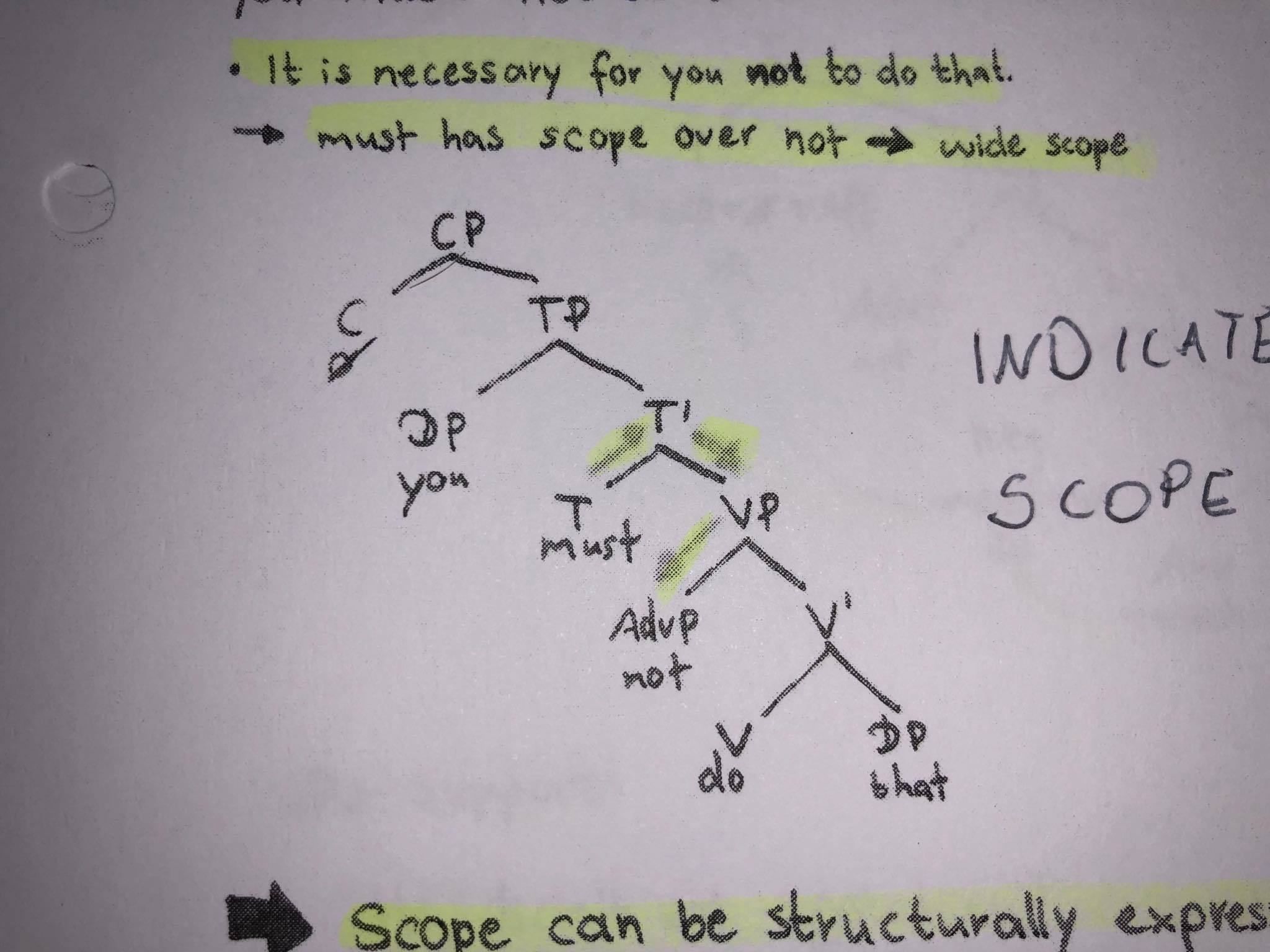
- 18Scope in Trees
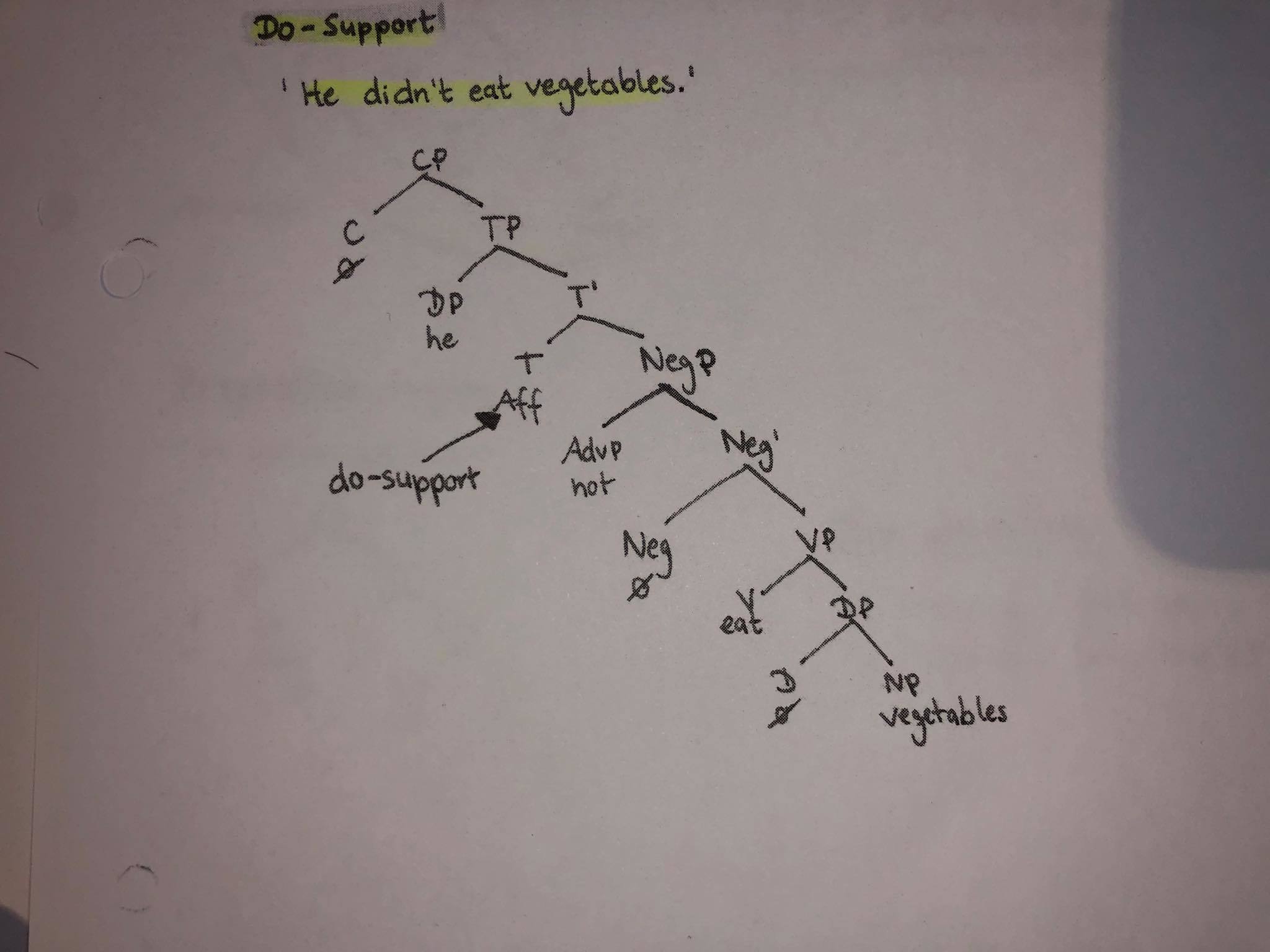
- 19Do Support
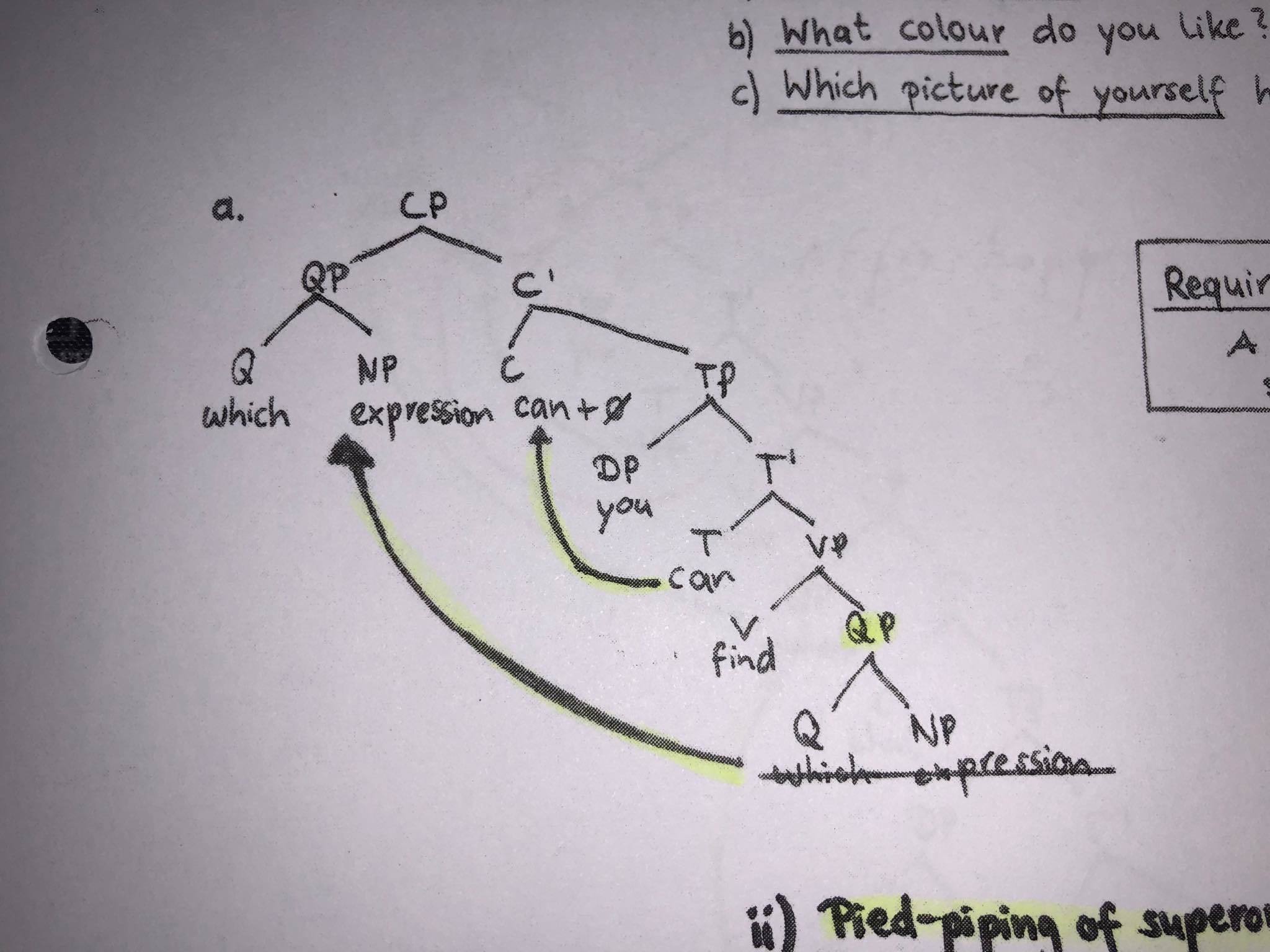
- 20Wh-MovementAll Wh-Questiosn
"Echo Question" - The wh-expression occupies the position of its answer (original position) tree, and delete the lower realization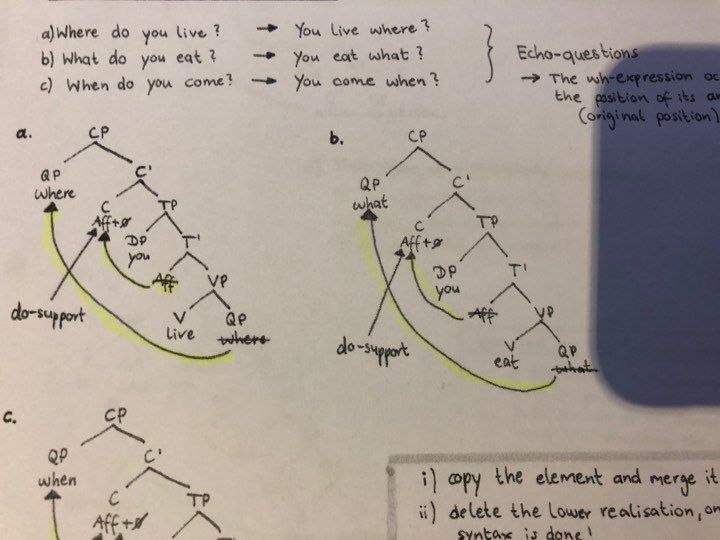
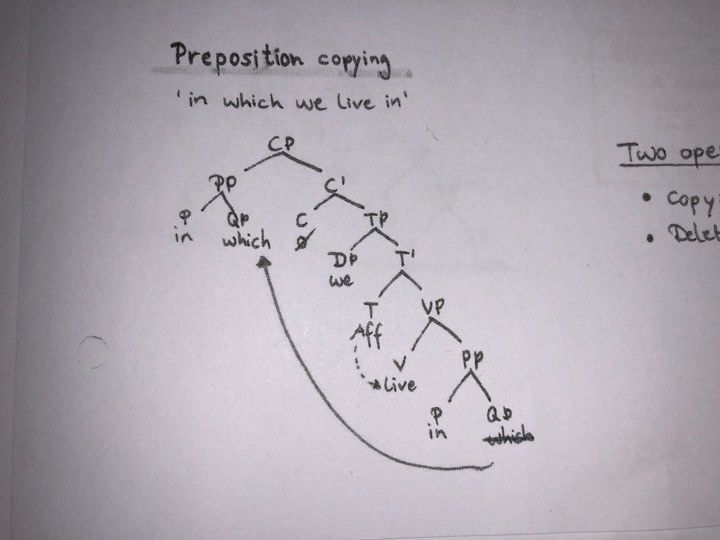
- 21Preposition CopyingAgain, echo question "In which we live in - "in which we live in which" and delete the lower realization
- 22Pied-Piping (process by which one element in a clause drags other words (such as prepositions) along.
- 23Chain Uniformity ConditionA chain is uniform regard to phrase structure status (dragging the prep. along)
- 24Impenetrability ConditionA constituent in the domain of a complementizer or prep. is impenetrable (cant be attracted by) to a higher head c-commanding the relevant complementizer/prep.
- 25Attract Smallest / Closest ConditionAttract Smallest Condition (A head which attracts a particular type of the item attracts the smallest constituent containing such an item which will not lead to violation of any UG principle)
Attract Closest condition (A head which attracts a given kind of constituent attracts the closest constitent of the relevant kind) - 26A-Movement
Information
- Description
- Flashcards on Syntax, created by Elijah Salvatore on 04/02/2020.
- Created by
- Elijah Salvatore
- Views
- 13
- Rating