
Flashcards
Atomic Structure and the Periodic Table
Cards in this deck (39)
- 1What happens to the ionisation energy of a species when an electron is being removed from a new inner shell?It decreases dramatically because not only is there a greater effective nuclear charge but there is also less shielding from inner electron shells. This increases the electron's attraction to the positive nucleus and makes it more difficult to remove
- 2What happens to the atomic radii of elements across a period?Atomic radii decreases because the number of protons increases, so the effective nuclear charge increases. The stronger nuclear attraction on the electrons means they get pulled in closer, hence atomic radius decreases.
- 3What happens to the atomic radii of elements down a group?Atomic radii increase because there is an increase in electrons, so increase shielding due to and increase in energy levels. This means there is less nuclear attraction on the outer electrons so they are not held in as closely.
- 4What happens to first ionisation energies across periods 2 and 3?They increase because across the periods there are more protons in the nucleus and hence grater nuclear charge and therefore the outer electron is more firmly held. There are some dips during this trend when the outer electron is alone in it's outer shell so it is easier to remove.
- 5What happens to first ionisation energies down a group?They decrease because down a group, there are more electrons and so more energy levels which means more shielding. The outer electrons are therefore less attracted to the nucleus and so are less attracted to the nucleus.
- 6Define electronegativityThe ability for the nucleus of an atom to attract a pair of electrons in a covalent bond
- 7Describe the process you would use to prove quantum energy levelsThe atomic emission spectra of elements. A species is heated, which gives it energy. Electrons have the ability to move to a higher energy level because of the energy provided by the heat. When they do this they are in an excited state. When the electron drops back down (to ground state), the same amount of energy absorbed by the electron is released in the form of light. The different colours produced by different frequencies of light are specific to different types of species and show that there are quantum energy levels.
- 8What is ionic bonding?The strong electrostatic attraction between oppositely charged ions.
- 9How many electrons can s subshells hold?2
- 10How many electrons can p subshells hold?6
- 11How many electrons can d subshells hold?10
- 12Why is RAM not an exact whole number?Most elements have naturally occurring isotopes which are taken into account when finding a relative atomic mass. The isotopes' abundance is also taken into account so the RAM is around the most commonly occurring isotope. The will usually make the RAM not an exact whole number.
- 13Describe the process of mass spectrometry1) All the air in the spectrometer is pumped out
2) A gaseous sample sample of an element or compound and is bombarded with high energy electrons from an electron.
3) The energy from the bombarding electrons strips electrons from the atoms or molecules, forming positive ions ( A(g) + energy --> A+(g) + e- )
4) The positive ions are accelerated by the high electric potential, pass through slits and emerge as a beam of ions.
5) Ions are deflected by a powerful magnetic field. Ions with a greater mass are deflected less than those with a smaller mass.
6) Ions are detected and a computer calculates the relative abundance of each mass detected. - 14What is the molecular ion peak?The peak on the far right on the spectra which corresponds to the molecular mass of the molecule.
- 15What is the base peak?The peak which shows the most abundance
- 16What is the maximum number of electrons that can fill each energy level?n=1 2
n=2 8
n=3 18
n=4 32 - 17What are orbitals?A region of space in a subshell where an electron is found. Each orbital can only hold a max of 2 electrons and this only happens if there are no other free orbitals.
- 18What is the Heisenberg uncertainty principle?It's impossible to define with absolute precision, at the same time, both the precision and momentum of an electron.
- 19What is the shape of an s-orbital?Spherical
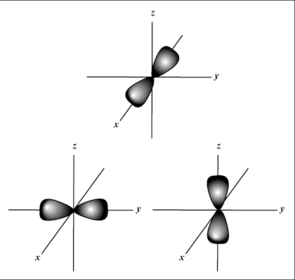
- 20What is the shape of a p-orbital?
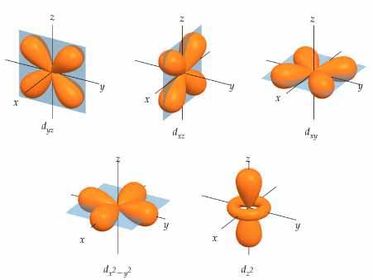
- 21What is the shape of a d-orbital?
- 22What is Hund's rule?When electrons are placed in orbitals with equal energy, they spread out to maximize the number of unpaired electrons.
- 23What is the Aufbau principle?Electrons in an atom start in the lowest energy orbital, as they are added they occupy the lowest energy orbital available
- 24Define first ionisation energy?The first ionisation of an element is the energy required to remove 1 electron from 1 mole of gaseous atoms of that element.
- 25Why do the successive ionisation energies for an atom increase?Each electron gets harder to remove due to a greater number of positive protons in the nucleus compared to negative electrons surrounding it (higher proton to electron ratio). This positive charge in the nucleus is the effective nuclear charge, which increases. This causes electrons to be pulled in closer and held more tightly, making them harder to remove.
- 26Define covalent bonding?The strong electrostatic attraction between the positive nuclei and their shared electrons
- 27What are the bond angles of a trigonal planar?120
- 28What are the bond angles of a tetrahedral?109.5
- 29What are the bond angles of a trigonal bipyramid?90, 120 and 180
- 30What are the bond angles of an octahedral?90 and 180
- 31How would you find the number of lone pairs in a molecule?(group no. - no. of bonds) / 2
- 32What is bond length?The distance between nuclei of atoms that are covalently bonded to eachother
- 33Describe a pure ionic bondThere is no overlapping of electron density between ionically bonded atoms because difference in electronegativity is not large enough
- 34Describe a covalent bond with ionic characterThere is an uneven distribution of electron density in the bond because of a large difference in electronegativity
- 35Describe an ionic bond with covalent characterElectron density is pulled towards a highly electronegative atom in the bond, forming an egg like shape of the less electronegative atom
- 36What happens to electronegativity down a groupDecreases because of an increase in shielding
- 37What happens to electronegativity as you go across a period?Increases because there is no overall increase in shielding and an increase in effective nuclear charge
- 38Why do linear molecules have a high boiling point?They can pack close together so london forces are stronger
- 39—
Information
- Description
- AS - Level Chemistry Flashcards on Atomic Structure and the Periodic Table, created by Kayla Price on 15/02/2016.
- Created by
- Kayla Price
- Views
- 22
- Rating