
Flashcards
C1
Cards in this deck (27)
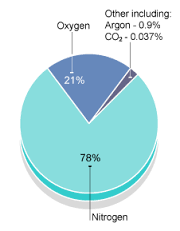
- 1C1 THE EARLY ATMOSPHEREFormed by gasses from volcanoes.
Large amounts of carbon dioxide and water vapour, hardly any oxygen, small amounts of other gasses. - 2C1 A CHANGING ATMOSPHEREFossil fuels increase CO2, farming increases CH4 and O2, deforestation decreases O2 and increases CO2, volcanoes increase CO2 and SO2.
- 3C1 ROCKS AND THEIR FORMATIONIgneous rocks: From magma or lava, made from inter locking crystals, the slower it cooled, the bigger the crystals (basalt-small,granite-big)
Sedimentary rocks:Compacted sediment, erode easily, made from founded grains, contain fossils (chalk, limestone)
Metamorphic rocks: Sedimentary under lots of heat and pressure, form crystals (Marble-from chalk or limestone) - 4C1 LIMESTONE AND ITS USESUsing limestone:Buildings, roads, railways, glass, concrete, cement.
Quarrying-Good: Important material, creates jobs, helps UK and local economy.
Quarrying-Bad: Dust, noise, destruction, wildlife, scenery, traffic, pollution) - 5C1 FORMULAE AND EQUATIONSMolecule: Two or more, one type of atom
Compound: Two or more, different atoms
Mixture: Not chemically joined - 6C1 CHEMICAL REACTIONSThermal decomposition: Metal carbonates decompose when heated, oxide and carbon dioxide formed
Precipitation reactions: Two soluble substances form one insoluble substance (precipitate) - 7C1 REACTIONS OF CALCIUM COMPOUNDSLimewater: calcium hydroxide dissolved in water, test for CO2 (if present goes cloudy)
Using calcium carbonate: neutralisation of acidic compounds (eg. used by farmers on soil)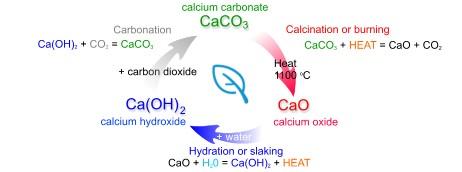
- 8C1 INDIGESTIONHydrocloric acid: made by stomach, kills bacteria, helps digestion with use of enzymes-only work in acidic conditions, too much = indigestion
Acid+base--->salt+water - 9C1 NEUTRALISATIONNeutralisation: Can be done with metal oxides, hydroxides and carbonates
acid+metal oxide--->salt+H2O
acid+metal hydroxide--->salt+H2O
acid+metal carbonate
--->salt+H2O+CO2 - 10C1 IMPORTANCE OF CHLORINEElectrolysis: decomposition of a compound with a dc current
Hydrocloric acid-->chlorine+H2O
Chlorine: obtained from sea water through electrolysis
Uses: Bleach, PVC (plastic)
Dangers: toxic gas, kills microorganisms, can harm or kill - 11C1 ELECTROLYSIS OF WATER2H2O--->2H2+O2
Hydrogen test: lit splint, will pop
Oxygen test: glowing splint, will relight
Chlorine: Damp blue litmus paper, red then will bleach white. - 12C1 ORESExtracting metals: most found as compounds (if unreactive, found as pure metal)
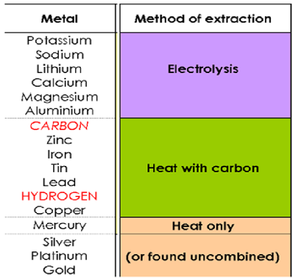
- 13C1 OXIDATION AND REDUCTIONOxidation: Gaining oxygen
Reduction: loss of oxygen
Higher in reactivity series, corrode faster. - 14C1 RECYCLING MATERIALSMaterials will last longer, less mines,less pollution (less energy to recycle than to extract), less land for landfill
Gold: jewellery, small electrical devices
Copper: wireing, water pipes
Steel: Bridges, cars, buildings
Aluminium:planes, cars - 15C1 ALLOYSAlloy: mixture of metals (eg. steel)
Gold: Too soft, alloys used
Shape memory alloys: Nitinol goes to original shape when heated - 16C1 CRUDE OILHydrocarbons: Hydrogen and carbon only
Crude oil: contains a mixture of hydrocarbons, not very useful as crude oil - 17C1 CRUDE OIL FRACTIONSGasses:heating and cooking
Kerosene: fuel for aircraft
Fuel oil: Large ships and power stations
Bitumen: roads and roofs
Gas (compared to bitumen): low boiling point, easy to set alight, low viscosity (runny) - 18C1 COMBUSTIONBurning hydrocarbons with oxygen: CO2 and H2O produced
- 19C1 ACID RAINSulfur dioxide: Most hydocarbon fuels contain impurities such as sufur, when the hydrocarbon is burnt, sulfur dioxide is formed
- 20C1 CLIMATE CHANGEReducing CO2: Seeding oceans with iron compounds, encorages microscopic plants
capturing CO2 and converting it back into hydrocarbons - 21C1 BIOFUELSBiofuel: Fuel made from plants (eg. wood or ethanol from sugar cane or sugar beet)
Advantages: Renewable, less pollution (however fossil fuels are used for transport and conversion into ethanol)
Disadvantages: Uses up land-leads to higher food prices - 22C1 CHOOSING FUELSGood fuel: burn easily, not produce ash or smoke, release lots of energy, easy to store and transport
- 23C1 ALKANES AND ALKENESAlkenes: unsaturated, have a carbon-carbon double bond
Unsaturated: Has a double bond
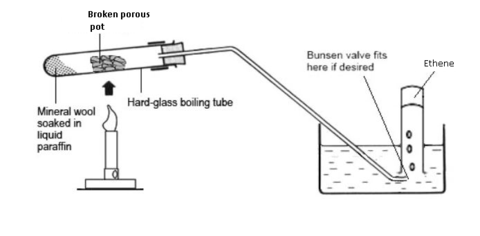
Bromine test: To find out if a liquid contains double bonds, Bromine dissolved in water is orange but becomes colourless when mixed with unsaturated molecules. - 24C1 CRACKINGBreaking down long chains into short chains and alkenes.
Cracking is necessary because there is a lager demand than supply for short chain molecules but vice verca for long chain. - 25C1 CRACKING PARAFFIN
- 26C1 POLYMERISATIONEthene can be polymerised to form poly(ethene) (polymer)
Small alkene molecules: Monomers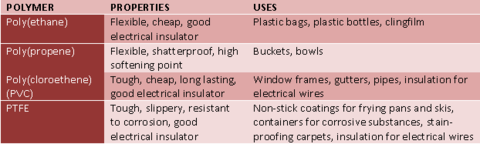
- 27C1 PROBLEMS WITH POLYMERSBiodegradability: Polymers don't rot - useful because will last a long time.
Disposing of polymers - good: Recycling - can melt to make new products, biodegradable poymers - in development, will rot away
Disposing of polymers - bad: Landfill - running out of landfill sites, burning - release toxic gases