
Flashcards
C1 revision
Cards in this deck (98)
- 1What are the relatve charges of each particle?Proton +1
Neutron 0
electron -1 - 2What is the atomic number and mass number of an element?The number of protons in an atom of an
element is its atomic number.
The sum of the protons and
neutrons in an atom is its mass number. - 3What is group 8/0 called and what makes them special and why?Group 8/0 is the noble gases. They are special because they are unreatice as they have a stable arrangement of electrons
- 4No atoms are lost or made during a chemical reaction so the mass of the __________ equals the mass of the __________.No atoms are lost or made during a chemical reaction so the mass of the products equals the mass of the reactants.
- 5How can calcium oxide and carbon dioxide be obtained from calcium carbonate?Thermal decomposition
- 6What is the word and symbol equation for the reaction between Calcium oxide and water.Calcium oxide + water -----> calcium
hydroxide
CaO + H2O ------> Ca(OH)2 - 7What can the product of the reaction between Calcium oxide and water be used for?To neutalise acids as it's an alkali.
- 8What colour does limewater go in the pressence of carbon dioxide?Colourless.
- 9How can calcium hydroxide be reacted to form calcium carbonate?A solution of calcium hydroxide in water (limewater) reacts with carbon dioxide to produce calcium carbonate.
- 10How is cement, mortar and concrete made?Limestone is heated with clay to make cement. Cement is mixed with sand to make mortar and with sand and aggregate to make concrete.
- 11What is the term used that ores have to be, to be extractedEconomically viable.
- 12What may happens to ores before they are extracted and purified?They maybe purified.
- 13Name a metal that is found in the earth as itself.Gold.
- 14How are metals less reactive than carbon extracted?Reduction with carbon.
- 15How are metals more reactive than carbon extracted?Electrolysis.
- 16Why are metals that are more reactive then carbon expensive.They require a lot of energy to extract.
- 17How can copper be extracted?Smelting rich ores, then electrolysis for purification.
- 18What is the problem with copper-rich ores?They are limited.
- 19What are the two new ways of extracting low-grade ores?Phytomining and bioleaching.
- 20Why are new ways of extracting metals being researched?To limit the enviromental impact of traditional mining.
- 21How does phytomining work?Phytomining uses plants to absorb metal
compounds and then the plants are burned to produce ash that contains the metal compounds - 22How does bioleaching work?Bioleaching uses bacteria to produce leachate solutions that contain metal compounds.
- 23How can copper be extracted from copper salts.Electrolysis or displacement using scrap iron.
- 24Why can't aluminium be extracted from their oxides using reduction from carbon.They are too reactive and so would need a lot of stages in the process and large amounts of energy.
- 25Why should we recycle metals?Extracting them uses limited resources and is expensive in terms of energy and effects on the enviroment.
- 26What percentage is iron from a blast furnace?96%
- 27Why does iron from a blast furnace have little uses.It is brittle from the impurities.
- 28What is steel an alloy of?Iron and carbon.
- 29What are the three types of steel and their uses?Low-carbon steels are easily shaped, high-carbon steels are hard, and stainless steels are resistant to corrosion.
- 30Why are most metals in everyday use alloys?Some of them e.g. pure copper,
gold, iron and aluminium are too soft for many uses and so are mixed with small amounts of similar metals to make them harder for everyday use. - 31What are elemnts in the central block of the periodic table called?Transition elements.
- 32What are properties of metalsThey are good conductors of heat and
electricity and can be bent or hammered into shape. - 33What is the usefulness of metal properties?They are useful as structural materials
and for making things that must allow heat or electricity to pass through them easily. - 34What properties does copper have that make it useful for wiring and plumbing.■ It is a good conductor of electricity and heat
■ It can be bent but is hard enough to be used to make pipes or tanks
■ It does not react with water. - 35What are two useful properties of aluminium and titanium?They have a low density and resistant to corrosion
- 36What is crude oil?A mixutre of a very large number of compunds
- 37What is a mixture?A mixture consists of two or more elements or compounds not chemically combined together. The chemical properties of each substance in the mixture are unchanged. It is possible to separate the substances in a mixture by
physical methods including distillation. - 38What do most of the compounds in crude oil consist of?Hydrocarbons.
- 39What are saturated hydrocarbons called?Alkanes.
- 40What is the general formula for alkanes?Cn H2n+2.
- 41What are the two way that ethane can be represented?■ C2H6
H H
I I
■ H –– C –– C –– H
I I
H H - 42What is the process of seperating crude oil called?Fractional distillation.
- 43What does the process of seperating crude oil involve?Evaporating the oil and allowing it to condense at a number of different temperatures (fractions)
- 44What effects some of the properties of hydrocarbons?Size
- 45What does viscosity mean?How thick and sticky a liquid is.
- 46Why are hydrocarbons?Compounds containing hydrogen and carbon only.
- 47What may be released by burning hydrocarbon based fuels?carbon dioxide, water (vapour),
carbon monoxide, sulfur dioxide and oxides of nitrogen. Solid particles (particulates) may also be released. - 48When are the oxides of nitrogen formed?High temperatures.
- 49What happens to the carbon and hydrogen during combustion?They are oxidised
- 50What causes acid rain?Sulfur dioxide and oxides of nitrogen
- 51What causes global warming?Carbon dioxide.
- 52What causes global dimming?Solid particles(possibly containing soot and unburnt fuels).
- 53Sulfur can be _____________ from fuels.Removed
- 54What are biofuels produced from?plant material
- 55What are the ethical issues of using biofuels?Crops that could be used to feed people are used to provide the raw materials for biofuels instead. This could cause food shortages or increases in the price of food.
- 56What are the enviromental issues of using biofuels?Although they are supposed to be carbon neutral, they aren't as fossil fuels are used in their production however they do produce less carbon than fossil fuels.
- 57What is involved in the cracking of hydrocarbons?Heating the hydrocarbons to vaporise them. The vapours are either passed over a hot catalyst or mixed with steam and heated to a very high temperature so that thermal decomposition reactions then occur.
- 58What are unsaturated hydrocarbons called?Alkenes
- 59What the general formula for Alkenes?CnH2n
- 60What are the two ways that propene can be represented■ C3H6
H H H
l I I
■ H –– C –– C == C
l I
H H - 61What turns bromine water colourless?Alkenes
- 62What can be used to make polymers?Alkenes.
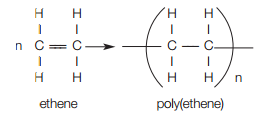
- 63What do monomers form?Polymers.
- 64How do you show Monomers turning into polymers
- 65Give 5 examples of uses of polymers.New packaging materials, waterproof coatings for fabrics, dental polymers, wound dressings, hydrogels, smart materials (including shape memory polymers).
- 66What is the problem with polymersMany polymers are not biodegradable, so they are not broken down by microbes and this can lead to problems with waste disposal.
- 67What are some new plastic bags being made from?Polymers andcornstarch
- 68How can ethanol be produced by hydration?ethenewith steam in the presence of a catalyst.
- 69How can ethanol be made using fermentation with yeast?sugar------> carbon dioxide + ethanol
- 70How is oil removed from plant material?The plant material is crushed and the oil removed by pressing or in some cases by distillation. Water and other impurities are removed.
- 71Why are vegetable oils important foods and fuels?They provide a lot of energy. They also provide us with nutrients.
- 72What is the result of using oils to cook?quicker cooking and different flavours but increases the energy that the food releases when it is eaten.
- 73Give three advantages of emulsifiers.Better texture, coating ability and appearance.
- 74What are the two parts of an emulsifier?A hydrophobic tail and a Hydrophilic head.
- 75What do unsaturated vegetable oils contain?carbon-carbon double bonds
- 76What is the test for carbon-carbon double bonds and what is the result?bromine water goes from orange to colourless
- 77How can vegetable oils be hardened?Reacting them with hydrogen in the
presence of a nickel catalyst at about 60 °C. - 78What happens to the hydrogen in the hardening in vegatable oils?Hydrogen adds to the carbon–carbon double bonds.
- 79What are the advantages of hardened vegetable oils?The hydrogenated oils have higher
melting points so they are solids at room
temperature, making them useful as spreads and in cakes and pastries. - 80What are the 3 layers in the earth?Core, mantle and crust.
- 81What is earth surronded by?The atmosphere
- 82What is the upper part of the mantle and the crust split up into?tectonic plates
- 83What causes the tectonic plates to move?Convection currents within the Earth’s mantle driven by heat released by natural radioactive processes cause the plates to move
- 84What can occur at plate boundaries?Earthquakes and volcanic eruptions.
- 85What is the distribution of nitrogen and oxygen in the atmosphere?About 80% nitrogen and 20% oxygen
- 86Name 3 other things that are in the atmosphere?small proportions of carbon dioxide, water vapour and noble gases.
- 87What released the gases that formed the early atmosphere?Intense volcanic activity
- 88What condensed that formed the oceans?Water vapour.
- 89What is one of the theories of the earths early atmosphere?The Earth’s atmosphere was mainly carbon dioxide and there would have been little or no oxygen gas. There may also have been water vapour and small proportions of methane and ammonia.
- 90Who did the experiment using gases from the early atmosphere to test if organic compound could form?Miller and Urey
- 91What is primordial soup theory?Early Earth had a chemically reducing atmosphere. This atmosphere, exposed to energy in various forms, produced simple organic compounds ("monomers"). These compounds accumulated in a "soup", which may have been concentrated at various locations (shorelines, oceanic vents etc.).
By further transformation, more complex organic polymers – and ultimately life – developed in the soup. - 92what produced the oxygen in the atmosphere?Plants and algae.
- 93What did most of the carbon dioxide get locked up in?Sedimentary rocks as carbonates and fossil fuels.
- 94How did limestone form?limestone was formed from the
shells and skeletons of marine organisms. - 95What do fossil fuels contain?Carbon and hydrocarbons that are the remains of plants and animals.
- 96The oceans also act as a reservoir for carbon dioxide but increased amounts of carbon dioxide absorbed by the oceans has an impact on what?marine enviroment.
- 97What does burning fossil fuels do to the carbon dioxide in the atmosphere?increases it.
- 98Why would you fractionally distil air?To provide a source of raw materials used in a variety of industrial processes.
Information
- Description
- Flashcards on C1 revision, created by daniel upton on 06/05/2017.
- Created by
- daniel upton
- Views
- 19
- Rating