
Flashcards
AQA Chemistry - Unit 3 Flashcards
Cards in this deck (53)
- 1Newlands and then Mendeleev attempted to...classify the elements by arranging them in order of the atomic weights.
- This list can be arranged in a table so elements with similar properties are in columns/groups - 2It's called a periodic table because...Similar properties occur at regular intervals
- 3The early periodic table was incomplete and some elements were placed in inappropriate groups if the strict order of atomic weight was followed. Mendeleev did what to solve this?He left gaps for elements that hadn't been found
- 4What discovery changed how the periodic table was constructed?That of protons, neutrons and electrons!
Then all elements were in the appropriate groups... - 5The modern periodic table can also be seen as an arrangement of the elements in terms of?Their electronic structures
- 6Group 1 metals have: - a low density - react with ____ to form ionic compounds that form a metal ion (with +1 charge) - The compounds are _____ solids which form _____ solutions in water - They react with ___ to form hydrogen - Form _____ that dissolve in water to give ____ solutions1) NON-METALS
2) WHITE
3) COLOURLESS
4) WATER
5) HYDROXIDES
6) ALKALINE - 7In Group 1 the further down an element is ...? (2 points) The ____ its melting and boiling point.The more reactive the elements get
The LOWER its melting and boiling point - 8Compared with G1 elements, transitions metals are:- Stronger and harder
- Higher melting points (EXCEPT for mercury that annoying element)
- Higher DENSITIES - 9Transitions metals are much less reactive and don't react that vigorously with oxygen and water as G1 elements True or False?TRUE
- 10Sing the 3 further praises of the transition metals1) Form coloured compounds
2) Have ions with different charges
3) Useful as catalysts - 11Elements in Group 7 (halogens) react with ______ to form IONIC compounds in which the ____ ion carries a charge of ___1) METALS
2) HALIDE
3) MINUS ONE - 12In Group 7 the further down you go:1) The LESS REACTIVE the element
2) The HIGHER its melting pt and boiling pt - 13A ___ reactive halogen can displace a ___ reactive halogen in an ___ solution of its salt1) MORE
2) LESS
3) AQUEOUS
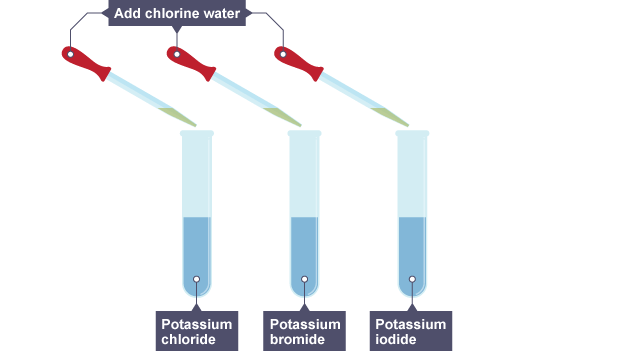
below is how you would start such a displacement. Can you predict which tests tube will show displacement?
The answer is: Tube 2 and 3 (from left) - 14Trends in reactivity in the periodic table can be explained cause the higher the energy level, the less easily...electrons are gained
- 15Name some commercial water softeners and advantages/disadvantagesIon exchange water softener
- Sodium ions could be bad for your health (HBP)
- Costs money to keep topped up
- Could be saving money because less soap is wasted
- Can add products to washing machine/kettle to protect from scale
- Filter jugs
- But softening water could be bad for your health - 16Soft water readily forms a lather with soap. Hard water reacts with soap to form ____ so more soap is needed to form lather. _____ detergents do not form scum.1) SCUM
2) SOAPLESS - 17Temporary hard water is softened by boiling. Permanent hard water remains hard when boiled. TRUE OR FALSE?TRUE
- 18Temporary hard water contains HCO3- ions (hydrogencarbonate) which ____ on heating into _____ ions. These react with calcium or magnesium ions to form _____.1) DECOMPOSE
2) CARBONATE
3) PRECIPITATES - 19Using hard water can ____ costs and temporary hard water can reduce the _____ of kettles and heating systems because it produces ____ when heated1) reduce
2) efficiency
3) scale - 20Hard water can be softened by: 1) adding sodium carbonate (washing soda) - ____ with calcium or magnesium ions to form ______ 2) ion exchange resins which contain ____ or sodium ions which replace the calcium and magnesium ions1) which reacts
2) precipitate of calcium and magnesium carbonate
3) hydrogen - 21Water of the correct quality is produced by? Human beings need water of the correct quality for LIFE which has sufficiently low levels of _____1) Choosing an appropriate source
2) Passing the water through filter beds to remove any solids
3) STERILISING with CHLORINE
4) Dissolved salts and microbes - 22Water filters containing carbon, silver and ion exchange resins can...improve taste and quality of water by removing dissolved substances from tap water
- 23Arguments for adding fluoride to water- Improves dental health
- Almost no health effects except fluorosis
- Can protect against some types of heart disease linked with tooth decay bacteria
- Only added in tiny amounts - 24Arguments against adding fluoride- People should choose
- Fluorosis
- Not big benefit
- Could affect brain e.g. cause learning difficulties
- Can't control people's intakes so can become unsafe - 25The relative amounts of energy released when substances ___ can be measured by what? What can this method be used to compare?1) ARE BURNED
2) SIMPLE CALORIMETRY
3) Amount of energy released by fuels and foods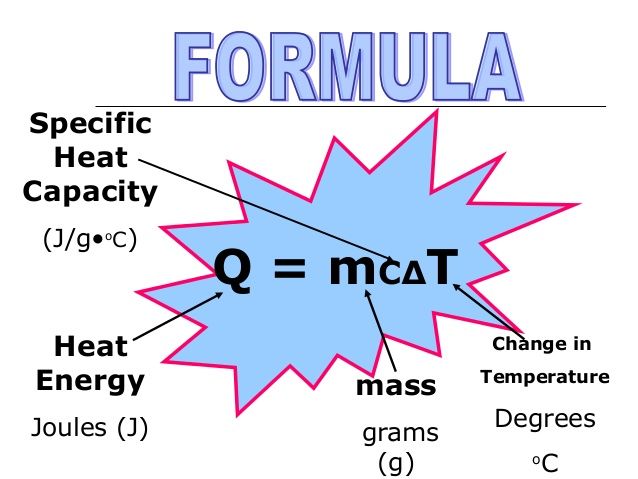
- 26How can we calculate the amount of energy released or absorbed by a chemical reaction in solution? What type of reactions can you use this method for?Mix the reagents together in an insulated container
Measure the temperature change
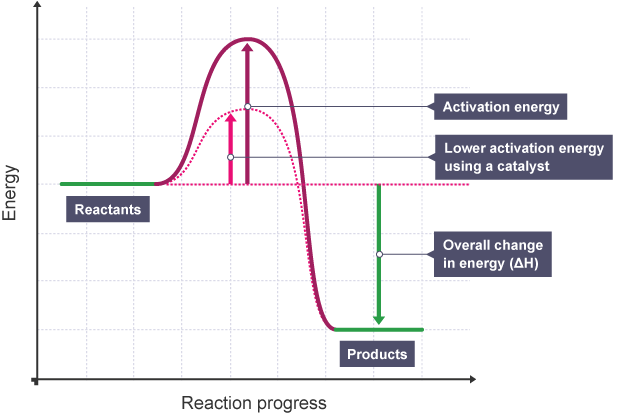
You can use this method for reactions of solids with water or for NEUTRALISATION reactions - 27Describe the energy level diagrams for exothermic and endothermic. How would you change it if you had to add activation energy?EXOTHERMIC
Reactants have more energy
Give out a lot of energy to the surroundings (-ΔH)
Products have less energy so are drawn lower
ENDOTHERMIC
the opposite of exothermic - 28In a chemical reaction energy must be supplied to ___ bonds and is released to ____ bonds. How do you calculate ΔH?1) BREAK
2) FORM
ΔH = sum of bonds broken – sum of bonds made - 29Energy released to form bonds is greater than energy needed to break existing bonds in an EXOTHERMIC reaction Energy needed to break existing bonds is greater than energy released to form new ones True or false?We form bonds for products (release energy)
We break bonds of the reactants (we need energy for this)
TRUE - 30Energy level diagram for catalyst
- 31Hydrogen can be ___ as a fuel in combustion ____. It can also be used in _____ that produce electricity to power vehicles. The equation for hydrogen combustion:1) burned
2) engines
3) fuel cells
hydrogen + oxygen --> water - 32Flames test are used to identify ____. The metals that can be identified with these are ____. Describe the flame colour for each.1) METAL IONS
2) Lithium - Crimson
Potassium - Lilac
Calcium - Red
Sodium - Yellow
Barium - Green - 33Name the ions that form white precipitates with SODIUM HYDROXIDE ions Of them, ____ precipitate dissolves in excess sodium hydroxide solution1) Aluminium, calcium and magnesium
2) ALUMINUM HYDROXIDE - 34Copper(II), iron(II) and iron(III) What precipitates do they form with sodium hydroxide solution?Copper(II) forms blue precipitate
Iron(II) forms a green one
Iron(III) forms brown - 35Carbonates react with dilute ___ to form ______ turning limewater cloudy because of the calcium carbonate white precipitate.1) ACIDS
2) CARBON DIOXIDE - 36Halide ions in solution produce ____ with ___ nitrate solution in the presence of dilute ____ acid. The ions and their precipitate colours are...?1) PRECIPITATES
2) SILVER
3) NITRIC
(Silver) bromide --> cream
chloride --> white
iodide --> yellow - 37Sulfate ions in solution produce a white precipitate with barium chloride solution in the presence of dilute HYDROCHLORIC ACID TRUE OR FALSE?TRUE
- 38Describe a titration1) Unknown concentration of solution in flask
2) Measure volume of solution using pipette
3) Indicator in flask
4) Solution of known concentration in burette
5) White tile under flask
6) Add acid/alkali drop-wise
7) Swirl the mixture and check for colour change (neutralisation) end point
8) Volume of known solution added is recorded - 39The raw materials for the Haber process areNitrogen (from the air)
Hydrogen (from natural gas or other sources) - 40The ___ gases are passed over ____ of __ at a high temperature (about ___*C) and a high pressure (about ___ atmospheres) What's the word equation? The ammonia ____ and is removed on c___. The remaining hydrogen and ____ are ____.1) PURIFIED
2) CATALYST
3) IRON
4) 450
5) 200
6) liquefies
7) cooling
8) nitrogen
9) recycled
nitrogen + hydrogen <-> ammonia - 41When a reversible reaction occurs in a closed system when is equilibrium reachedWhen the reactions occur at exactly the same rate in each direction
- 42The relative amounts of all the reacting substances at equilibrium depend on the conditions of the ___REACTION
- 43If the temperature is raised how is the yield in endo/exo reactions affected?The yield from the ENDOTHERMIC reaction increases and the yield from the EXOTHERMIC REACTION decreases
- 44If the temperature is lowered, yield from the endothermic reaction DECREASES and yield from the exothermic reaction INCREASES true or falsetrue
- 45In ____ reactions, an increase in pressure will favour the reaction that produces the least number of ____ as shown by the symbol equation1) GASEOUS
2) MOLECULES - 46Importance of equilibrium in Haber processThese factors, together with reaction rates, are important when determining the optimum conditions in industrial processes
- 47Social and economic pros and cons of uses of alcoholsAlcohols
SOCIAL
1) Death and illness
2) Days lost at work
ECONOMIC
1) Big income from taxes for government and drinks companies
2) Costs a lot of money to police alcohol-related crimes and costs NHS a lot of money - 48Same as last flashcard but for carboxylic acids and estersSOCIAL
1) Ethanol can be used as biofuel. Biodiesel (made from plant oils which are esters). When processed these break down into carboxylic acids. Reacted with methanol/ethnaol to make esters used as biodiesel.
2) Land could be used for food crops
3) Land for biodiesel farms made by deforestation - harmful to environment but we need an alternative to crude oil, so there's little choice - 49Methanol, ethanol and propanol- First 3 members of a homologous series of alcohols
- Dissolve in water to form a neutral solution
- React with sodium to produce HYDROGEN
- BURN in air
- Are used as FUELS and SOLVENTS
- Ethanol is the main alcohol in alcoholic drinks - 50Ethanol can be oxidised to ___ by chemical oxidising agents or microbial action. Ethanoic acid is the main acid in ____.1) ETHANOIC ACID
2) VINEGAR - 51Carboxylic acids- dissolve in WATER to form ACIDIC solutions
- react with carbonates to produce CARBON DIOXIDE
- react with ALCOHOLS in the presence of an ACID CATALYST to produce esters
- don't ionise completely when dissolved in WATER and so are WEAK ACIDS
- Aqueous solutions of WEAK ACIDS have a higher pH value than aqueous solutions of STRONG ACIDS with the same concentration - 52Esters (like ethyl ethanoate) Functional group? Uses?Ethyl ethanoate is an ester produced from ethanol and ethanoic acid.
-COO-
They are volatile compounds with distinctive smells and are used with perfumes and flavourings - 53Social, environmental, economic consequences of using fuelsSOCIAL
- May not be convenient to use hydrogen as not many filling stations
- H Might not be able to match performance with petrol
ENVIRONMENTAL
- Global warming
- Pollution
- May need to use alternative fuel sources e.g. hydrogen which don't contribbute to global warming
- Supplying hydrogen could be bad for the environment because use electrolysis (which burns fossil fuels)
ECONOMIC
- Safety and storage is an issue with fuels like hydrogen
- Price of hydrogen might be higher
Information
- Description
- Flashcards to help you memorise the last unit :)
- Created by
- Shreya Manna
- Views
- 36
- Rating