
Express, Resulting and Constructive Trusts
27 resources created by 20 users
This GoConqr page gathers over 27 community-made resources on Express, Resulting and Constructive Trusts: quizzes, mind maps, flashcards and notes to revise and practise with.
Top Express, Resulting and Constructive Trusts resources
-
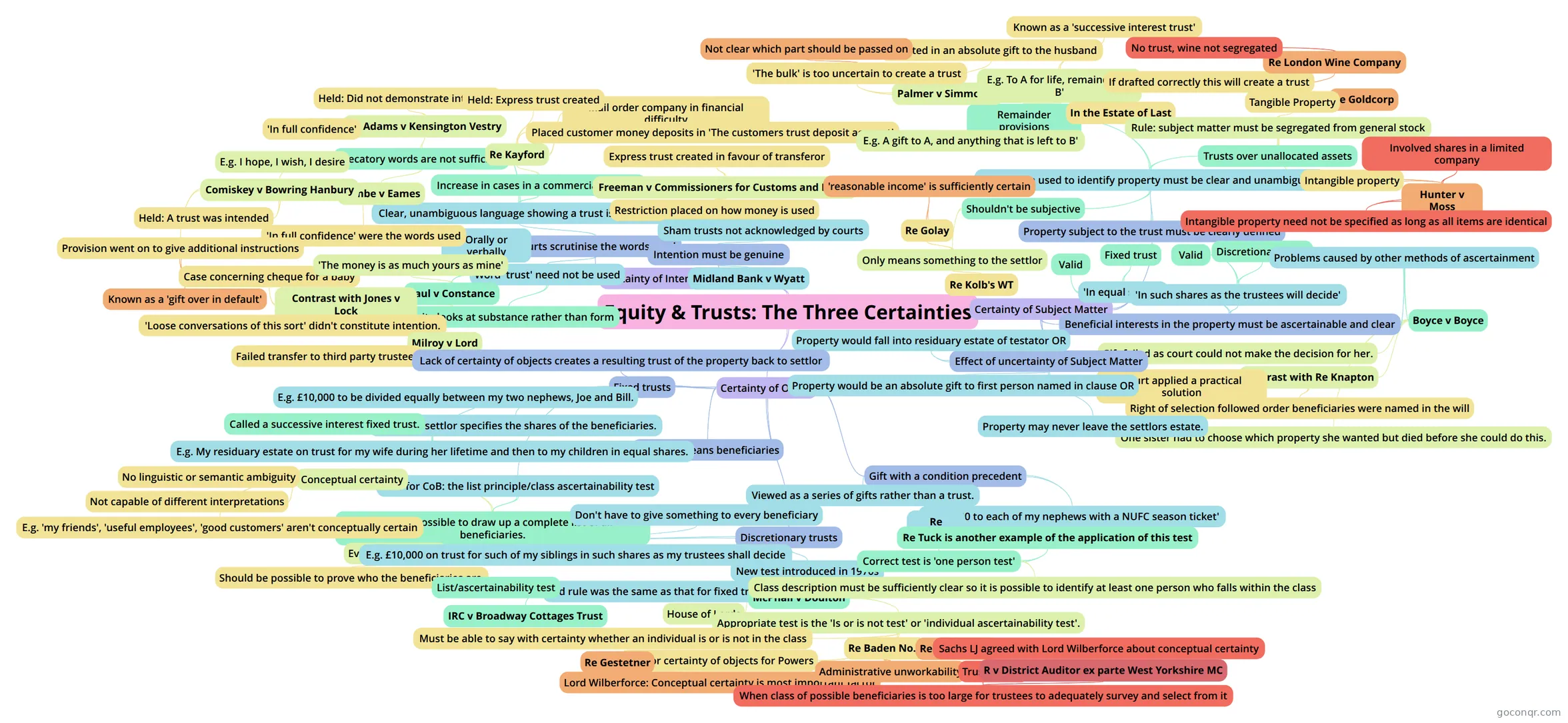 Mind map Equity & Trusts: The Three Certainties An explaination of the three certaintais in terms of trusts law in the uk
-
Mind map Express Trusts
-
Mind map Three Certainties
-
Mind map Week 10 Cases Constructive Trusts Continued
-
31 cardsExpress Trusts- constitution and formalities Oughtred v IRC
-
Mind map 1_1_1_3 Certainties
-
Mind map 1_1_3 Certainties
-
Mind map Trust law - lecture 3
Mind maps
See all 20 mind mapsFlashcards
-
31 cardsExpress Trusts- constitution and formalities Oughtred v IRC
-
28 cardsEquity and Trusts, Express Trusts Paul v Constance
-
13 cardsEPT - Certainty of Objects £5k to each of my daughters
-
15 cardsE, c 2 q Mcphail v Daoulton (Re Badens No 1)
-
3 cardsIntro Paul v Constance [1977]
-
10 cardsUntitled pettit v pettit
Notes
Topics in Express, Resulting and Constructive Trusts
More Civil law topics
About Express, Resulting and Constructive Trusts
GoConqr OriginalWhat this unit covers
The resources follow the three routes by which a trust arises. Express trusts come first, then resulting trusts, then constructive trusts. The listed material includes mind maps, flashcard decks and one set of notes, all made by GoConqr users.
Where to start
Begin with the mind map Express Trusts. It explains how a settlor declares a trust, transfers legal title to a trustee and gives an equitable interest to a beneficiary. Next, read The Three Certainties and the map Equity & Trusts: The Three Certainties. They set out certainty of intention, subject matter and objects, with cases such as Knight v Knight, Lambe v Eames and Re Adams. Several shorter maps cover each certainty on its own, so you can go deeper where you feel unsure.
Formalities and constitution
The note Formalities covers section 53(1)(b) of the LPA 1925 and trusts over land. The flashcard deck Intro covers lifetime trusts of personalty, with Paul v Constance and Richards v Delbridge. The deck on constitution and formalities then moves to secret trusts, mutual wills and cases such as Blackwell v Blackwell, Ottaway v Norman and Oughtred v IRC.
Objects, resulting and constructive trusts
- The flashcards on express trusts cover IRC v Broadway Cottages, Re Gulbenkian's Settlement Trust and McPhail v Doulton.
- The maps Presumed RT and Total or partial failure of express trust cover resulting trusts.
- The map Tinsley v Milligan [1993] looks at a single case.
- The map on Week 10 constructive trusts looks at Re Goodchild and mutual wills.
Using maps and flashcards together
Read a map to see how the ideas connect. Then use the flashcards to recall the cases and what each decided. Return to the maps to check anything you missed. This unit sits in the Equity and Trusts strand of Civil law. Pick a map and see how far you get, then try writing your own flashcards.
Frequently asked questions
Which resource should I open first?
Start with the Express Trusts mind map. It shows how a trust is declared and what passes to the trustee and the beneficiary. After that, move to the maps on the three certainties, which build directly on that picture.
What do the three certainties maps cover?
They cover certainty of intention, subject matter and objects. The maps note that courts look closely at the words used, and that the word trust need not appear. They also mention cases such as Knight v Knight, Lambe v Eames and Re Adams.
Is there anything on formalities and secret trusts?
Yes. The Formalities note covers section 53(1)(b) of the LPA 1925 for trusts over land. The flashcards on constitution and formalities cover secret trusts, mutual wills and cases such as Blackwell v Blackwell and Ottaway v Norman.
Are these resources free to use?
Yes. Every resource listed here is free to open and study with no account needed. They were made by GoConqr users, not by GoConqr itself. A free account also lets you save your own work and create your own maps, flashcards and notes.
Who is this page for?
It is for university students working on equity and trusts, and for teachers who want ready-made material. All the listed resources are at university level, so they suit revising cases, comparing types of trust and spotting gaps in your notes.
Does the page cover resulting and constructive trusts?
Yes. Look at the maps on presumed resulting trusts, the total or partial failure of an express trust, and Tinsley v Milligan. For constructive trusts, the Week 10 cases map covers Re Goodchild and the prerequisites linked to mutual wills.