
Population and Community Ecology
8 resources created by 7 users
This Population and Community Ecology page on GoConqr gathers community-made quizzes, mind maps, flashcards and notes, from life tables and metapopulations to succession, disturbance and trophic cascades. It's built for university students and professional candidates, school students, and teachers after ready-made material, with plenty to practise on population growth, species interactions and community structure. There are over 90 resources here, including more than 10 quizzes, over 30 mind maps and over 30 flashcard decks, with one AP Environmental Science test among them. Pick a topic, try a quiz, then see what you recall.
Top Population and Community Ecology resources
-
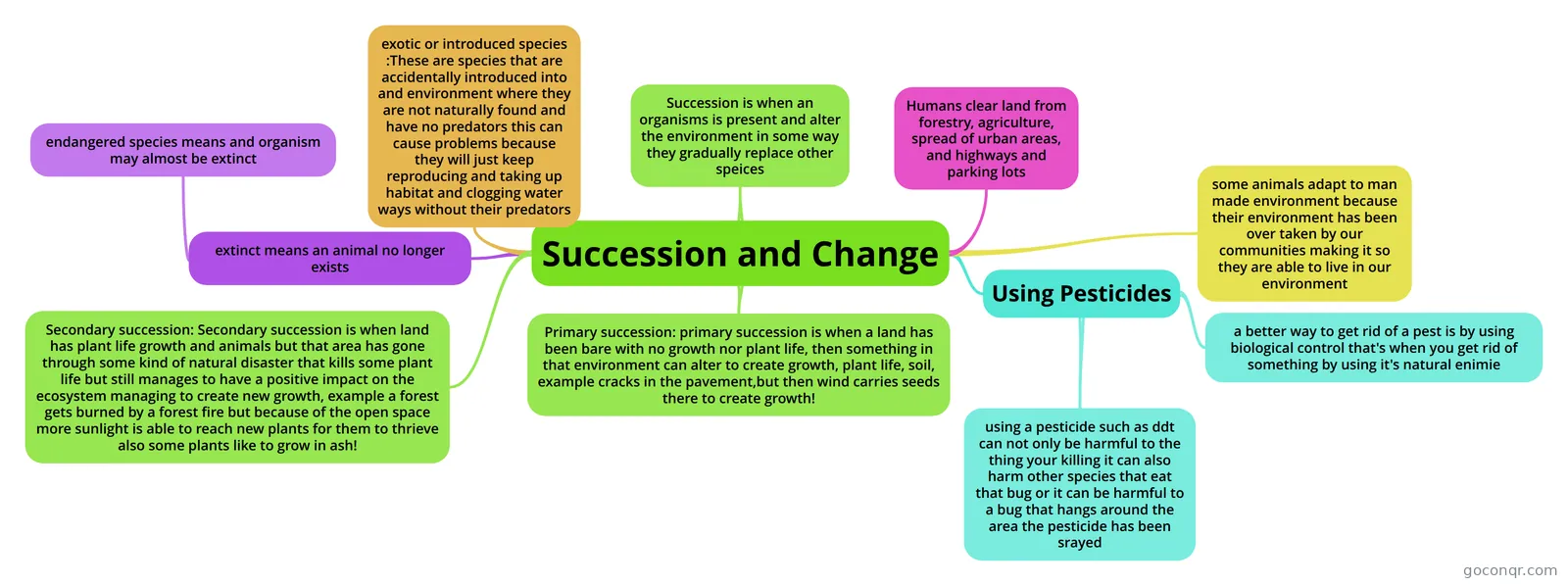 Mind map Succession and Change
-
35 questionsPopulation and community ecology part 1 Which of the following definitions best describe population ecology?
-
Mind map Disturbance what is disturbance and How it effects community structure and biodiversity
-
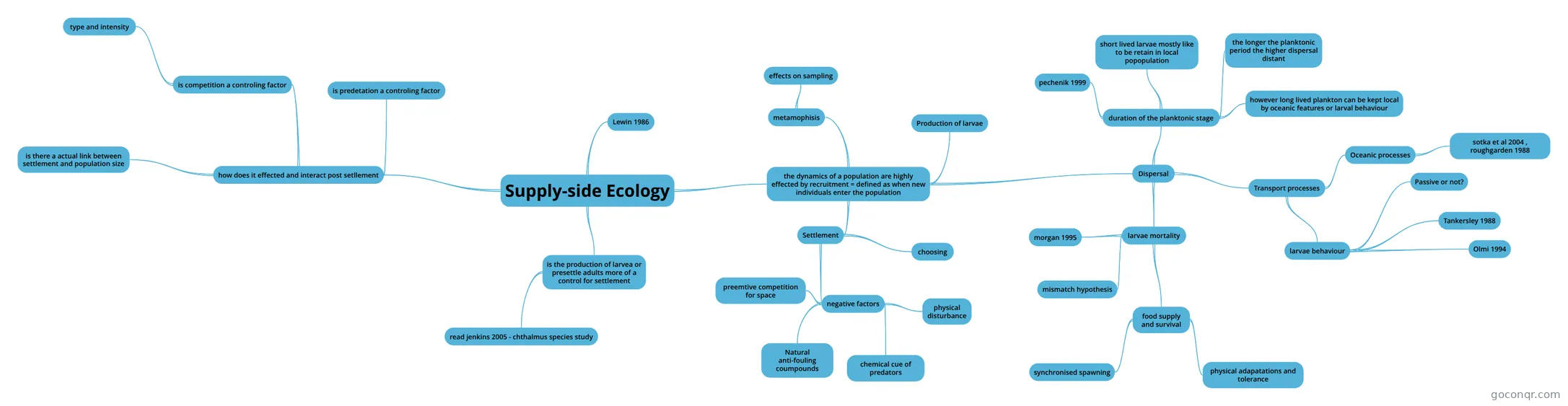 Mind map Supply-side Ecology quick notes on supply-side ecology, how it is effected and if it is actually a main cause of population cha...
-
16 cardsBIOL368: Lecture 6 Define a population.
-
26 cardsEnviSci 214 - Predation, Herbivory, & Parasitism Exam #3 Material
-
3 questionsEnvironmental Science Midterm What does population density refer to?
-
7 cards1.3 variation in population size what are the stages of the pattern of growth for a natural population?
Quizzes
Mind maps
Flashcards
More Environmental science and ecology topics
About Population and Community Ecology
GoConqr OriginalWhat the unit covers
This unit sits in the Ecology and Biodiversity strand of Environmental science and ecology. It moves from single populations to whole communities. On the population side, the mind map Population Ecology covers counting methods such as direct counts and mark-recapture, dispersion patterns, survivorship curves and growth models. The quiz on life tables, cohorts and age structured populations looks at mortality rates and hypothetical mortality curves.
Community and change
On the community side, the quiz on predators, parasites and herbivores looks at interactions where one organism benefits and another is harmed. Species Distribution deals with niche, tolerance, geographic distribution and species ranges. Disturbance defines damage or mortality caused by an external agent, physical or biological. Succession and Change explains primary succession, where bare land gradually gains soil and plant life.
Where to start
- Begin with the mind maps Ecology and Population Ecology to get the key terms in place.
- Move to the flashcards on metapopulations in Lecture 19 and the conservation deck on density dependence.
- Try the quiz on life tables, then the quiz on predators, parasites and herbivores.
- Finish with Succession and Change and Disturbance to see how communities shift over time.
Using quizzes and maps together
Read a mind map first, then close it and take the matching quiz. Any gap you notice tells you which branch to reread. Flashcards are handy for short definitions, such as what a metapopulation is or why patches vary in population size. The AP Environmental Science: Chapter 6 Test suits anyone who wants to practise reading a demographic diagram and thinking about human population growth.
Make it your own
Teachers can pick a mind map for a lesson and set a quiz afterwards. Students can choose a deck, test themselves, and then write a short set of their own notes on the topic that gave them most trouble.
Frequently asked questions
Which resource should I open first?
Start with the mind maps Ecology and Population Ecology. They set out the basic vocabulary, from counting populations and survivorship curves to growth models. Once the terms feel familiar, take the quiz on life tables, cohorts and age structured populations to check what has stuck.
What do the mind maps on this page cover?
They range across population dynamics, species distribution, disturbance, succession, community ecology and mutualisms. Others look at small populations and the problem of rarity, trophic cascades, human population growth and what makes a species prone to extinction. Each one is a quick way to see a topic laid out.
Are the resources free to use?
Yes. Every resource listed here is free to open, study and take, with no account needed. They were made by GoConqr users rather than by GoConqr itself, so styles and depth vary. If you want to save quiz scores or make your own materials, a free account adds that.
Which levels and exams do these resources suit?
Most of the material is aimed at university students and professional candidates, with a smaller share for school students. One quiz, the AP Environmental Science: Chapter 6 Test, and a Unit 3 flashcard deck for AP Environmental science mention that exam by name.
Is there anything on predators and parasites?
Yes. There is a quiz on predators, parasites and herbivores that covers interactions where one organism benefits and another is harmed. There is also a flashcard deck titled EnviSci 214 - Predation, Herbivory, & Parasitism, which works well as a follow-up for revision.
What if I cannot find the topic I need?
Try a nearby resource first, since many cover related ideas under different titles, such as Community ecology, Com Ecology and Community Ecology. If the gap remains, you can build your own mind map, flashcards or notes on the topic and use them for revision.