
Study Designs and Research Methods
113 resources created by 85 users
This Study Designs and Research Methods page on GoConqr gathers community-made mind maps, flashcards, quizzes and a note, from cohort, case-control and cross-sectional studies to randomised trials, bias and confounding. It's built for university students practising how to tell designs apart and weigh evidence, and for teachers after ready-made material. There are more than 110 resources here, including over 60 mind maps, 30 flashcard decks and 8 quizzes. Try a quiz to find your gaps, then open a map to fill them.
Top Study Designs and Research Methods resources
-
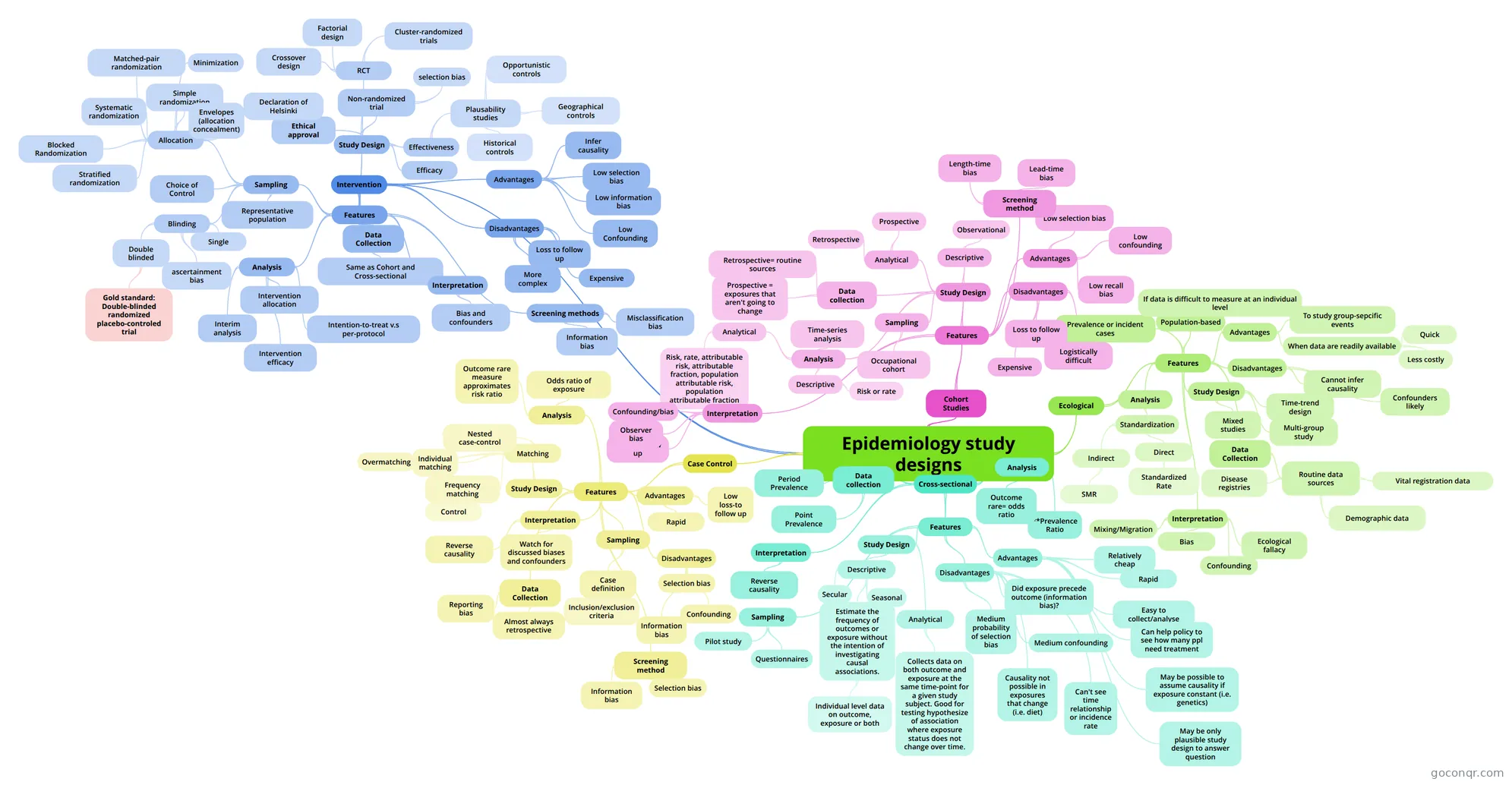 Mind map Epidemiology study designs
-
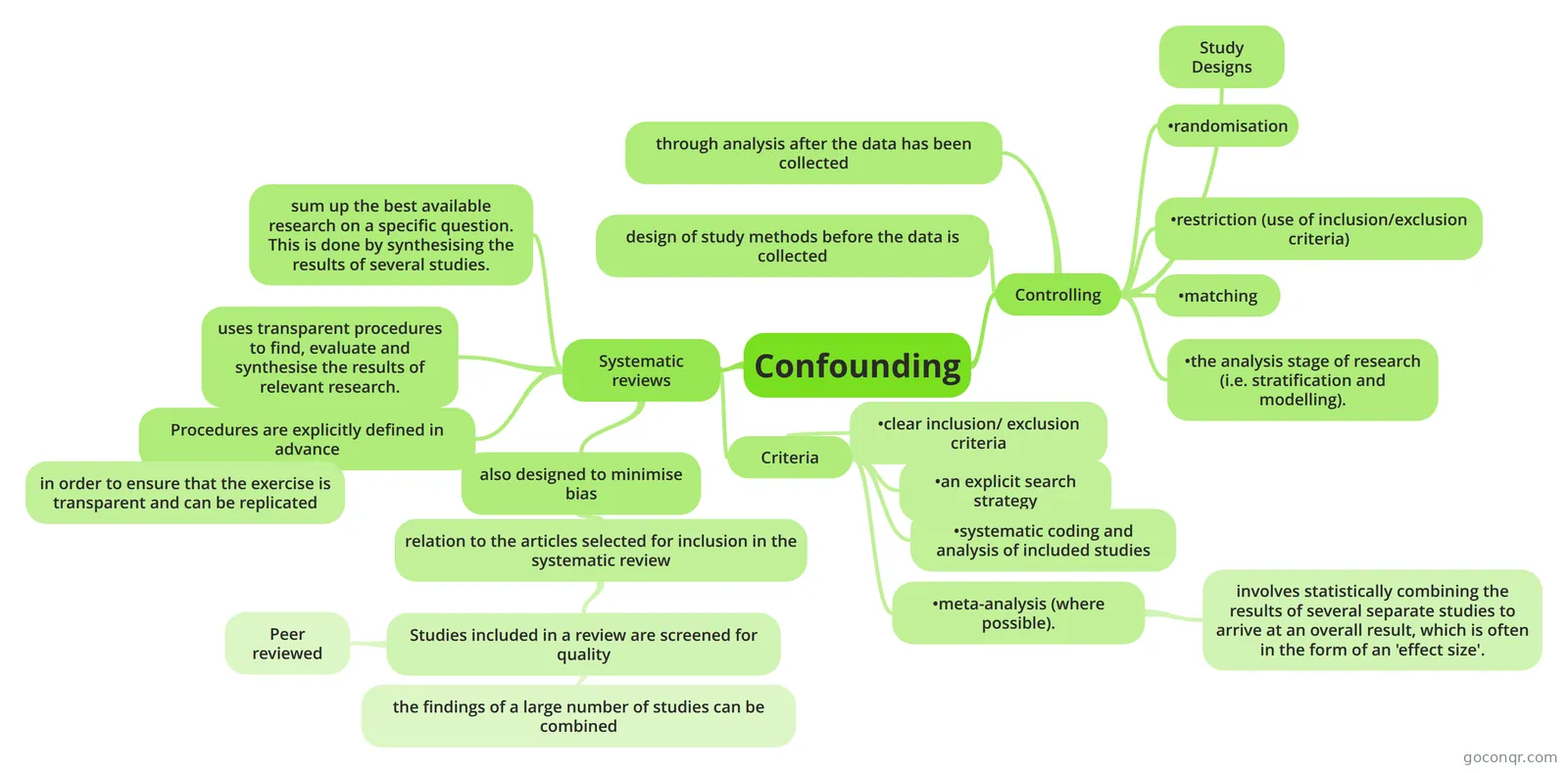 Mind map Confounding
-
6 cardsEpi Flash Cards Week 6 Definition of terms
-
6 cards2. The common design features of all epidemiological studies: GATE What does the 'P' in PECOT stand for?
-
54 cardsTypes of Epidemiological Study What are descriptive studies?
-
32 cardsObservational Studies Case report/Case series
-
Mind map Observational studies
-
126 cardsTerminology Quiz (week 1) The WHO definition of health
Quizzes
-
45 questionsUntitled A researcher with a medium-sized grant wants to study the relationship between sickness and exposure to in-...
-
35 questionsPUBH Important Concepts You can protect randomisation in an RCT by 1) concealing allocation and 2) using intention to treat analysis
-
17 questionsLecture 17 and 18 - Chance Which of the following is CORRECT
-
39 questionsUntitled which type of research method is conducted on either animals, humans, computer models, or tissue cultures?
-
18 questionsStudy Types Which of the following best describes a cross sectional study
-
11 questionsLecture 15 + 23 RCTS and Causation Which of the following is CORRECT
-
16 questionscommunity1 Sample size is included in :
-
8 questionsHCMG 3213 - Concept 4
Mind maps
See all 70 mind mapsFlashcards
See all 30 flashcards-
6 cardsEpi Flash Cards Week 6 Definition of terms
-
6 cards2. The common design features of all epidemiological studies: GATE What does the 'P' in PECOT stand for?
-
54 cardsTypes of Epidemiological Study What are descriptive studies?
-
32 cardsObservational Studies Case report/Case series
-
126 cardsTerminology Quiz (week 1) The WHO definition of health
-
129 cardsHS 2801 MIDTERM what are the two types of health research
-
36 cardsEpidemiology what are the major categories of analytic designs?
-
67 cardsCross sectional
Flowcharts
Notes
Topics in Study Designs and Research Methods
More Public health and epidemiology topics
About Study Designs and Research Methods
GoConqr OriginalWhat this unit covers
The resources on this page are about how epidemiological studies are designed and judged. The mind map Epidemiology study designs sets out ecological studies, with their features, advantages and disadvantages. Other maps look at observational designs, case reports and case series, cross-sectional studies, cohort studies, case-control studies and randomised control trials.
Where to start
Begin with the broad overview maps, such as Epidemiology study designs and Observational Study Designs. They explain that observational designs are non-experimental and more open to bias and confounding than randomised trials. Then move to the single-design maps one at a time.
- Read an overview map to see how the designs differ.
- Open the map for one design, such as Cohort studies or Case-control.
- Go through a flashcard deck on the same design.
- Take a quiz to check what stuck.
Bias, confounding and evidence
The Confounding map covers ways of controlling it: randomisation, restriction, matching and analysis methods such as stratification and modelling. The deck Bias and miscalssification and the map Levels of Evidence help you judge how far a study can be trusted. The deck Observational Studies adds 2 by 2 tables, odds ratios, relative risk and attributable risk.
Using quizzes and maps together
Quizzes such as Study Types and Lecture 15 + 23 RCTS and Causation show quickly which designs you mix up. Go back to the matching map for those, then retry the quiz. Teachers can use the same sequence as a ready-made revision set.
Where it sits
This unit belongs to the Epidemiology and Research Methods strand of Public health and epidemiology. Pick one design today and work through its map, deck and quiz.
Frequently asked questions
Which resource should I open first?
Start with the mind map Epidemiology study designs, which gives an overview of ecological studies and their strengths and weaknesses. Then move to the maps on observational designs and randomised trials, so you can compare how each design answers a question before you test yourself.
What do the mind maps cover?
They cover ecological, cross-sectional, cohort and case-control studies, case reports and series, and randomised control trials. There are also maps on confounding, bias, levels of evidence and regression models for case-control and cohort studies, so you can follow a design from definition to analysis.
Are the resources free to use?
Yes. Every resource listed here is free to open, study and take, with no account needed. A free account also saves your quiz scores and lets you make your own quizzes, mind maps, flashcards and notes.
Who made these resources?
They were made by GoConqr users, not by GoConqr itself. Many follow university lecture weeks and course topics, so wording and emphasis can differ between resources. Comparing a few on the same design is a good way to spot gaps.
Which quizzes are available?
There are 8 quizzes, including Study Types, Lecture 17 and 18 - Chance, and one on RCTs and causation. Use them after reading a map or deck to see which designs or ideas you still confuse.
What level are these resources?
They are almost all university level, with a small share aimed at professionals. They suit university students learning to compare study designs and appraise evidence, and teachers who want ready-made material to share.