
Apuntes
Taxonomy and naming species - notes
Contenido del apunte (1)
Página 1
In order to classify species we place them in seven discrete (non-overlapping) categories called taxonomic groups (or just taxa).
The taxonomic groups are as follows:
Kingdom
Phylum
Class
Order
Family
Genus
Species
What this tells you is that each kingdom is comprised of several phyla, each comprised of several classes, etc. (note that the plural of genus is genera). If two species are in the same family, they must also be in the same kingdom, phylum, class and order.
You need to know the order of the taxonomic groups, so come up with a simple mnemonic such as:
King Philip Cried Out, "For Goodness' Sake!" (You'll be able to come up with a much better one than mine I'm sure.)
Species are named by the binomial system, where the first name (always capitalised) indicates the genus and the second name (not capitalised) indiciates the species. For example, Staphylococcus aureus belongs to the genus Staphylococcus and the species aureus.
Remember the definition of a species:
"A group of organisms which are similar enough that they can interbreed to produce fertile offspring."
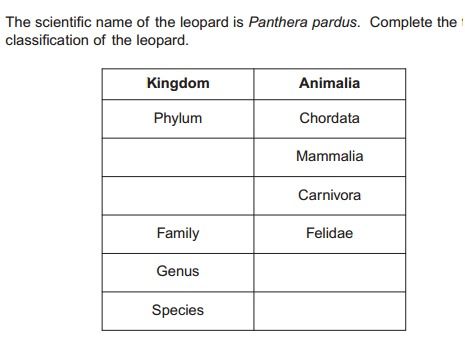
A very common style of exam question is as follows: (answers on next spread)
On the left: Class, Order (in that order)
On the right: Panthera, pardus (in that order)
Taxonomy and naming species
Answer
Información
- Descripción
- A-Level (Classification (unit 2)) Biology Apunte sobre Taxonomy and naming species - notes, creado por Stephen Cole el 04/04/2014.
- Creado por
- Stephen Cole
- Visitas
- 100
- Etiquetas
- Valoración