
Test
Key Events in the Civil Rights Movement and The Vietnam War
Este test tiene tipos de pregunta que se abren en el reproductor de siempre.
Preguntas del test (18)
1In what year was the Brown vs Topeka case?
- A1954
- B1973
- C1964
- D1955
2Which of these were factors in the Little Rock Nine incident of 1957?
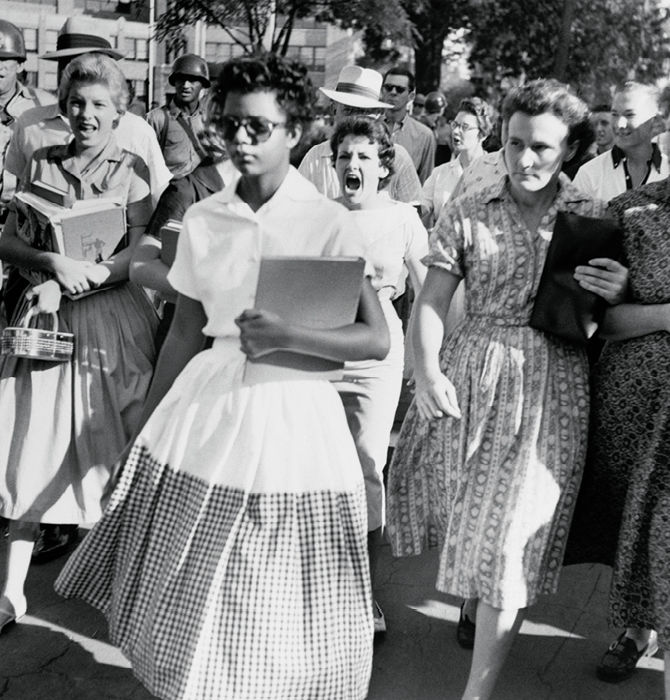
- AGovernor Orval Fawbus places the National Guard in front of the school to prevent the students from entering
- BEisenhower demands the removal of the guard
- CEisenhower sends the US military in to defuse the situation and enforce the federal law
- DThe students had been recruited by Daisy Gaston Bates, president of the Arkansas NAACP
- EAll of the above
3Emmett Till was a [blank_start]14[blank_end]-year-old boy from Chicago. whilst visiting family in [blank_start]Mississippi[blank_end] in [blank_start]1956[blank_end], he was believed to have made a pass at a white woman behind the counter at a [blank_start]store[blank_end]. 4 days later, the woman's husband and his [blank_start]brother-in-law[blank_end] kidnapped Emmett. They Emmett carry a 75-pound fan to a barn and ordered him to take off his clothes. The two men then beat him nearly to death, gouged out his eye, shot him in the head and then threw his body, tied to the cotton-gin fan with barbed wire, into the river. The trial lasted [blank_start]67[blank_end] minutes, with the defendants found [blank_start]innocent[blank_end]. Emmett's mother had an open casket funeral to show the press what the men had done to her son
- A14
- B15
- C13
- D1956
- E1957
- F1953
- GSouth Carolina
- HMemphis
- IMississippi
- Jbrother
- Kbrother-in-law
- Lcousin
- M46
- N23
- O67
- Pguilty
- Qinnocent
- Rguilty of manslaughter, not murder
- Sstore
- Tresteraunt
- Ubank
4Blacks made up 75% of riders on public transport, which was why the Montgomery Bus Boycott was so impactful
- AVerdadero
- BFalso
5In which ways had progress been made in the Civil Rights' Movement since the Brown vs Board case? Check all that apply
- AIncrease in Black Americans who registered to vote
- BSchools were now integrated
- CCivil Rights movement was the country's main concern
- DBuses across the USA were integrated
- ECorruption eliminated in the south
6The city of Birmingham, Alabama was targeted by the Civil Rights Movement because the Chief of Police was Bull Conner, a known racist. The protests started on [blank_start]April 3rd[blank_end], 1963. To disperse the protestors, Conner used [blank_start]attack dogs[blank_end] and high-pressure water hoses. Over 2,000 people were arrested, [blank_start]1,300[blank_end] of which were children. Kennedy ordered de-segregation within [blank_start]90 days[blank_end], along with the passing of a [blank_start]Civil Rights[blank_end] Act to force de-segregation.
- AApril 3rd
- BFebruary 19th
- CMarch 10th
- Dgunfire
- Eofficers armed with batons
- Fhigh-pressure hoses
- G250
- H1,300
- I1,800
- JPrejudiced Brutality
- KLaw Enforcement
- LCivil Rights
- M2 months
- N6 months
- O3 weeks
7What did the Civil Rights Act of 1964 outlaw? Check all that apply.
- ADiscrimination on the basis of ONLY race
- BDiscrimination on the grounds of race, sex, nationality OR origin
- CThe taxing of polls to make voting more difficult for minorities
- DSegregation of public places
- ESegregation of schools
- FThe Right to vote
8[blank_start]The March on Washington[blank_end] was a massive protest march that occurred in August [blank_start]1963[blank_end], when some 250,000 people gathered in front of the [blank_start]Lincoln Memorial[blank_end] in Washington, D.C. Also known as the March on Washington for [blank_start]Jobs and Freedom[blank_end], the event aimed to draw attention to continuing challenges and inequalities faced by African Americans a century after emancipation. It was also the occasion of Martin Luther King Jr.’s now-iconic “I Have A Dream” speech.
- AThe March from Selma to Montgomery
- BThe March on Washington
- CThe Greensboro Sit-Ins
- D1963
- E1965
- F1962
- GWhitehouse
- HLincoln Memorial
- IWashington Monument
- JRights and Liberty
- KPower and Equality
- LJobs and Freedom
9Why did the USA lose Vietnam?
- ANorth Vietnam had monetary aid from China and the USSR, who both sent over $3bn from 1954 and 1957. However, in the USA there was significant opposition to the war, leading to spending limits being set by Congress in '71
- BThe USA were fighting in a foreign landscape in a strange country, giving the VC an advantage
- CThe Americans had to use interpreters to speak to people, nit understanding the cultural importance in saying in your ancestor's home or that the Vietnamese could not read bomb warning leaflets
- DIn Vietnam, the entire country wanted a unified Vietnam and was in support of the war. In America, opposition to the war grew every day
- EThe VC used guerilla fighting techniques, using the jungle landscape to their advantage. That meant that the USA had trouble winning with brute force and weaponry alone
- FAll of these reasons
10On March 16th, 1968, a group of American soldiers were ordered to go into the village of My Lai and kill [blank_start]'everyone and everything'[blank_end], as intelligence suggested that the VC were hiding there. Within 4 hours, [blank_start]350[blank_end] people were killed. [blank_start]None[blank_end] were Vietcong members. Lieutenant Calley was arrested, as he had shot 109 people in a ditch. He was charged with 22 counts of [blank_start]murder[blank_end] and sentenced to 20 years in prison, of which he served [blank_start]4[blank_end].
- A'everyone and everything'
- B'everyone but women and children'
- C'every bit of livestock they have'
- D'everything suspicious'
- E250
- F890
- G180
- H350
- I20
- J30
- K60
- LNone
- Mthe entire sentence
- N10
- O4
- P16
- Qmanslaughter
- Rcrimes against humanity
- Smurder
- Thomicide
11Which of these were factors of Operation Phoenix?
- ASet up in 1968
- BSet up by the CIA
- CSet up by the FBI
- DAim was to arrest 3,000 VietCong members each month
- EAim was to arrest 1,000 Vietcong members each month
- FUsed torture to get information
- GUsed bribery to get information
- HArrested 28,000 in the end
- IExtremely successful- most were Vietcong
- JA huge failure- the majority were innocent people
12Vietnam was gradually conquered by the French, who controlled it. Vietnamese rule did not return to the country until Sept. 2, 1945, when Ho Chi Minh proclaimed its independence. From 1946 to 1954, the French opposed independence, and Ho Chi Minh led [blank_start]guerrilla[blank_end] warfare against them in the first Indochina War that ended in the [blank_start]Vietnamese victory[blank_end] at Dien Bien Phu in 1954. An agreement was signed at [blank_start]Geneva[blank_end] on July 21, 1954, providing for a temporary division of the country, between a communist-dominated north and a [blank_start]U.S.[blank_end]-supported south. Activities of pro-communist rebels in South Vietnam led to heavy U.S. intervention in the mid-1960s and the Second Indochina War, or Vietnam War, which caused great destruction and loss of life.
- AU.S.
- BFrench
- CUN
- DStalemate
- EFrench Victory
- FVietnamese Victory
- GRome
- HGeneva
- IParis
- Jguerilla
- Khead-on
- Lpolitical
13The Us initially placed 500,000 troops in Vietnam, when they entered in 1965
- AVerdadero
- BFalso
14In late January 1968, during the “Tet” holiday, North Vietnamese and communist Viet Cong forces launched a coordinated attack against a number of targets in South Vietnam. The U.S. and South Vietnamese militaries [blank_start]sustained heavy losses[blank_end] before finally repelling the communist assault. The Tet Offensive played an important role in [blank_start]weakening[blank_end] U.S. public support for the war in Vietnam. The strikes on the major cities of Huế and Saigon had a strong psychological impact, as they showed that the NLF troops were [blank_start]not as weak[blank_end] as the Johnson Administration had previously claimed. The NLF even managed to breach the outer walls of the U.S. Embassy in Saigon. At the end of the Tet Offensive, both sides had endured losses, and [blank_start]both sides claimed victory[blank_end]. The U.S. and South Vietnamese military response almost completely eliminated the NLF forces and regained all of the lost territories. At the same time, the vivid reporting on the Tet Offensive by the U.S. [blank_start]media[blank_end] made clear to the American public that an overall victory in Vietnam was [blank_start]not imminent[blank_end].
- ATook little time to prepare
- BSuffered little damages
- Csustained heavy losses
- Dstrengthening
- Eweakening
- Fsustaining
- Gnot as weak
- Hjust as weak
- Ijust as desperate
- Jmilitary
- KPresident
- Lmedia
- Minevitable
- Neasy
- Onot imminent
- Pboth sides claimed victory
- QThe US claimed victory, while the VC had
- RThe VC claimed victory, while the US had
15In what became famous as the “Hard Hat Riot,” about 200 union workers, mostly [blank_start]construction workers[blank_end], attacked anti-Vietnam War protesters in lower Manhattan, NYC, on this day. Over [blank_start]70[blank_end] people were injured, including four police officers.
The original anti-Vietnam War protest, involving about 1,000 [blank_start]high school and college students[blank_end] began at about 7:30 in the morning at the intersection of Broad and Wall Streets. The union workers attacked around noon. Most carried [blank_start]American flags[blank_end] and carried signs reading “America, Love “It or Leave It,” and other pro-Vietnam War and pro-America slogans.
The anti-war protests were part of the national wave of protests following President Richard Nixon’s announcement that he had ordered the invasion of [blank_start]Cambodia[blank_end], and the shooting and killing of four people by Ohio National Guard officers at Kent State University on May 4, 1970.- A45
- B70
- C50
- Dconstruction workers
- Ejanitors
- Fbus drivers
- GSouth Vietnam
- HCambodia
- IChina
- JWall Street workers
- Kjournalists
- Lhigh school and college students
- Mguns
- NAmerican flags
- Opepper spray
16What was Agent Orange?
- AA co-ordinated attack on Vietnamese villages
- BAn intelilgence mission to hunt VC members
- CA powerful herbicide capable of wiping out acres of land
17What were the properties of Napalm?
- A3rd-degree burns, due to burning at 1,000+ degrees Farenheit
- BALmost ensuring the death of those exposed to it
- CSticks to skin, so it can't be wiped off
- DWaterproof, to prevent it being washed off
18What was the year that all the US troops finally removed from Vietnam?
- A1971
- B1973
- C1972
Información
- Descripción
- Test sobre Key Events in the Civil Rights Movement and The Vietnam War, creado por Catherine Gannon el 25/02/2018.
- Autor
- Catherine Gannon
- Idioma
- English
- Visitas
- 72
- Etiquetas
- Valoración
- Aún sin valoraciones Valora este test