
Test
International Experience
Crea una cuenta gratis para terminar este test
Guarda tu progreso y consulta tu resultado final.
¿Ya tienes cuenta? Inicia sesión
Preguntas del test (136)
1How many definitions had Kroeber and Kluckhorn found by 1952?
- Aa. over 100
- Bb. over 150
- Cc. over 1000
- Dd. over 10
2What do all researchers, dealing with the concept of culture on a theoretical basis, have in common?
- Aa. All researchers agree that culture is a human-made interpretation of the environment.
- Bb. All researchers agree that culture is clearly defined.
- Cc. All researchers agree that culture covers a very broad field.
3Read the following two statements. Which of them would you consider to fit best?
A: Culture is a universal phenomenon.
B: Culture creates a structured environment within which a population can function.- Aa. A
- Bb. B
- Cc. A & B
- Dd. none
4Read the following two statements. Which of them would you consider to fit best?
A: Culture is a specific phenomenon.
B: Culture creates a structured environment within which a population can function.- Aa. A
- Bb. B
- Cc. A & B
- Dd. none
5Read the following two statements. Which of them would you consider to fit best?
A: Culture is a universal phenomenon.
B: Culture is manifested in a system of orientation typical to a country, society, organization or group.- Aa. A
- Bb. B
- Cc. A & B
- Dd. none
6Read the following two statements. Which of them would you consider to fit best?
A: Culture has an influence on the perception, thought patterns, judgment and action of all members of a
given society.
B: Culture is defined as national entity, which provides its members with a sense-giving system of orientation.- Aa. A
- Bb. B
- Cc. A & B
- Dd. none
7Every individual grows into the social network, this is called the socialisation process. When does the
socialization process take place?- Aa. It takes place in early childhood.
- Bb. It takes place in certain life phases.
- Cc. It takes place throughout life.
8When does the success of the socialization process or inculturation become evident?
- Aa. At the end of an individual`s life.
- Bb. When an individual acts in accordance with his/her worldview
- Cc. When an individual acts in accordance with his worldview and this behaviour is shared, understood
and accepted by other individuals within a given social network. - Dd. When an individual acts in accordance with his/her worldview and this behaviour is shared,
understood and accepted by other individuals from another social network.
9According to Alexander Thomas, cultural standards can be defined on the basis of specific indicators. Which of the following statements does not belong to these indicators?
- Aa. One`s own and other unfamiliar behavior is directed, regulated and judged on the basis of the
cultural standard. - Bb. The individual and group-specific way of applying cultural standards to adjust behavior can fluctuate
within a range of tolerance. - Cc. Cultural standards provide a regulatory function for mastering a given situation and dealing with
people. - Dd. Forms of behavior that exceed this specific range are accepted by respective collective.
- Aa. One`s own and other unfamiliar behavior is directed, regulated and judged on the basis of the
10What is meant by seniority orientation?
- Aa. The elderly are treated with reverence and special respect not only within their own family, but also
in all aspects of public life, regardless of their social status, personal fame or personality. - Bb. The elderly are treated with reverence and special respect within their own family.
- Cc. The elderly are treated with reverence and social respect in all aspects of public life but not within
their own family. - Dd. The elderly are not treated with reverence and social respect at all.
- Aa. The elderly are treated with reverence and special respect not only within their own family, but also
11What are cultural standards for?
- Aa. Cultural standards are indicative of an entire culture.
- Bb. Cultural standards provide insight into what makes up the respective culture as a whole.
- Cc. Cultural standards are helpful in navigating and accumulating knowledge about the other system of
orientation and serve to explain unexpected and unfamiliar behavior on the part of the interaction
partner
12What improves the chances of realistically perceiving other-culture behavoir and of adequately reading characteristic signals of one`s own and other-culture systems of orientation?
- Aa. Well-founded knowledge of cultural standards.
- Bb. Well-founded knowledge of the other-culture standards.
- Cc. Well-founded knowledge of the one`s own cultural standards.
- Dd. Well-founded knowledge of cultural standards together with the ability to deal with both one`s own
and other-culture standards.
13Who was a pioneer in the research about cultural dimensions?
- Aa. Geert Hofstede
- Bb. Richard R. Gesteland
- Cc. Edward Tylor
- Dd. Gerhard Winter
14Which of the following dimensions does not belong to the four fundamental cultural dimensions?
- Aa. Power distance
- Bb. People- /Nature Orientation
- Cc. Individualism/ Collectivism
- Dd. Uncertainty Avoidance
15Read the following two statements. Which of them would you consider to fit best?
A: High contact cultures are cultures that display considerable interpersonal closeness or immediacy, because people in these countries touch more, stand closer and prefer more sensory stimulation.
B: Low-contact cultures are cultures where people prefer more sensory involvement.- Aa. A
- Bb. B
- Cc. A & B
- Dd. none
16Read the following two statements. Which of them would you consider to fit best?
A: People in individualistic cultures are more distant.
B: People in collectivistic cultures have a more fixed social network.- Aa. A
- Bb. B
- Cc. A & B
- Dd. none
17Which of the following features does not represent feminine cultures?
- Aa. Relationships are important.
- Bb. Both men and women deal with facts and feelings.
- Cc. Material success is a dominant value.
- Dd. Conflicts are solved by compromise.
18A culture, where men and women`s roles in society are clearly designated is called … .
- Aa. … an individualistic culture.
- Bb. … a collectivistic culture.
- Cc. … a masculine culture.
- Dd. … a feminine culture.
19Who developed the dimensions of space, time and communication?
- Aa. Geert Hofstede
- Bb. Richard R. Gesteland
- Cc. Edward Tylor
- Dd. Edward T. Hall
20Which culture tends to have a lower tolerance threshold when it comes to changes in timing, scheduling and other interruptions?
- Aa. Monochronic Culture
- Bb. Polychronic Culture
- Cc. Low Context Culture
- Dd. High Context Culture
21Which culture spans many different levels in pursuing their intended communicative action, any number of which can occur simultaneously?
- Aa. Monochronic Culture
- Bb. Polychronic Culture
- Cc. Low Context Culture
- Dd. High Context Culture
22Read the following two statements. Which of them would you consider to fit best?
A: E.T. Hall differentiates between the so-called "low-context" and "high-context" communication.
B: The adjectives "low" and "high" refer to the extent to which the nonlinguistic context in a given situation is included in a conversation.- Aa. A
- Bb. B
- Cc. A & B
- Dd. none
23Who developed the dimensions of the relationship of human beings to time, their relationship to nature and their interaction with others?
- Aa. Geert Hofstede
- Bb. Richard R. Gesteland
- Cc. Fons Trompenaars
- Dd. Edward T. Hall
24Which of the following cultural dimensions of Fons Trompenaars is nearly identical to that of Geert Hofstede`s?
- Aa. Universalism/ Particularism
- Bb. Individualism/ Collectivism
- Cc. Neutral/ Affective
- Dd. Specificity/ Diffuseness
25. According to Fons Trompenaars, for which cultural dimension does the following description fit? “This dimension shows to what extend the public expression of feelings and emotions is prevalent.”
- Aa. Universalism/ Particularism
- Bb. Neutral/ Affective
- Cc. Specificity/ Diffuseness
- Dd. Ascription/ Achievement
26According to Fons Trompenaars, for which cultural dimension does the following description fit? “This
dimension describes the situation in which individuals interrelate.”- Aa. Universalism/ Particularism
- Bb. Neutral/ Affective
- Cc. Specificity/ Diffuseness
- Dd. Ascription/ Achievement
27According to Fons Trompenaars, for which cultural dimension does the following description fit? “This
dimension shows what factors determine social standing in a culture.”- Aa. Universalism/ Particularism
- Bb. Neutral/ Affective
- Cc. Specificity/ Diffuseness
- Dd. Ascription/ Achievement
28According to Fons Trompenaars, for which cultural dimension does the following description fit? “This
dimension shows to what extent universally valid laws and regulations prevail in universalistic societies.”- Aa. Universalism/ Particularism
- Bb. Neutral/ Affective
- Cc. Specificity/ Diffuseness
- Dd. Ascription/ Achievement
29. Please read the following two statements. Which of them would you consider to fit best?
A: According to Fons Trompenaars, in the first case of people-nature orientation, nature is seen as a sort of
power in its own right, independent of human interference that requires constant confrontation.
B: According to Geert Hofstede, in the second case of people-nature orientation, man sees himself as part of nature instead of its opponent, whose mission is to adapt to nature in order to co-exist in harmony.- Aa. A
- Bb. B
- Cc. A & B
- Dd. none
30Please read the following statements. Which of them would you consider to fit best?
A: Trompenaars differentiates between two orientation forms with regard to time: cultures with past
orientations and cultures with future orientations.
B: Trompenaars differentiates between three orientation forms with regard to time: cultures with past orientations, cultures with future orientations and cultures with present orientations.- Aa. A
- Bb. B
- Cc. A & B
- Dd. none
31What characterizes the cultural dimensions, developed by the French researcher, Jacques Demorgon?
- Aa. According to Demorgon, all dimensions are characterized by two opposing poles.
- Bb. According to Demorgon, all dimensions are characterized by a division into good and bad.
- Cc. According to Demorgon, all dimensions are characterized by opposites.
32Which of the following cultural dimensions of Jacques Demorgon is related to E.T. Hall`s differentiation between monochronic and polychronic patterns of time?
- Aa. Action orientation
- Bb. Attention
- Cc. Communication mode
- Dd. Motivation
33Which one of Demorgon`s cultural dimensions do the two opposite poles "centered and diffuse" describe?
- Aa. Action orientation
- Bb. Attention
- Cc. Communication mode
- Dd. Motivation
34Which one of Demorgon`s cultural dimensions do the two opposite poles "explicit and implicit" describe?
- Aa. Action orientation
- Bb. Attention
- Cc. Communication mode
- Dd. Motivation
35Which one of Demorgon`s cultural dimensions do the two opposite poles "objective and subjective"
describe?- Aa. Action orientation
- Bb. Attention
- Cc. Communication mode
- Dd. Motivation
36Which one of Demorgon`s cultural dimensions do the two opposite poles "task-related orientation and
relationship orientation" describe?- Aa. Action orientation
- Bb. Attention
- Cc. Communication mode
- Dd. Motivation
37. Please read the following statement. What does it describe?
Those who, like Geert Hofstede, set up an axis with the extremes, "low power distance" and "high power
distance" at either pole and line up all countries along this axis, implicitly imply that hierarchical
constellations all over the world differ only in relation to the degree to which the existing power distances are accepted.- Aa. The issue of one-dimensionality
- Bb. The problem of perspective
- Cc. The problem of level
- Dd. The issue of areas
38Please read the following statement. What does it describe?
If unusual forms of action are repeatedly observed, one might ask if the observed behavior is shown by an
individual, a small group of individuals or by a specific social class or if it is a phenomenon that can be observed throughout all groups and subcultures of a nation.- Aa. The issue of one-dimensionality
- Bb. The problem of perspective
- Cc. The problem of level
- Dd. The problem of areas
39Please read the following statement. What does it describe?
Even if specific modes of behavior can be observed in all areas of life and social groups, they can still be
situational snapshots taken under conditions of force or necessity, for example, in connection with war or the collapse of the economy.- Aa. The issue of one-dimensionality
- Bb. The problem of perspective
- Cc. The problem of level
- Dd. The problem of history
40In the 1970s Geert Hofstede conducted a large research project, what was it about?
- Aa. Ethical-related value patterns of intercultural employees
- Bb. Work-related value patterns of intercultural employees
- Cc. Religious-related value patterns of intercultural employees
41What did Geert Hofstede develop?
- Aa. stereotypes
- Bb. cultural dimensions
- Cc. culture
- Dd. cultural strategies
42What describes the cultural dimension Power Distance?
- Aa. It examines the extent to which a weak hierarchical system is built within a culture.
- Bb. It examines the extent to which a strong hierarchical system is built within a culture.
- Cc. It examines the extent to which a culture accepts equal power distribution.
- Dd. It examines the extent to which a culture accepts unequal power distribution.
43Please read the following statement. What does it represent?
Power is seen as a basic fact in society and stress coercive or referent power. Control and influence is concentrated in the hands of a few- Aa. Low power distance cultures.
- Bb. High power distance cultures.
- Cc. Moderate power distance cultures.
- Dd. None
44Please read the following statement. What does it represent?
Power should be used only when it is legitimate, control and influence is equally distributed.- Aa. Low power distance cultures.
- Bb. High power distance cultures.
- Cc. Moderate power distance cultures.
- Dd. None
45Please read the following example:
After taking over a British investment bank, German bankers in the corporate finance department were surprised to find out that their British partners were earning considerably more than them and that the team was frequently changing, with senior staff being recruited by rival banks. Most of the German team had been in the Bank since the beginning of their careers and would not consider a change to a rival bank, even if they were offered more money.
Which part of nonverbal communication does this illustrate?- Aa. Power distance
- Bb. Immediacy
- Cc. Uncertainty Avoidance
- Dd. Context
46Which of the following features does not represent weak uncertainty avoidance cultures?
- Aa. Uncertainty is a normal feature of life.
- Bb. Motivation by security.
- Cc. Tolerance of innovative ideas.
- Dd. There should not be more rules than necessary.
47Which one of the following countries is an example for a strong uncertainty avoidance culture?
- Aa. Singapore
- Bb. Denmark
- Cc. Great Britain
- Dd. Japan
48Which of the following dimensions is described by the following explanation:
“It shows to what extent the members of a culture define themselves as part of a social network and how committed they are to this network.”- Aa. Individualism/ Collectivism
- Bb. Power Distance
- Cc. Uncertainty Avoidance
- Dd. Masculinity and Femininity
49Which of the following dimensions is described by the following explanation:
“It shows to what extent unclear and ambiguous situations create feelings of insecurity and anxiety in a culture.”- Aa. Individualism/ Collectivism
- Bb. Power Distance
- Cc. Uncertainty Avoidance
- Dd. Masculinity and Femininity
50Which of the following dimensions is described by the following explanation:
“It shows to what extent gender roles are delineated and predefined.”- Aa. Individualism/ Collectivism
- Bb. Power Distance
- Cc. Uncertainty Avoidance
- Dd. Masculinity and Femininity
51A culture having stable and binding social structures over generations and resisting change, is defined as a … .
- Aa. … culture with a high degree of long-term orientation.
- Bb. … culture with a low degree of long-term orientation.
- Cc. … culture with strong uncertainty avoidance.
- Dd. … culture with weak uncertainty avoidance.
52Why is Geert Hofstede’s work acknowledged beyond the field of academic and has found much resonance with individuals active internationally?
- Aa. Because it is true.
- Bb. Because it is a subject of much debate.
- Cc. Because it is practical.
53Which of the following descriptions does not fit for long-term oriented societies?
- Aa. Good and evil are absolute
- Bb. Traditions can be changed
- Cc. Common sense and choosing the middle way
- Dd. The superior person adapts to the circumstances
54Which of the following descriptions does not fit for short-term oriented societies?
- Aa. Good and evil are absolute
- Bb. Traditions can be changed
- Cc. Fixed norms apply always, whatever the circumstances
- Dd. Religious and ideological fundamentalisms
55Which of the following descriptions does not fit for Indulgent societies?
- Aa. Less moral discipline
- Bb. A perception of personal life control
- Cc. Pessimism
- Dd. Leisure ethic
56Which of the following descriptions does not fit for Restrained societies?
- Aa. Less sports participation
- Bb. Stricter moral discipline
- Cc. Pessimism
- Dd. Leisure ethic
57Which of the following statements is a basis for effective cooperation with people in and from other nations?
A: Speaking of having learned a shared language.
B: Acting according to shared rules and standards.- Aa. A
- Bb. B
- Cc. A & B
- Dd. none
58Read the following two statements. Which of them would you consider to fit best?
A: According to Geert Hofstede, there are substitutes for personal international experience to gain an international perspective.
B: We should develop skills for "translating" between cultures, according to Geert Hofstede.- Aa. A
- Bb. B
- Cc. A & B
- Dd. none
59According to Geert Hofstede`s research, there are six basic problems for each society. These six basic problems are…
- Aa. 1. How much (in)equality should there be among us? 2. How afraid are we of unknown people, ideas and objects? 3. How dependent are we on our (extended) family? 4. How should a man or a woman feel? 5. Do we focus on the future, the present or the past? 6. May we have fun or is life a serious
matter? - Bb. 1. How important is religion in the society? 2. How afraid are we of unknown people, ideas and objects? 3. How dependent are we on our (extended) family? 4. How should a man or a woman feel? 5. Do we focus on the future, the present or the past? 6. May we have fun or is life a serious matter?
- Cc. 1. How much (in)equality should there be among us? 2. How afraid are we of unknown people, ideas and objects? 3. How important is religion in the society? 4. How should a man or a woman feel? 5. Do we focus on the future, the present or the past? 6. May we have fun or is life a serious matter?
- Dd. 1. How much (in)equality should there be among us? 2. How afraid are we of unknown people, ideas and objects? 3. How dependent are we on our (extended) family? 4. How important is religion in the society? 5. Do we focus on the future, the present or the past? 6. May we have fun or is life a serious
matter?
- Aa. 1. How much (in)equality should there be among us? 2. How afraid are we of unknown people, ideas and objects? 3. How dependent are we on our (extended) family? 4. How should a man or a woman feel? 5. Do we focus on the future, the present or the past? 6. May we have fun or is life a serious
60What is the World Values Survey?
- Aa. A worldwide investigation of business ethics.
- Bb. A worldwide investigation of economic progress.
- Cc. A worldwide investigation of sociocultural and political change.
- Dd. A worldwide investigation of inequality.
61What kind of methodology is used in the World Values Survey?
- Aa. Individual face-to-face or telephone interviews
- Bb. Group interviews
- Cc. Computer simulations
- Dd. Literature review
62How many questions are there in the World Values Survey questionnaire?
- Aa. About 10
- Bb. About 100
- Cc. About 150
- Dd. More than 250
63An analysis of the World Values Survey data made by the political scientists, Ronald Inglehart and Christian Welzel supports the claim that there are two major dimensions of cross cultural variation in the world. How is one of these dimensions called?
- Aa. Individual values versus collective values.
- Bb. Traditional values versus secular-rational values.
- Cc. Company values versus personal values.
- Dd. Environmental values versus business values.
64An analysis of the World Values Survey data made by the political scientists, Ronald Inglehart and Christian Welzel supports the claim, that there are two major dimensions of cross cultural variation in the world. How is one of these dimensions called?
- Aa. Individual values versus collective values.
- Bb. Environmental values versus business values.
- Cc. Company values versus personal values.
- Dd. Survival values versus self-expression values.
65Which statement is correct?
A: Following a transit from development country via industrialization to post-industrial knowledge society, a country tends to shift from traditional toward secular-rational values.
B: Following a transit from a developing country via industrialization to a post-industrial knowledge society, a country tends to shift from secular-rational values toward traditional values.- Aa. A
- Bb. B
- Cc. A & B
- Dd. none
66Which attribute corresponds to the dimension "traditional values" derived by the political scientists, Ronald Inglehart and Christian Welzel from the World Values Survey?
- Aa. Deference to authority.
- Bb. Less emphasis on religion.
- Cc. Divorce is seen as relatively acceptable.
- Dd. Less emphasis on traditional family.
67Which attribute corresponds to the dimension "secular-rational values" derived by the political scientists, Ronald Inglehart and Christian Welzel from the World Values Survey?
- Aa. Deference to authority.
- Bb. Less emphasis on religion.
- Cc. Divorce is rejected.
- Dd. Emphasizing the importance of traditional family
68Which attribute corresponds to the dimension "Survival values" derived by the political scientists, Ronald Inglehart and Christian Welzel from the World Values Survey?
- Aa. High priority to environmental protection.
- Bb. High priority to growing tolerance of foreigners.
- Cc. Rising demands for participation in decision-making in economic and political life.
- Dd. Emphasis on economic and physical security.
69Why were cultural arguments to explain why countries differ mainly abandoned by economists in former times?
- Aa. Because they were seen as lacking explanatory power.
- Bb. Because there was no data on cultural arguments.
- Cc. Because there are no different cultures.
- Dd. Because there are too many different cultures.
70How does J. Mokyr describe culture in his book "A Culture of Growth"?
- Aa. A set of beliefs, values, and preferences, capable of affecting behaviour, that are socially transmitted and that are shared by some subset of society.
- Bb. As a collective programing of the mind; it manifests itself not only in values, but in more superficial ways: in symbols, heroes, and rituals.
- Cc. Culture is man’s medium: there is not one single aspect of human life that remains untouched and unaltered by culture.
- Dd. Culture is a universal phenomenon. All human beings live within a specific culture and contribute to its development.
71According to J. Mokyr, which of the following statements on culture and institutions would you consider not being correct?
- Aa. Culture helps to determine what kind of institutions emerge, but it does not guarantee outcomes.
- Bb. Institutions create the environment in which cultural evolution occurs.
- Cc. Cultural changes are a result of the incentives and stimuli provided by an institutional environment.
- Dd. Culture and intuitions are not interrelated and do not influence each other
72According to J. Mokyr, what is essential about why sustained growth begins and about where it starts?
- Aa. Social evolution
- Bb. Economic evolution
- Cc. Cultural backslash
- Dd. Cultural evolution
73What is the focus of the book "Why nations fail", as stated by the authors D. D. Acemoğlu and J.A. Robinson?
- Aa. Explaining world inequality.
- Bb. Explaining environmental problems.
- Cc. Explaining cultural differences.
- Dd. Explaining international business ethics.
74According to D. D. Acemoğlu and J.A. Robinson, what is the main driver for economic growth?
- Aa. Climate
- Bb. Institutions
- Cc. Culture
- Dd. Religion
75Why do D. Acemoğlu and J.A. Robinson reject cultural theories in order to explain why countries differ economically and politically?
- Aa. Because cultural theories often emphasize institutions in order to explain why countries differ.
- Bb. Because cultural theories often emphasize climate differences in order to explain why countries differ.
- Cc. Because cultural theories often emphasize religion and national ethics in order to explain why countries differ
76Why do D. Acemoğlu and J.A. Robinson reject the geographic theory in order to explain why countries differ economically and politically?
- Aa. Because the geographic theory emphasizes religion and national ethics in order to explain why countries differ.
- Bb. Because the geographic theory emphasizes institutions in order to explain why countries differ.
- Cc. Because the geographic theory emphasizes different languages in order to explain why countries differ.
- Dd. Because the geographic theory emphasizes climate differences in order to explain why countries differ.
77What does the "Ignorance hypothesis" assume when applied to explaining economic growth according to D. Acemoğlu and J.A. Robinson?
- Aa. The "Ignorance Hypothesis" assumes that poor countries are poor because they have many market failures.
- Bb. The "Ignorance Hypothesis" assumes that rich countries are rich because they have many market failures.
- Cc. The "Ignorance Hypothesis" assumes that poor countries are poor because they are located in certain climate regions.
- Dd. The "Ignorance Hypothesis" assumes that poor countries are poor because they have certain cultural traits.
78What characterizes "extractive institutions" according to D. Acemoğlu and J.A. Robinson?
- Aa. Extractive institutions allow individuals to make their own decisions about their working lives.
- Bb. Extractive institutions remove the majority of the population from participation in political or economic affairs.
- Cc. Extractive institutions allow the majority of the population participate in political or economic affairs.
- Dd. Extractive institutions are those that allow and encourage participation by the great mass of people in economic activities that make the best use of their talents and skills.
79What characterizes "inclusive institutions" according to D. Acemoğlu and J.A. Robinson?
- Aa. Inclusive institutions discourage participation by the great mass of people in economic activities that make the best use of their talents and skills.
- Bb. Inclusive institutions remove the majority of the population from participation in political or economic affairs.
- Cc. Inclusive institutions hinder individuals to make their own decisions about their working lives.
- Dd. Inclusive institutions allow individuals to make their own decisions about their working lives.
80What kind of institutions are vital for sustainable growth according to D. Acemoğlu and J.A. Robinson?
- Aa. Extractive institutions
- Bb. Inclusive institutions
- Cc. Exclusive Institutions
- Dd. Interactive Institutions
81Which of the following statements is not a reason for the increase in ethically oriented thinking in business?
- Aa. Internationalization and globalization have become an integral part of the society and continue to increase in importance.
- Bb. The realization that the person in his entire personality is an important factor in the success of ongoing change processes and is indispensable for sustaining business success.
- Cc. A lack of mutually binding and globally valid (ethical) value orientation at both a national and international level as a basis for viable corporate cultures and successful intercultural management.
- Dd. An ethical mind-set replaces a socio-political and economic framework with international standards by voluntary commitment to ethical behavior in an effort to protect corporate self-determination and avoid overly stringent regulation.
82For what should multinational organisations be responsible as long as there is no globally valid frame of reference for business and socio-political issues?
- Aa. For the strengthening of the international corporation`s corporate identity.
- Bb. For the worldwide enforcement of social and environmental standards.
- Cc. For the declaration of the corporate ethics.
- Dd. For a socio-political and economic framework with international standards.
83According to Leisinger (1997), what happens if corporate license is abused?
- Aa. Nothing
- Bb. The call for control and supervision becomes attractive.
- Cc. Business freedom is lost.
- Dd. Large multinational corporations become connected.
84Which of the following constitutes the most common examples of ethical dilemmas faced by transnational operations, according to Kleinfeld (1999)?
- Aa. Race discrimination, child labor and investment in countries accused of human rights abuse
- Bb. Race discrimination, gender discrimination and investment in countries accused of human rights abuse
- Cc. Race discrimination, child labor and gender discrimination
85Why is ethical action of multinational organizations regarded as being close to ethical action in its true sense, according to Kant (1785)?
- Aa. Because it is a free action.
- Bb. Because it embodies ethical personal responsibility as a part of company-specific commitment.
- Cc. Because it constitutes an act of voluntary commitment.
86Genuine moral and ethical action in a corporate setting can only flourish if …
- Aa. … ethical personal responsibility coexists alongside corporate policy.
- Bb. … corporate identity exists.
- Cc. … corporate policy accepts ethical personal responsibility.
- Dd. … corporate policy embodies ethical personal responsibility as a part of company-specific commitment and honours this accordingly
87How can the responsibilities of an international manager be summarized?
- Aa. In terms of corporate ethic.
- Bb. In terms of organizational, social, religious and civic responsibility while sustaining a satisfying relationship with the business partner.
- Cc. In terms of leading complex and sophisticated discussions.
- Dd. In terms of the ability to observe one`s self and one`s own cultural mind-set from a reflective distance.
88Under which circumstances, do discussions and questions related to fairness tend to unfold?
- Aa. Discussions and questions related to fairness tend to unfold when cultural and political circumstances in the partner`s countries of origin are the same.
- Bb. Discussions and questions related to fairness tend to unfold when cultural and political circumstances in the partner`s countries of origin differ slightly.
- Cc. Discussions and questions related to fairness tend to unfold when cultural and political circumstances in the partner`s countries of origin differ considerably.
89The EPRG-Model shows different management models for globally active companies. Who developed the EPRG-Model?
- Aa. Howard V. Perlmutter
- Bb. Paul Watzlawick
- Cc. Friedemann Schutz von Thun
- Dd. E.T. Hall
90The EPRG-Model describes four different management approaches. Which one of the following does not belong to the EPRG-Model?
- Aa. Ethnocentric approach
- Bb. Regiocentric approach
- Cc. Polycentric approach
- Dd. Geocentric approach
- Ee. Monocentric approach
91What are the key success factors in change and intercultural management?
- Aa. Corporate ethics and corporate identity
- Bb. Ethical business conduct and responsibility
- Cc. Ethics and an ethical value orientation
92Please read the following values. For which civilization are these core values?
Human dignity and personal freedom, striving for personal happiness and individuality, social justice, solidarity, equal rights and a Christian world view.- Aa. The Asian civilization
- Bb. The African civilization
- Cc. The Western civilization
93Read the following two statements. Which of them would you consider to fit?
A: Intercultural or trans-cultural ethics in form of general human rights and a universally accepted standard for the evaluation and design of international and intercultural relations exist.
B: Intercultural or trans -cultural ethics in form of general human rights and a universally accepted standard for the evaluation and design of international and intercultural relations do not exist.- Aa. A
- Bb. B
- Cc. A & B
- Dd. none
94Read the following two statements. Which of them would you consider to fit?
A: In an intercultural overlap situation, responsibility must be assumed not only for oneself, but also for the other - culture interaction partner.
B: The key term, cultural standards, addresses important cultural differences and potential conflict areas in work motivation, leadership and negotiation styles, conflict-resolution procedures, team communication and expectations of fairness.- Aa. A
- Bb. B
- Cc. A & B
- Dd. none
95Which of the following does not represent a problem area with regard to reflecting ethical issues in
intercultural contact?- Aa. The effect of unfamiliar experience on the self.
- Bb. The communicative perspective and the relationship aspect.
- Cc. Rationality and Fairness, Cooperation and Ethics
- Dd. Moral and the economy regarding organizational structures.
96What does Bryan W. Husted want to investigate in his paper?
- Aa. He wants to investigate the relationship of culture to environmental sustainability based on the cultural theory of Geert Hofstede.
- Bb. He wants to investigate the relationship of culture to the Human Development Index.
- Cc. He wants to reexamine the theory of cultural understanding according to Geert Hofstede.
- Dd. He wants to investigate the relationship of culture to economic inequality.
97What is the definition of sustainable development according to The World Commission on Environment and Development?
- Aa. Sustainable development is social equity and environmental quality.
- Bb. Sustainable development is a multidimensional construct, which has been conceptualized in different ways.
- Cc. Sustainable development is development, which meets the needs of the present without compromising the ability of future generations to meet their own needs.
- Dd. Sustainable development is framed by the dimensions of sustainability in terms of the quality of environmental systems.
98What are the four different work-related values that characterize different cultures around the globe according to Husted?
- Aa. People-Nature Orientation, Individualism-Collectivism, Masculinity-Femininity, Uncertainty Avoidance
- Bb. Power Distance, People-Nature Orientation , Masculinity-Femininity, Uncertainty Avoidance
- Cc. Power Distance, Individualism-Collectivism, Masculinity-Femininity, Context
- Dd. Power Distance, Individualism-Collectivism, Masculinity-Femininity, Uncertainty Avoidance
99Husted (2005) hypothesizes in his work: The higher the level of power distance in a country, …
- Aa. … the lower the social and institutional capacity for environmental sustainability.
- Bb. … the higher the social and institutional capacity for environmental sustainability.
- Cc. … neither the lower nor the higher the social and institutional capacity for environmental sustainability.
100Husted hypothesizes in his work: The more individualistic in a country, …
- Aa. … the lower the social and institutional capacity for environmental sustainability.
- Bb. … the higher the social and institutional capacity for environmental sustainability.
- Cc. … neither the lower nor the higher the social and institutional capacity for environmental sustainability.
101Husted hypothesizes in his work: The greater the masculinity of a country, …
- Aa. … the lower the social and institutional capacity for environmental sustainability.
- Bb. … the higher the social and institutional capacity for environmental sustainability.
- Cc. … neither the lower nor the higher the social and institutional capacity for environmental sustainability.
102Husted hypothesizes in his work: The higher the level of economic development of a country, …
- Aa. … the lower the social and institutional capacity for environmental sustainability.
- Bb. … the higher the social and institutional capacity for environmental sustainability.
- Cc. … neither the lower nor the higher the social and institutional capacity for environmental sustainability.
103Read the following two statements. Which of them would you consider to fit best?
A: Economic development will not have interactive effects on the cultural variables.
B: In rich societies characterized by strong pluralism, environmental issues cannot come easy to the fore of attention.- Aa. A
- Bb. B
- Cc. A & B
- Dd. none
104One problem with the use of Hofstede`s measures is …
- Aa. … that he measures cultural differences.
- Bb. … that he measures cultural differences at a national level.
- Cc. … that he collected data only from a few countries.
- Dd. … that he collected data from too many countries.
105Which dependent variable did Bryan W. Husted use in the OLS regression for his study "Culture and Ecology: A Cross-National Study of the Determinants of Environmental Sustainability"?
- Aa. Measures of culture
- Bb. Economic development
- Cc. Social and institutional capacity
- Dd. Population growth
106Read the following sentence: "It is a relationship between the error terms over a range of independent variables." What does this describe?
- Aa. Homoscedasticity
- Bb. Heteroscedasticity
- Cc. Nothing
107Look at Figure 1 (Husted, 2005, p. 363). What does it describe?
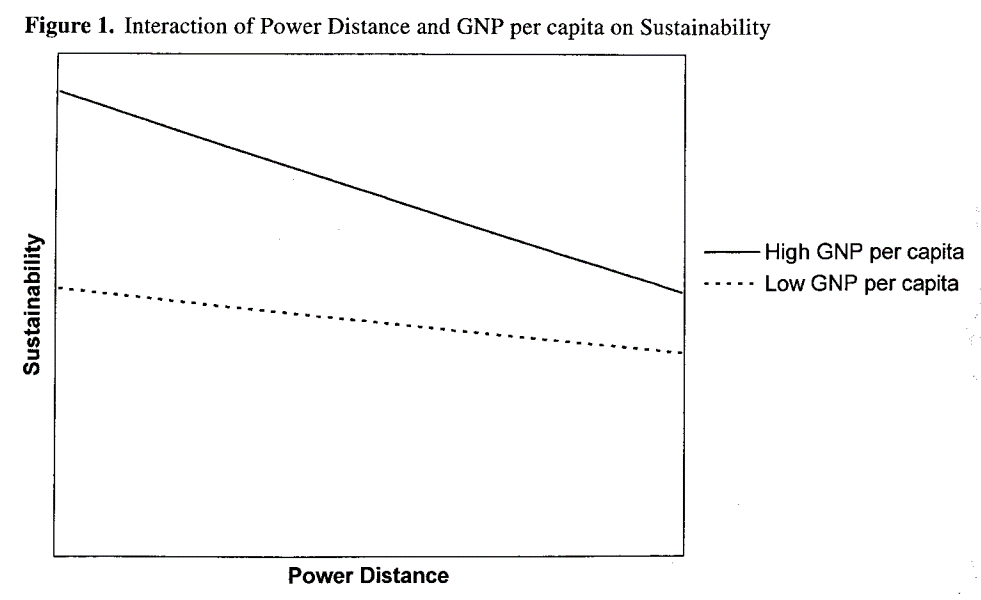
- Aa. As we move from low GNP per capita to high GNP per capita, the slope of the relationship between power distance and sustainability becomes more negative.
- Bb. As we move from low GNP per capita to high GNP per capita, the slope of the relationship between power distance and sustainability becomes more positive.
- Cc. As we move from low GNP per capita to high GNP per capita, the slope of the relationship between power distance and sustainability becomes less negative.
- Dd. As we move from low GNP per capita to high GNP per capita, the slope of the relationship between power distance and sustainability does not change.
108According to Husted, what is the main driver of social and institutional capacity for environmental
sustainability?- Aa. Measures of culture
- Bb. Economic development
- Cc. Population growth
109Read the following two statements. Which of them would you consider to fit?
A: According to Husted (2005), countries with low levels of power distance, high levels of individualism, and low levels of masculinity, have higher social and institutional capacity.
B: According to Husted (2005), the impact of power distance and masculinity on the social and institutional capacity appears to vary with economic development.- Aa. A
- Bb. B
- Cc. A & B
- Dd. none
110What are the components of the Human Development Index (HDI)?
- Aa. A long and healthy life, Knowledge, The ecological footprint
- Bb. Economic inequality, Knowledge, A decent standard of living
- Cc. A long and healthy life, Security, A decent standard of living
- Dd. A long and healthy life, Knowledge, A decent standard of living
111What does the Human Development Index (HDI) measure?
- Aa. Income or wealth inequality
- Bb. Achievements in three aspects of human development: health, education and living standards
- Cc. Economic growth compared to the previous year
- Dd. The gross national product
112"Mean years of schooling" and "Expected years of schooling" - to which sub indicator of the Human
Development Index (HDI) does it correspond?- Aa. Life expectancy index
- Bb. Education index
- Cc. Gross National Income (GNI) index
113Which statement fits best?
- Aa. The Human Development Index (HDI) was created to emphasize that people and their capabilities should be the ultimate criteria for assessing the development of a country.
- Bb. The Human Development Index (HDI) was created to emphasize that economic growth should be the ultimate criteria for assessing the development of a country.
- Cc. The Human Development Index (HDI) was created to emphasize that the ecological footprint should be the ultimate criteria for assessing the development of a country.
- Dd. The Human Development Index (HDI) was created to emphasize that economic inequality should be the ultimate criteria for assessing the development of a country.
114Which statement is correct?
- Aa. The world average Human Development Index (HDI) rose to 0.902 in 2013 from 0.597 in 1990.
- Bb. The world average Human Development Index (HDI) rose to 0.702 in 2013 from 0.597 in 1990.
- Cc. The world average Human Development Index (HDI) declined from 0.702 in 1990 to 0.597 in 2013.
- Dd. The world average Human Development Index (HDI) rose to 0.597 in 2013 from 0.298 in 1990.
115Which statement is correct?
- Aa. The slowest progress concerning the Human Development Index (HDI) since 1990 has been in East Asia and the Pacific, followed by South Asia, then the Arab States.
- Bb. The fastest progress concerning the Human Development Index (HDI) since 1990 has been in North Africa, followed by South Africa, then South East Asia.
- Cc. The fastest progress concerning the Human Development Index (HDI) since 1990 has been in East Asia and the Pacific, followed by South Asia, then the Arab States.
116Which statement fits best?
- Aa. The lower a country’s Human Development Index (HDI) score, the higher its level of human development.
- Bb. The higher a country’s Human Development Index (HDI) score, the higher its level of inequality.
- Cc. The lower a country’s Human Development Index (HDI) score, the lower its level of inequality.
- Dd. The higher a country’s Human Development Index (HDI) score, the higher its level of human development.
117Which additional dimension does a corrected Human Development Index (HDI) for Costa Rica include?
- Aa. Culture
- Bb. Leisure
- Cc. Security
- Dd. Family
118Which of the following dimensions does the security-corrected Human Development Index for Costa Rica not include?
- Aa. Police interventions
- Bb. Bribery
- Cc. Victims of homicide
- Dd. Robbery and mugging
119What does the Ecological Footprint measure?
- Aa. The Ecological Footprint measures only the use of natural resources of nations over time.
- Bb. The Ecological Footprint measures only the amount of CO2 emissions of nations over time.
- Cc. The Ecological Footprint measures the ecological resource use and resource capacity of nations over time.
- Dd. The Ecological Footprints measures only the amount of pollution of nations over time.
120What kind of methodology is used to derive the Ecological Footprint?
- Aa. Face-to-face interviews
- Bb. Literature Review
- Cc. Data calculations
- Dd. Group interviews
121What does the Ecological Footprint of consumption measure?
- Aa. The Ecological Footprint of consumption measures the consumption of biodiversity by a country's inhabitants.
- Bb. The Ecological Footprint of consumption measures the consumption of biodiversity resulting from the production processes within a country.
- Cc. The Ecological Footprint of consumption measures the consumption of biodiversity derived from international trade.
122How is the Ecological Footprint of consumption calculated?
- Aa. Ecological Footprint of consumption = Ecological Footprint of production - (Ecological Footprint of imports - exports)
- Bb. Ecological Footprint of consumption = Ecological Footprint of production - Ecological Footprint of imports
- Cc. Ecological Footprint of consumption = Ecological Footprint of production - Ecological Footprint of exports
- Dd. Ecological Footprint of consumption = Ecological Footprint of production + (Ecological Footprint of imports - exports)
123Which of the following Ecological Footprints mirrors the Gross National Product (GDP)?
- Aa. Ecological Footprint of consumption
- Bb. Ecological Footprint of production
- Cc. Ecological Footprint of international trade
- Dd. Ecological Footprint of exports
124What is the rationale behind using the Ecological Footprint of consumption in the context of globalization issues?
- Aa. That in a world with increasingly globalized trade flows many products are consumed at their place of production.
- Bb. That in a world with increasingly globalized trade flows many products are produced at their place of consumption.
- Cc. That in a world with increasingly globalized trade flows many products are not consumed at their place of production.
125Which dimension does the Maastricht Globalization Index include?
- Aa. A political, economic, social– cultural, technological and ecological dimension.
- Bb. A political, economic, social– cultural and technological dimension.
- Cc. A political, social– cultural, technological and ecological dimension.
- Dd. A Political, economic, technological and ecological dimension.
126Which dimension of the Ecological Footprint does the Maastricht Globalization Index include?
- Aa. The Ecological Footprint of production as a share of biocapacity.
- Bb. The Ecological Footprint of consumption as a share of biocapacity.
- Cc. The Ecological Footprint of imports and exports as a share of biocapacity.
127Which of the following two statements is/are correct when talking about an ecological deficit according to the Ecological Footprint assumptions?
A: The country consumes more natural resources than it is able to provide.
B: The available natural capital is not sufficient to sustain given consumption and production patterns.- Aa. A
- Bb. B
- Cc. A & B
- Dd. none
128What is the Palma ratio?
- Aa. It is the ratio of national income shares of the top 50 per cent of households to the bottom 50 percent.
- Bb. It is the ratio of national income shares of the top 10 per cent of households to the bottom 40 percent.
- Cc. It is the ratio of national income shares of the top 1 per cent of households to the bottom 40 percent.
- Dd. It is the ratio of national income shares of the top 20 per cent of households to the bottom 40 percent.
129What does the 20/20 ratio measure?
- Aa. It compares the ratio of the average income of the richest 20 per cent of the population to the average income of the poorest 20 per cent of the population.
- Bb. It compares the ratio of the average wealth of the richest 20 per cent of the population to the average wealth of the poorest 20 per cent of the population.
- Cc. It compares the ratio of the income of the 20 richest people of the population to the income of the 20 poorest people of the population.
130Which of the two statements is/are true for the Atkinson’s index?
A: A higher value entails greater social willingness by individuals to accept smaller incomes in exchange for a more equal distribution.
B: A lower value entails greater social willingness by individuals to accept smaller incomes in exchange for a more equal distribution.- Aa. A
- Bb. B
- Cc. A & B
- Dd. none
131What is usually displayed on the horizontal axis of the Lorenz curve?
- Aa. The cumulative number of income recipients ranked from the richest to the poorest individual or household.
- Bb. The cumulative number of income recipients ranked from the poorest to the richest individual or household.
- Cc. The absolute number of income recipients ranked from the poorest to the richest individual or household.
132Which of the following statements is true for the Gini coefficient ranging between 0 and 1?
- Aa. A Gini coefficient of 1 would represent total equality.
- Bb. A lower Gini coefficient represents a more unequal distribution.
- Cc. A higher Gini coefficient represents a more equal distribution.
- Dd. A Gini coefficient of 0 would represent total equality.
133Which of the following statements is not true for the Gini coefficient?
- Aa. The Gini coefficient is a measure of absolute wealth of a country.
- Bb. The Gini coefficient allows the comparison of two populations’ income distribution, regardless of their sizes.
- Cc. The Gini coefficient measures the extent to which the distribution within an economy deviates from a perfectly equal distribution.
- Dd. The Gini coefficient is considered to be the most widely cited measure of inequality.
134What is the main limitation for the Gini coefficient?
A: That it is not easily decomposable or additive.
B: It does not respond, in the same way, to income transfers between people in opposite tails of the income distribution as it does to transfers in the middle of the distribution.- Aa. A
- Bb. B
- Cc. A & B
- Dd. none
135Which statement is most correct?
A: Globalization leads to more income inequality.
B: Globalization leads to less income inequality.
C: The role of globalisation concerning inequality is mixed- Aa. A
- Bb. B
- Cc. C
136Which of the following arguments is usually used to explain growing income inequality?
- Aa. Only globalization
- Bb. Only technological change
- Cc. Only regulatory reforms
- Dd. Globalization, technological progress, and regulatory reforms
Información
- Descripción
- BWL Test sobre International Experience, creado por Pia Y el 04/03/2024.
- Autor
- Pia Y
- Idioma
- Deutsch
- Visitas
- 4
- Etiquetas
- Valoración
- Aún sin valoraciones Valora este test