
Madagascar Hissing Cockroaches
Diapositivas del conjunto (5)
-
Madagascar Hissing Cockroaches
-
Madagascar Hissing Cockroaches
- No names available; Colony started in 2001
- Lifespan: 2-4 years captivity
- To prepare carrier: Place a small amount of lightly crumpled paper towel in the bottom. Make sure the lid and hatch are secure.
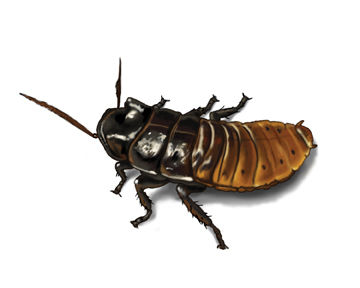
- Handling: Using thumb and first finger, gently lift the cockroach around the middle and place in carrier. They try to hold on as you pick them up, so please avoid removing their limbs. Males can be identified as having two large bumps on their heads. Only one or two cockroaches are need for a program; we suggest one male and one female or one male. They can be held during programs (in palm or with thumb and first finger, light pressure around abdomen). They can also be shown in their carrier. Guests are welcome to gently touch on the back with one finger.
-
Madagascar Hissing Cockroaches
- Range: Madagascar
- Habitat: Forest floor under leaf litter; lowland tropical forests, Rainforests
- Predators: Birds, Arachnids, Ants, Frogs, Lizards, Tenrecs, Other mammals (including humans)
- Threats: Deforestation
- Status: Not listed
- As an endemic species, if a fatal disease spread through their population, they would go extinct in the wild.
- Diet: Detritivore (decaying organic matter), some vegetation and small insects
- Zoo diet: fruits and vegetables.
- Activity: Nocturnal
- Size: 2-3"
- Sexual dimorphism: Males have "horns" on their heads that they use to fight other males over territory and females. They also have fuzzy antennae, but sometimes lose their antennae in battle. Females do not have horns and have non-fuzzy antennae.
- Social structure: Live in large colonies. Patriarchal; male dominance hierarchy. Females are free to leave/join colony as they please. Males are aggressive towards each other, but not towards females or offspring.
-
Madagascar Hissing Cockroaches
- Exoskeleton: Because they are invertebrates and have an exoskeleton, in order to grow, they have to molt. White cockroaches have recently molted and do not have protection against predators. Their new exoskeleton hardens and turns dark within a few hours.
- Defense mechanisms: Hard exoskeleton, Mandibles (similar to a grasshopper), Hissing (Forcing air through spiracles, 90 dB group hissing can be heard at least 12' away; hissing is also used in territory battles and courtship)
- Reproduction: Ovoviviparous- they present an "ootheca" to be fertilized, draw it back in, and the nymphs are born live (20-60 per birthing)
- Fun facts:
- They have no wings, but have "hooked" or "adhesive" feet that allow them to climb glass
- They have a mutualistic symbiosis relationship with mites
- There are 3000+ species of cockroaches spanning every continent on Earth
- Ninety-nine percent of cockroach species, including this one, are not classified as pests
- Fossilized cockroaches suggest they have existed, in some capacity, for at least 350 million years
- Insects have 3x the protein of chicken and beef, if you were to eat 12oz of each!
-
- Tenrec
- Madagascar
- http://www.marylandzoo.org/assets/Cockroach-Madagascar-hissing.01.27.15.pdf
- http://rosamondgiffordzoo.org/assets/uploads/animals/pdf/Madagascar%20Hissing%20Cockroach.pdf
- Pittsburgh Zoo & PPG Aquarium education handbook
Información
- Descripción
- Facts about Madagascar Hissing Cockroaches
- Creado por
- Katie Maloney
- Visitas
- 114
- Etiquetas
- Valoración