
Fichas
Integumentary system
Fichas del conjunto (39)
- 1Explain the relationship between 'anatomy' and 'physiology'anatomy- structure
physiology- function - 2what is homestasisconstant internal environment throughout regulatory mechanisms that compensate for a constant changing external environment
- 3what causes loss of homeostasisacid levels, salt content, fluid volumes, pressure of O2, temp, O2 saturation,
- 4how does homeostasis contributes to health* balance of O2 & nutrients
* elimination of waste
* maintenance of H2O & electrolytes
* maintenance of temp
Maintance of immune system - 5what are the three layers of skin1- epidermis
2- dermis
3- hypodermis - 6what is the structure and function of 'epidermis'squamous epithelial tissue the outer covering, of the body for protection
- 7what is the structure and function of the dermisconnective tissue- The dermis contains nerve endings, sweat glands and oil (sebaceous) glands, hair follicles, and blood vessels
- 8what is the structure and function of the 'hypodermis'adipose loose connective tissue, store energy (form of fat), cushioning, insulates the body, nutrients- blood supply
- 9what are the 4 cells of the epidermis?1- Kerationocytes
2- melanocytes
3- langerhan cells
4- markel cells - 10what is the function of keratinocytesis a tough water-proof material that provides cells in the outer layer with a horny, abrasive-resistance & protective quality
- 11what is the function of melanocytesproduces pigment- melanin to absorb harmful UV rays
- 12what is the function of langerhans cellsfor protection, by keeping dangerous microbes from entering the body
- helps activate the immune system - 13what is the function of merkel cellssense of touch
- 14what are the 4 layers of the epidermis1-stratum corneum
2- stratum granulosum
3- stratum spinosum
4- stratum basal - 15what is stratum corneum functionwhere the dead skin flake of
- 16what is stratum granulosum function?prevents water loss- kerationocytes
- 17what is stratum spinosum functionprovides strength
- 18what is stratum basal functionmitosis of new cells
- 19What is the structure function of the dermisstrong and flexible -connective tissue
- 20what is the structure and function of papillary layer- part of the dermis
- a thin layer of connective tissue arranged in a specific pattern- fingerprints
- intertwined with epidermis - 21what is the structure and function of recticular layers- dense layer
- bundles of interlocking collagen fibres
- provides strength - elastically, & cushioning, cleavage lines - 22what is the structure and function of hypodermismain storage of fat, cushioning & padding, blood supply
- 23What are some changes in the skin when pregnant?stretch marks
hyperpigmentation- caused by hormone changes
spirer naevi- spider veins- caused by damage of vein valves, and becomimg of the blood - 24what is the function of hair-protection, thermoregulation,
- 25what is the structure and function of nailsharden keratin
protect the lunula
protective seal- cuticle - 26what is the structure and function of sebaceous (oil) glands?-all over the body, except palms and feet
-secrete sebum which is ducted from a hair follicle
- soften and lubricates the hair
-antibacterial
slows water loss from skin - 27what is the structure and function of sweat glands?all over, except lips, nipples & genitals
thermoregulation - 28what is the structure and function of mucous membranes?- stratified squamous or pseudostratified epithelia
- location- eyes, ears, nose, vagina, urethra & anus
-line surface openings directly to the exterior environment - 29what is 7 functions of the integumentary system?1- protection
2- excretion & absorption
3- homeostasis of body temp
4- sensation
5- Vitamin D production
6- stores blood- reservoir
7- Immunity - langerhan cells - 30Understand how the body achieves homeostasis of body temperatureThe tendency to maintain a stable, relatively constant internal environment is called homeostasis. The body maintains homeostasis for many factors in addition to temperature.
eg:
Hot- sweat glands - cool
cold- shiver - 31Describe how negative feedback mechanisms maintain homeostasisMaintenance of homeostasis usually involves negative feedback loops. These loops act to oppose the stimulus, or cue, that triggers them. For example, if your body temperature is too high, a negative feedback loop will act to bring it back down towards the set point, or target value, of
- 32Describe how positive feedback mechanisms maintain homeostasisIn contrast, positive feedback loops push the organism further out of homeostasis, but may be necessary for life to occur. A good example of a positive feedback system is child birth. During labor, a hormone called oxytocin is released that intensifies and speeds up contractions.
- 33Understand how the body achieves homeostasis of blood clottingHemostasis has three major steps:
1) vasoconstriction,
2) temporary blockage of a break by a platelet plug
3) blood coagulation, or formation of a fibrin clot.
These processes seal the hole until tissues are repaired. - 34What are the 4 phases of wound healing1-Haemostatic Phase
2-Inflammatory Phase
3-Prefiltration Phase
4-Remodelling Phase - 35what is happening in Haemostatic PhaseBlood vessels constrict (vasoconstriction), platelets aggregate and a clot is formed preventing blood los
- 36what is happening in Inflammatory PhaseInfection fighting phase: immune response to combat invading harmful microorganisms and foreign material, charactered by presence of white blood cells (various forms such as neutrophils, macrophages and lymphocytes) in wound bed and surrounding tissue.
- 37What is happening in Prefiltration PhaseBuilding up new connective tissue from the base to the top (granulation tissue): growth supported by formation of new capillaries (angiogenesis). Extracellular matrix made up of elastin, collagen, blood vessels
- 38What is happening Remodelling PhaseFinal phase where (epithelial) cells adjacent to wound migrate across surface and wound edges close over; this phase can last for years in older skin.
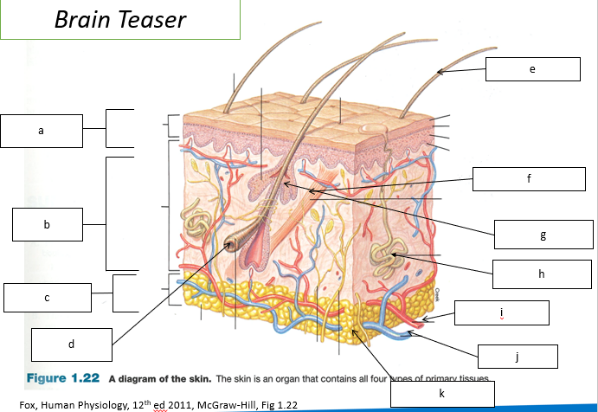
- 39—a- epidermis b- dermis
c- hypodermis d- hair root
e- hair shaft f- arrector muscle
g- sebaceous glands h- sweat gland
i- artery j- vein
k- adipose tissue