
Fichas
2. Microbial Evolution
Fichas del conjunto (17)
- 1How do scientist explore the origin of life?Since the Earth is ~4.6 billion y/o, scientist explore the origin of life by examining indirect evidence
- 2What set attributes do scientist use to define life?1. orderly structure
2. ability to obtain and use energy (metabolism)
3. ability to reproduce - 3Which indirect evidence do scientist examine to explore the origins of life?Scientist examine:
1. remains that indicate evidence of life's attributes (i.e. orderly structure, energy metabolism and reproductive ability)
2. organism that exist today (extant species) that possess characteristics of ancient life forms. [Ex. hydrogen bacteria]
3. fossilized remains of 3.5 billion y/o prokaryotic cells found in stromatolites - 4What does the RNA World theory suggest about early life?Early life was probably RNA based. RNAs were the first self replicating molecules that stored information and had catalytic activity (aka ribozymes). Eventually,
1. DNA evolved as as the molecule for information storage since it was more stable.
2. Proteins became the molecules for catalytic activity - 5With the early Earth being a hot environment that lacked oxygen, how did early organisms make use of the available energy sources (i.e carry out energy-conserving metabolic processes)?- Some of the earliest prokaryotes were anaerobic & used inorganic substances [ex. FeS] as a source of energy (lithotrophs)
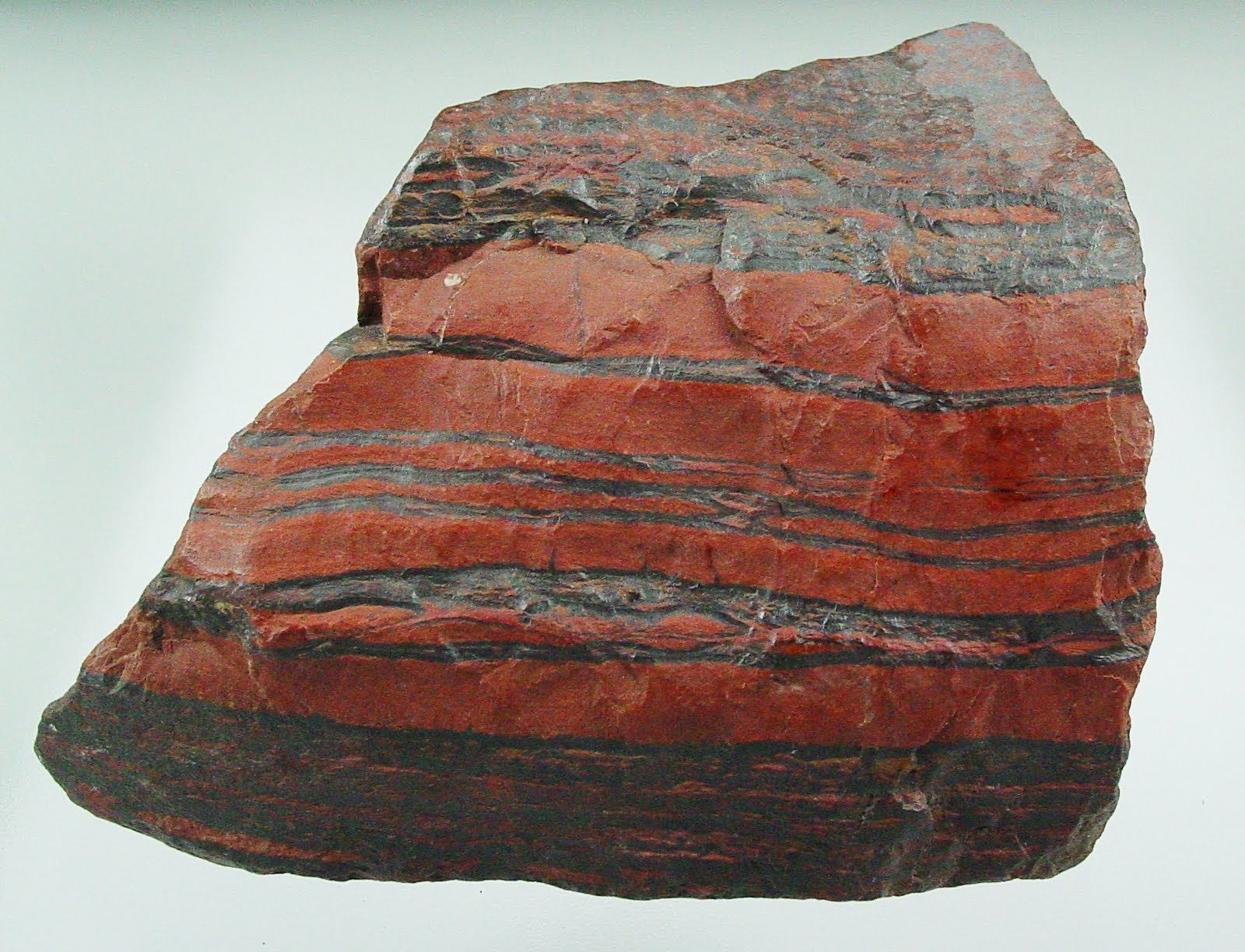
- Cyanobacteria probably developed oxygenic photosynthesis as a source of energy? - 6- What evidence supports that the earliest prokaryotes were lithotrophs?The fact that today's archaea use inorganic molecules such as FeS as a source of energy hints that early prokaryotes were lithotrophs.
- 7- What evidence supports that cyanobacteria probably developed oxygenic photosynthesis?There was a presence of oxidized minerals [banded iron formations] found in stromatolites that contained fossils of cyanobacteria which hinted that these cyanobacteria carried out oxygenic photosynthesis.
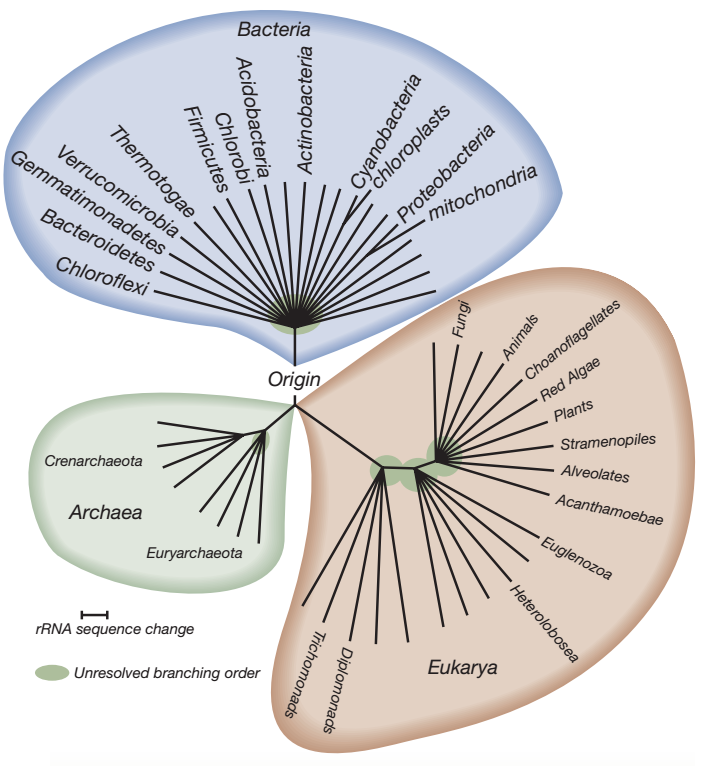
- 8How was the universal phylogenetic tree developed?The universal phylogenetic tree was developed by comparing SSU rRNA of organisms to show evolutionary distances
- 91. What does the acronym LUCA stand for? 2. What is the significance of LUCA, in terms of the universal phylogenetic tree?1. Last Universal Common Ancestor
2. LUCA sits at the bottom of the bacterial branch which means that archaea and eukarya evolved independently of bacteria.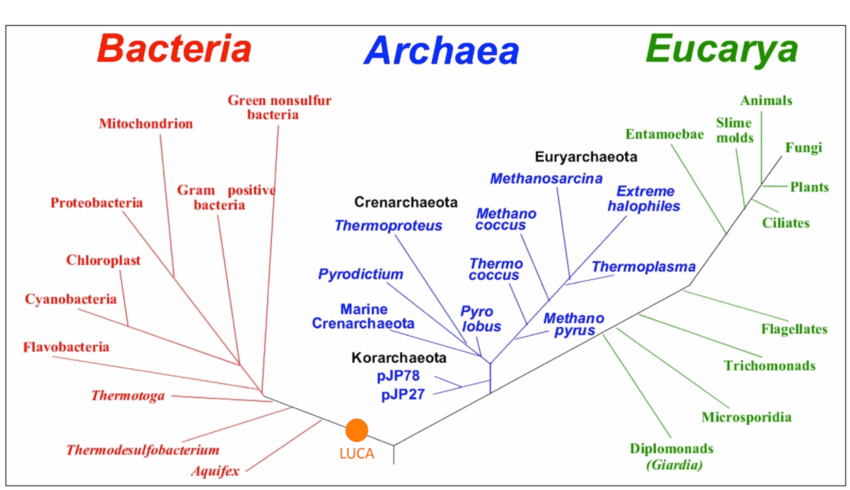
- 10What is the Endosymbiotic Theory?The organelles (mitochondria, chloroplasts, and hydrogenosomes) arose from prokaryotes that used to live independently but at some point, they became endosymbionts to eukaryotic host cells and lost their ability to survive independently.
- 11Which 3 eukaryotic organelles came about as a result of the endosymbiotic theory?1. mitochondria
2. chloroplasts
3. hydrogenosomes - 12How did cellular life forms [bacteria, archaea, and eukaryotes] develop over time?Cellular life forms developed through:
1. mutation and 2. horizontal gene transfer - 131. Why can't a group of the same prokaryotes [bacteria & archaea] be referred to as a species? 2. Which term is more appropriate to refer to a group of the same prokaryotes?1. Species refers to a group of organisms that are capable of interbreeding BUT, prokaryotes are not capable of sexual reproduction!
2. It is more appropriate for a group of the same prokaryotes that share similar properties (pure culture) to be referred to as a strain. - 14The endosymbiotic theory was modified into the hydrogen hypothesis. 1. What is the hydrogen hypothesis? 2. How does it relate to mitochondria and hydrogenosomes?The hydrogen hypothesis states that the endosymbiont was a bacterium that produced hydrogen as an end product of its metabolism which the host cell became dependent on.
2. Eventually the endosymbiont evolved into the organelles mitochondria (if it developed the ability to perform aerobic respiration) or hydrogenosome (if it developed the ability to perform fermentation) - 15What is endosymbiosis?the interaction between two organisms in which one organism (the endosymbiont) lives inside the other (the host).
- 16What evidence supports that the organelles, mitochondria and chloroplast, used to live independently?- they both contain their own DNA and ribosomes.
- 171. What is the hydrogenosome organelle? 2. How is it similar to mitochondria?1. an organelle that produces ATP by a process called fermentation.
2. Similarly, mitochondria produces ATP by a process called cellular respiration.
Información
- Descripción
- Senior Undergraduate (Chapter 1: The Evolution of Microorganisms and Microbiology) Microbiology Fichas sobre 2. Microbial Evolution, creado por Michael Mckoy el 28/01/2021.
- Creado por
- Michael Mckoy
- Visitas
- 3
- Valoración