
Fichas
Enzymes
Fichas del conjunto (29)
- 1How does increasing the concentration of substrates or enzymes affect enzymatic activity?increasing concentration increases the reaction rate to a point until all the enzymes/substrates are used up
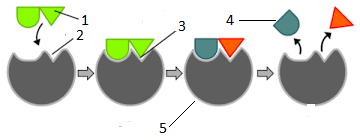
- 2Label the following numbers in the diagram shown.1. Reactants / Substrates
2. Enzyme
3. Substrates bind with the enzyme
4. Products
5. Enzyme -Substrate Complex - 3What is the optimum temperature for the human body? What is the pH level in the blood or mouth?Body temperature: 37 Degrees
pH level in blood/ mouth: 7 (neutral) - 4To which class do enzyme belong?Proteins
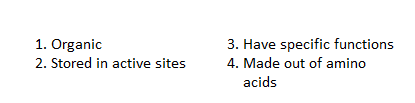
- 5Which of the following statements are true about enzymes?Numbers 1, 3, 4 only.
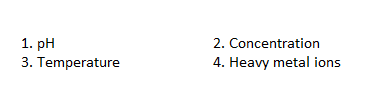
- 6Which factor will not affect the shape of an enzyme or its active site?2. Concentration. This will only increase or decrease the reaction rate until a point where all substrates/enzymes are currently being used.
- 7What does the term "Homeostasis" mean?Homeostasis is a set of processes that function to maintain a constant internal environment.
- 8How do enzymes affect the metabolism?enzymes speed up the metabolism by ensuring the reactions take place with low energy requirements and production (lower the activation energy)
- 9What is a competitive inhibitor?Competitive inhibitors bind the active site blocking the substrates which decreases the reaction rate.
- 10How does increasing the enzyme concentration affect the enzyme activity?increasing the concentration of the enzyme will increase the reaction rate until there isn't enough substrates to bind with.
- 11How does changing in pH affect enzyme activity?Changing the pH levels can cause the denaturation of enzymes, however, creating an ideal pH will create the ideal active site.
- 12What are activated enzyme - substrate complexes?Enzyme-substrate complexes occur when the substrate binds perfectly with the enzyme, which will create a product.
- 13What is activation energy?Activation energy is the energy required for a reaction to occur.
- 14What are active sites?Active sites are located on an enzyme where the substrate binds to form the E-S complex
- 15What does the term Anabolism mean?Anabolism is where the substrates bind together to form a single product
- 16What makes enzymes denature?Enzymes are sensitive to change. This includes changes in temperature, pH, heavy metal ions
- 17What is negative feedback?Negative feedback is the interaction between molecules when the concentration of the product is too high and therefore binds with the initial enzyme to slow its production.
- 18How does the presence of enzymes affect its activation energy?enzymes lower the activation energy thus enabling reactions to occur faster.
- 19Without enzymes, the reactions necessary to sustain life would require________ in order to occur.higher temperatures
- 20What are non-competitive inhibitors?non-competitive inhibitors combine with the enzyme in a different location other than the active site which distorts the shape of the enzyme
- 21How does inhibitors affect the metabolism?Inhibitors get in the way of enzymatic reactions. They prevent the E-S complex from forming effectively.
- 22What are cofactors?Cofactors are inorganic ions that assist in enzymatic reactions
- 23What are coenzymes?coenzymes are organic complexes containing vitamins that aid in enzymatic activity.
- 24How do heavy metal ions affect the enzyme activity?heavy metal ions grab electrons from the enzyme and disrupt the electron distribution , changing the active site. This also decreases the reaction rate.
- 25What is catabolism?Catabolism is the breakdown of molecules to form two products using the E-S complex
- 26What do substrates require in order to form the activated E-S complex?Substrates require an active site on the enzyme, the correct orientation and enough energy for the reaction to occur.
- 27What type of substance is a coenzyme?Vitamin
- 28What is the lock and key analogy?In this analogy, the lock is the enzyme and the key is the substrate, and that they fit perfectly together without any changes.
- 29Describe the induced fit hypothesis.The Induced Fit Hypothesis states that the binding of a substrate or some other molecule to an enzyme causes a change in the shape of the enzyme so as to enhance or inhibit its activity.
Información
- Descripción
- Flashcards for Enzymes section of Biology 12
- Creado por
- Kaitlyn Schrauwen · abr 2016
- Actualizado
- 18 ene 2017
- Visitas
- 74
- Valoración