
Enzymes
179 resources created by 145 users
This Enzymes page on GoConqr gathers community-made quizzes, mind maps, flashcards and notes, from active sites and the lock and key idea to pH, temperature, inhibitors and immobilised enzymes. It's built for school students revising a topic and teachers after ready-made material. There are over 1,100 resources here, including more than 60 quizzes, over 600 mind maps and more than 300 flashcard decks, with GCSE, A-level and IB Biology among the exams mentioned. Pick a resource, try a quiz to find your gaps, then make your own revision sets.
Top Enzymes resources
-
11 questionsFactors Affecting Enzyme Activity The main reason why rate of enzyme action increases with temperature initially is...
-
21 cardsEnzyme Inhibition What are the 2 types of enzyme inhibitors?
-
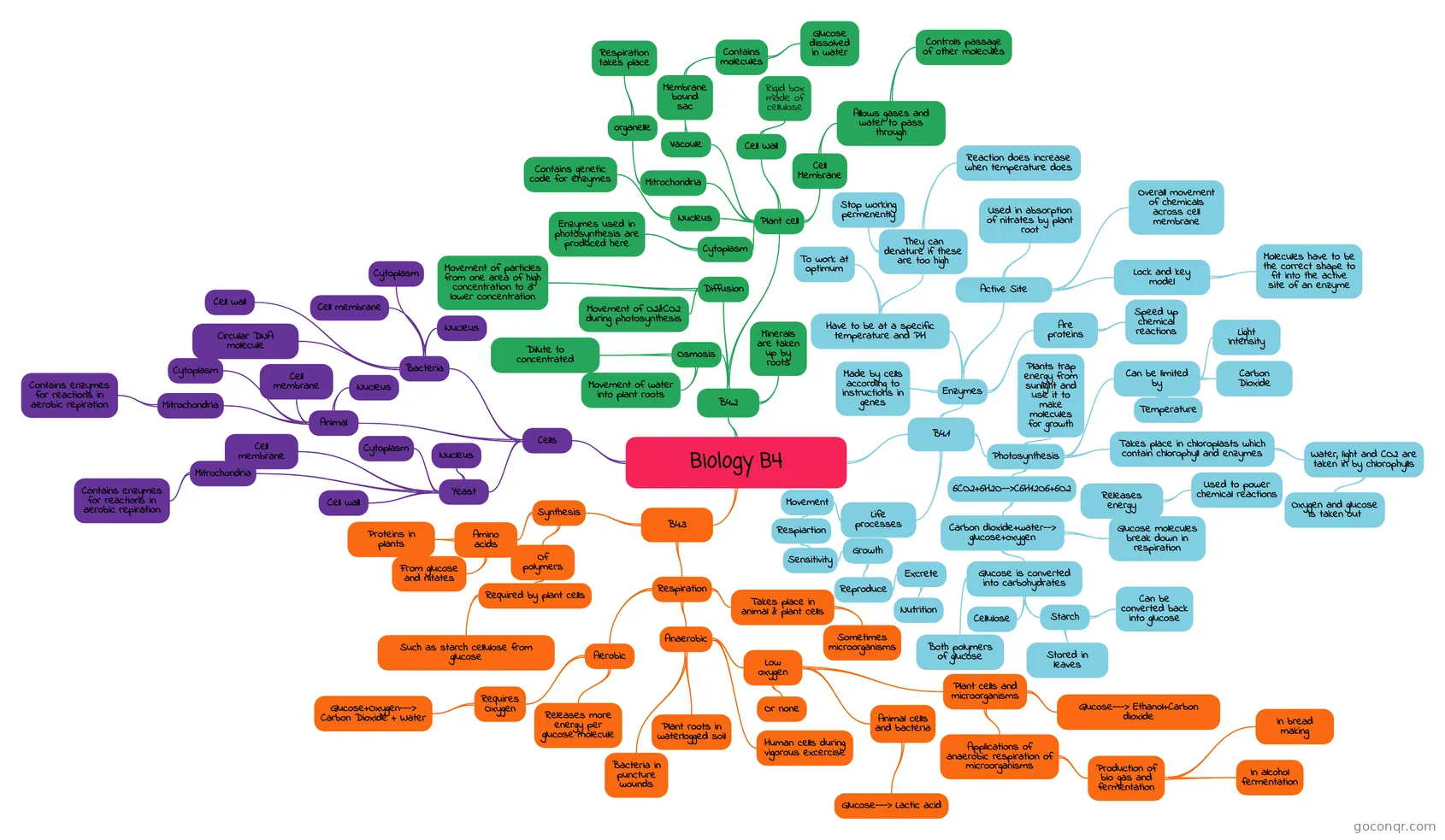 Mind map Biology B4 Biology B4 mind map
-
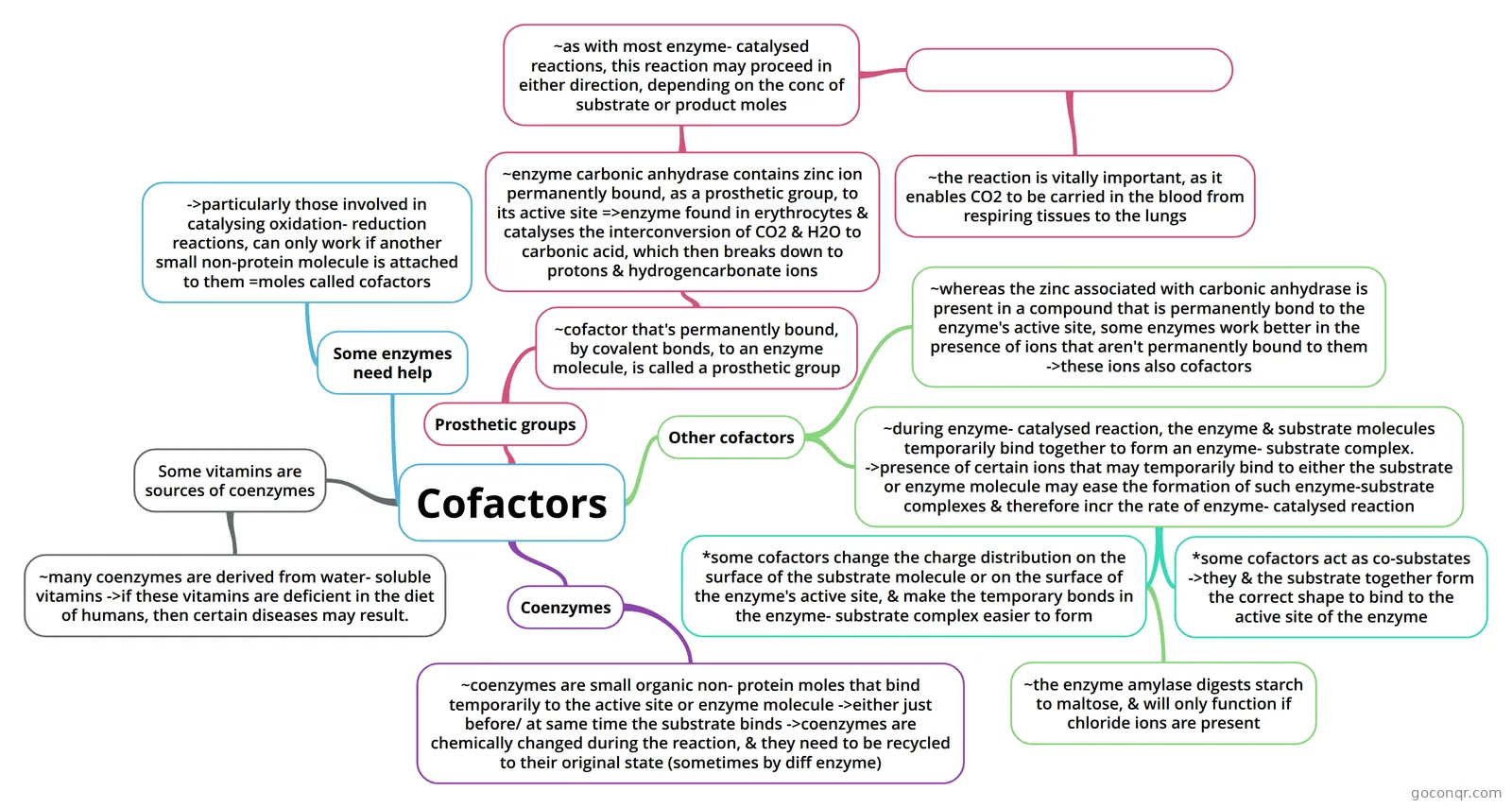 Mind map Cofactors
-
Mind map Enzymes
-
Mind map Enzymes and Respiration Part of AQA GCSE Science on Enzymes and Respration
-
Mind map Enzymes
-
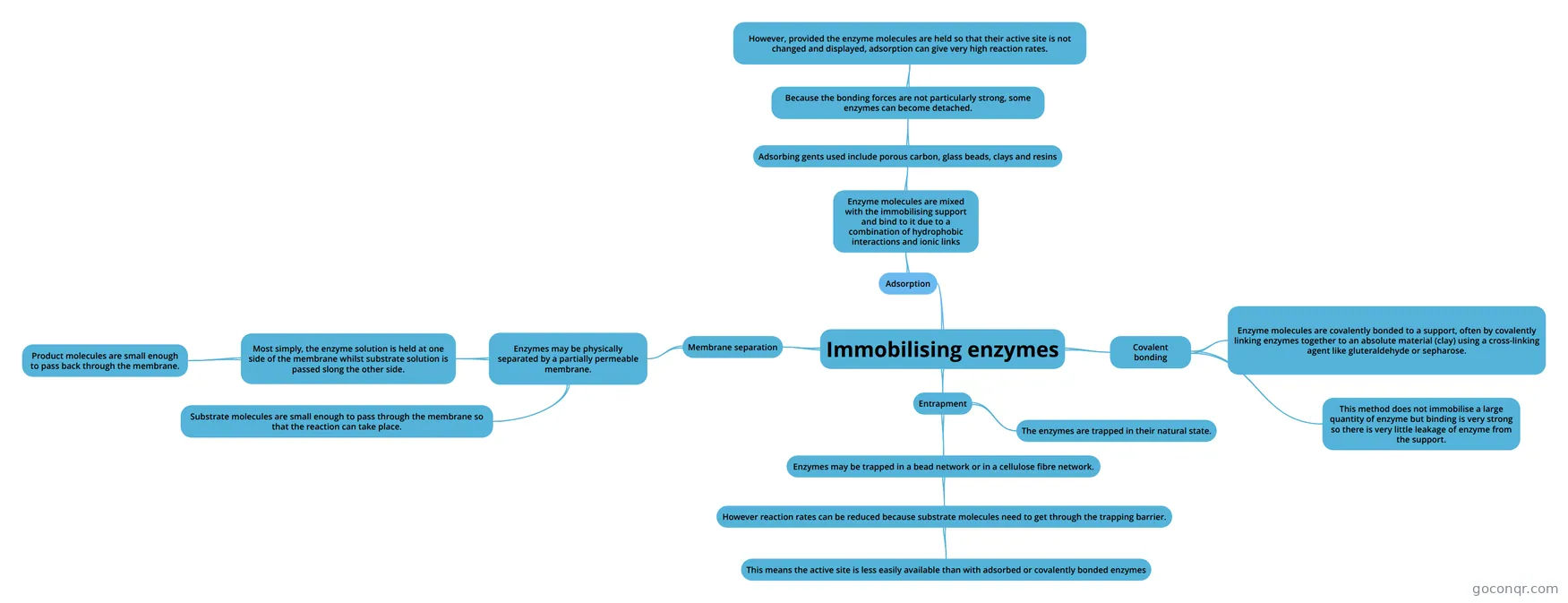 Mind map Immobilising enzymes
Quizzes
See all 18 quizzes-
11 questionsFactors Affecting Enzyme Activity The main reason why rate of enzyme action increases with temperature initially is...
-
22 questionsB4 Quiz Label the below image with the names of each process described.
-
40 questionsEnzymes
-
32 questionsB3- Science. Cells, Genes and Enzymes. What is a Nucleus?
-
15 questionsProteins and Enzymes A quiz on proteins and enzymes
-
9 questionsEnzymes Which of the following statements correctly relates to enzymes? Check all that apply.
-
20 questionsAQA GCSE Biology Unit 2.3 Which of these are examples of reactions involving enzymes?
-
19 questionsChapter 5 Enzymes Vocabulary Biology Vocabulary
Mind maps
See all 64 mind maps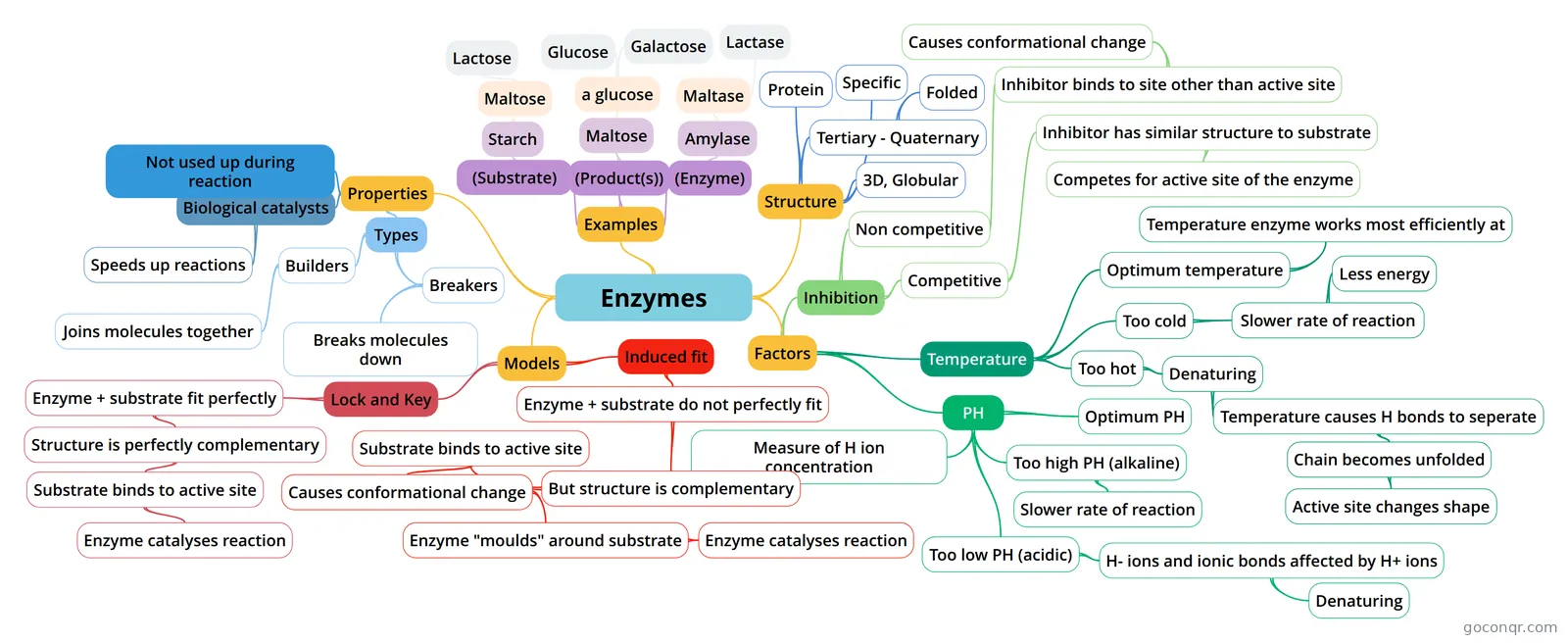
Flashcards
See all 70 flashcards-
21 cardsEnzyme Inhibition What are the 2 types of enzyme inhibitors?
-
10 cardsCofactors What are cofactors?
-
11 cardsFLASHCARDS: 2.5 - Enzymes
-
8 cardsEnzymes chapter 3
-
10 cardsENZYMES At what temperature do enzymes denature?
-
28 cards1.4 Enzymes How do you test for protein?
-
30 cardsEnzymes
-
20 cardsEdexcel GCSE Biology - Enzymes What is an Enzyme?
Flowcharts
Notes
See all 24 notes-
Enzymes at Work - pH Effects What is pH?pH is a measure of the hydrogen ion concentration, with values from 1 to 14. In this range, pH 7 is neutral, below pH7 is referred to as an acid, above pH7 is an alkali (or basic).The higher the concentrati...
-
2.5 - Enzymes 2.5 - Enzymes Active sites and enzymes Enzymes: globular proteins that work as catalysts speed up biochemical reactions aren't altered themselves in reactions found in all living cells also secreted by some cells to w...
-
Enzymes Enzymes 26/10/2016Enzymes - Enzymes are Biological catalysts. They are found in all living cells which speed up chemical reactions in our cells/body. Without Enzymes, chemical reactions inside our cells/body will work...
-
Interfering with Enzymes - Poisons and Drugs Deadly poisonsMany poisonous substances have their effects because they inhibit or even overactivate enzymes. Potassium cyanide, for example, inhibits cell respiration. It does this because it is a non-competitive inh...
-
Enzymes and Temperature Heat and kinetic energyThe molecules in a gas or liquid move around continually. They have natural kinetic energy and move continously and randomly. These movements mean that molecules continually collide with each ot...
-
Enzymes at Work - Concentration Effects Increasing the substrate concentrationIn an experimental situation, the concentration of substrate can be varied for a fixed concentration of enzyme molecules. If there is no substrate, the reaction cannot proceed, be...
-
Proteins Proteins are made from long chains of smaller molecules called amino acids. These long chains are folded into particular shapes. This is important in relation to how antibodies and enzymes work. Enzymes are biological...
-
Enzymes MetabolismMetabolism is the sum of all the chemical reactions that take place within an organism. e.g. growth, movement, maintenance of a constant internal state, repair, response to stimuli, and reproduction.The most...
Slides
More Biology and natural sciences topics
About Enzymes
GoConqr OriginalWhat the unit covers
This unit sits in the Molecules and Cells strand of Biology and natural sciences. The resources start with the basics: an enzyme is a protein that acts as a biological catalyst, speeding up a reaction without being used up. Many of the maps describe the active site, where the substrate fits, and the lock and key idea.
Where to start
Begin with the Enzymes mind map that sets out the active site theory. It gives you the vocabulary in one view. Then read the note Enzymes at Work - pH Effects, which explains what pH is and why it matters for enzymes.
Factors and inhibitors
Next, move on to the things that change the rate of reaction:
- Temperature: the rate rises as kinetic energy increases, up to the optimum.
- pH: each enzyme works best in a particular range.
- Concentration: covered in the note Enzymes at Work - Concentration Effects.
- Inhibitors: the mind map 1.9 Enzyme Inhibition separates competitive inhibitors, which bind to the active site, from non-competitive ones, which bind to an allosteric site.
There are also resources on cofactors, poisons and drugs, and immobilising enzymes, for those who want to go further.
Using quizzes and maps together
- Read a mind map and cover up the branches you can recall.
- Take the quiz Factors Affecting Enzyme Activity to test the ideas on temperature and collisions.
- Note the questions you missed and go back to the matching map or note.
- Use the flashcard decks for short, repeated recall, and the Enzyme practical activity quiz for practical work.
The slide set Required Practical 1 - Enzyme-controlled reactions is useful when you are preparing for the practical side of the topic.
Make it your own
Teachers can set a map or deck for a class, and students can pick a resource that matches their course. Choose one that fits your exam board, then build your own notes around it.
Frequently asked questions
Which resource should I open first?
Start with the Enzymes mind map on the active site theory, which sets out what an enzyme is and how the substrate fits. After that, read the note Enzymes at Work - pH Effects, then test yourself with the Factors Affecting Enzyme Activity quiz.
What do the mind maps cover?
The mind maps cover enzyme structure, the active site, temperature and pH, competitive and non-competitive inhibition, cofactors, immobilised enzymes, and poisons and drugs. Some link enzymes to respiration and digestion. There are over 600 maps, so you can compare how different students have organised the same ideas.
Are the resources free to use?
Yes. Every resource listed here is free to open, study and take, with no account needed. They were made by GoConqr users, not by GoConqr itself. A free account also saves your quiz scores and lets you create your own quizzes, mind maps, flashcards and notes.
Which exams and levels do these suit?
Most of the resources are for school students. The listed titles mention GCSE Biology, AQA GCSE Biology, IGCSE Biology, AS Biology, A-level Biology, OCR A-level Biology, OCR AS Biology, IB Biology and MCAT. Check the title or description of each one to see whether it matches your course.
Are there quizzes on the practical work?
Yes. The Enzyme practical activity quiz focuses on practical work, and the slide set Required Practical 1 - Enzyme-controlled reactions covers enzyme-controlled reactions. Together they give you a way to revise method and results alongside the theory.
What if I can't find the topic I need?
Look through the other formats, since a topic missing as a quiz may appear as a flashcard deck, note or mind map. Inhibitors, cofactors and immobilised enzymes all have several. If something is still missing, you can make your own resource and share it.