
Fichas
Unit 4 - Exposure Technique
Fichas del conjunto (54)
- 1What are the primary factors of exposure?mAs
kVp - 2What are the secondary factors of exposure?focal spot size
OID/SOD/SID
grid
CR
tube filtration
compensating filters - 3Milliamperage (mA)QUANTITY of photons in the x-ray beam
- 4Exposure timeQUANTITY of photons being pushed through the x-ray beam measured in seconds
- 5mAsmA x time = mAs
- 6mAs controls ....the quantity of electrons boiled off of the filament and available to produce
*related to the density/brightness* - 7Reciprocity Law"the density will be the same if the mAs value is constant whether you adjust the mA or the time"
mA time mAs
100 0.8 80
200 0.4 80
400 0.2 80 - 8When a radiograph is too bright or too dark, which exposure factor must be altered?mAs
- 9What are some factors to consider when adjusting your mAs?patient's age, condition, body habitus, and presence of pathology
- 10You should make a ___% change in mAs to make a visible change in the radiograph30%
- 11Kilovoltage Peak (kVp)QUALITY of the energy of the x-ray beam
- 12kVp controls...pushing power of the beam and the energy of the photons being pushed
*related to contrast* - 13TRUE OR FALSE Before the mAs can be adjusted, the kVp must be enough to penetrate the patient.TRUE
adjusting mAs without sufficient kVp will underexpose the radiograph - 14Increasing kVp will _______ penetration and _______ absorption. It produces ____-____ contrast with low contrast, and more scatter.increase penetration
decrease absorption
long-scale contrast - 15Decreasing kVp will ______ penetration and ______ absorption. It produces ______-_____ contrast with high contrast.decrease penetration
increase absorption
short-scale contrast - 16You should make a __% change in kVp to make a visible difference on the radiograph15%
- 1715% RuleIncrease kVp 15% and decrease mAs 1/2
Decrease kVp 15% and increase mAs x2
same effect as doubling/halving mAs - 18TRUE OR FALSE If kVp is too low when you reprocess the image digitally, you may see quantum noise.TRUE
You can post process an underexposed radiograph to adjust the brightness and contrast, but you cannot fix quantum noise. - 19TRUE OR FALSE If kVp was too high during exposure, the image will be reprocessed but the brightness and contrast will not change.FALSE:
You can adjust the brightness and contrast of an overexposed image during post processing, but the patient was overexposed. - 20TRUE OR FALSE: Quantum noise is a result of overexposure.FALSE:
Quantum noise is a result from underexposure - not enough photons reached the IR, not enough mAs was used. - 21TRUE OR FALSE: An image's brightness does not depend on mAs or kVp.TRUE.
Brightness is the result of luminance on a display monitor. - 22Why does DR use higher kVp and lower mAs?-Less patient exposure
-contrast is primarily controlled during post processing so the image will turn out acceptable - 23Focal Spot SizeSize of the focal spot affects sharpness and spatial resolution recorded in the image
"Actual focal spot is the area being bombarded by the filament electrons" - 24Increasing focal spot size _____ recorded detail and spatial resolution. Decreasing focal spot size _____ recorded detail and spatial resolution.decreases
increases - 25You increase the SID from 30'' to 40'' for an abdomen x-ray. What will happen to the radiograph?- magnification decreases
- spatial resolution increases
- radiation intensity decreases - 26You decrease the SID from 72'' to 60'' for an AP cart CXR. What will happen to the radiograph?- magnification increases
- spatial resolution decreases
- radiation intensity increases - 27TRUE OR FALSE Any time you change SID with DR, you should also adjust your kVp.FALSE
SID affects the density of a radiograph
adjust the mAs when changing SID - 28How does the Air-Gap technique reduce scatter?The photons have more space to bounce away from the IR instead of being absorbed by it
*air-gap technique produces higher contrast* - 29How should you adjust your technique if you use a grid?Grids will absorb scatter, but will also increase the contrast of the radiograph.
Increase mAs when using a grid - 30TRUE OR FALSE: Tube filtration reduces patient dose.TRUE
Filtration absorbs low energy photons that don't contribute to the image - 31How would you adjust your technique if you used a compensating filter?Increase mAs to maintain overall exposure
- 32How is kVp adjusted with variable kVp-fixed mAs?kVp increased by 2 for every 1 cm part thickness while mAs remains the same
- 33How is mAs adjusted with variable mAs - fixed kVp?mAs adjusted by factor of 2 for every 4-5 cm thickness while kVp remains the same
- 34Short-Scale ContrastLow kVp
high contrast
few shades of gray - 35Long-Scale ContrastHigh kVp
low contrast
many shades of gray - 36High Subject Contrastarea of differing tissue types that produce many different densities
- 37Low Subject Contrastarea of similar tissue types that produce very similar densities
- 38Which factors will produce good geometric properties on a radiograph?OID
SID
SOD - 39Which factor will produce sharpness of structural lines on a radiograph?Spatial Resolution
- 40Which factor will produce adequate visibility of anatomic structures?Contrast
Brightness - 41A radiograph turns out black and white. The radiographer wants to increase the contrast of the image for the repeat exposure, how will she change her technique? 75 kVp @ 10 mAsIncrease kVp by 15%
divide the mAs in half
75 x .15 = 11.25
75 + 11.25 = 86.25
10/2 = 5
NEW TECHNIQUE:
86.25 kVp @ 5 mAs - 42A radiograph turns out with very high contrast. The radiographer wants to see more blacks and whites. How will she change her technique for the repeat exposure? 125 kVp @ 16 mAsDecrease kVp by 15%
double the mAs
125 x .15 = 18.75
125 - 18.75 = 106.25
16 x 2 = 32
NEW TECHNIQUE:
106.25 kVp @ 32 mAs - 43The radiographer is x-raying a 6 month old using the piggostat, but the child is still having a hard time staying still. How will the radiographer adjust the technique? 85 kVp @ 12 mAs85 kVp can remain the same since we just want to decrease the exposure time.
12 mAs = 100 mA x .12 sec
half the exposure time, and double the mA
12 mAs = 200 mA x .06 - 44—
- 45—INVERSE SQUARE LAW
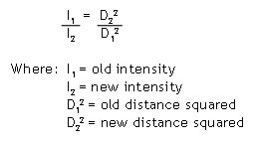
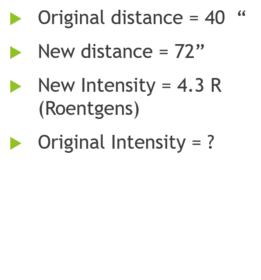
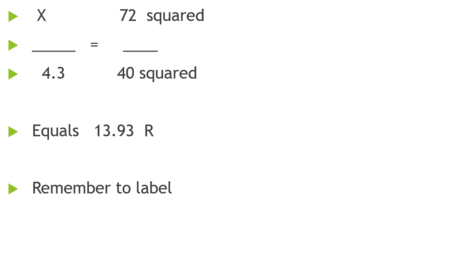
- 46Which formula would we use to figure out the intensity of the beam if the original x-ray beam is 2mR @ 40 SID, and we are changing it to 72 SID?INVERSE SQUARE LAW
-only to find intensity! - 47You took a CXR of a patient before surgery at 125 kVp @ 5 mAs with a 72'' SID Now you have to do a cart CXR on the same patient after surgery, and you will not get the same SID. Which law will you use to change your technique?mAs Maintenance
- 48—mAs Maintenance
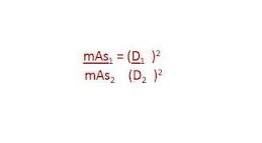
- 49—mAs
maintenance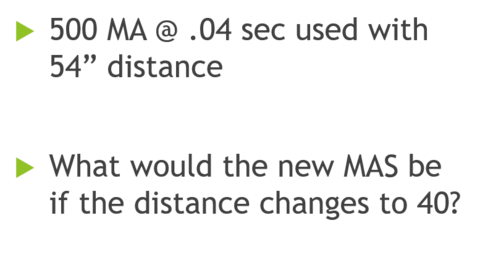
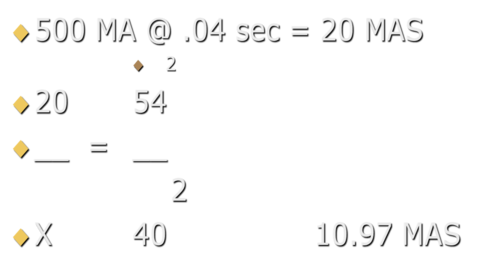
- 50If we wanted to determine the degree of magnification of a radiograph, how would we proceed?Use the Magnification Factor
*what's after the decimal is always the percentage*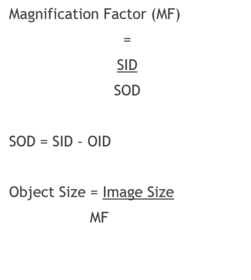
- 51If we want to determine what the object size was of what we x-rayed, how would we proceed?
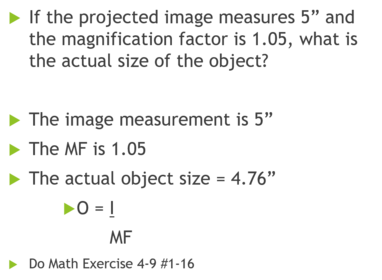
- 52If we add a grid when using an exam and we have to alter our mAs?
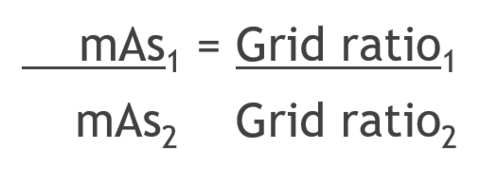
- 53As beam restriction increases (gets tighter), density ______density decreases
- 54An image will have higher contrast if the window width is _____narrow
Información
- Descripción
- ARRT Image Evaluation Fichas sobre Unit 4 - Exposure Technique, creado por RadTech Fairy el 08/02/2017.
- Creado por
- RadTech Fairy · feb 2017
- Actualizado
- 19 feb 2018
- Visitas
- 42
- Valoración