
Fichas
Engineering: Materials 2
Fichas del conjunto (57)
- 1What are the 3 main views?side elevation
plan elevation
front elevation - 2What are thick lines used for when drawing 3rd angle orthographic?Thick lines are used to outline your design.
- 3What are thin lines used for when drawing 3rd angle orthographic?Thin lines are used for construction, hatching or for dimensions.
- 4What are dashes lines used for when drawing 3rd angle orthographic?Dashed lines are used for hidden detail.
- 5What are chain lines lines used for when drawing 3rd angle orthographic?_._._. chain lines are used for centre lines.
- 6What are chain lines with arrows used for when drawing 3rd angle orthographic?_._._._
^ ^
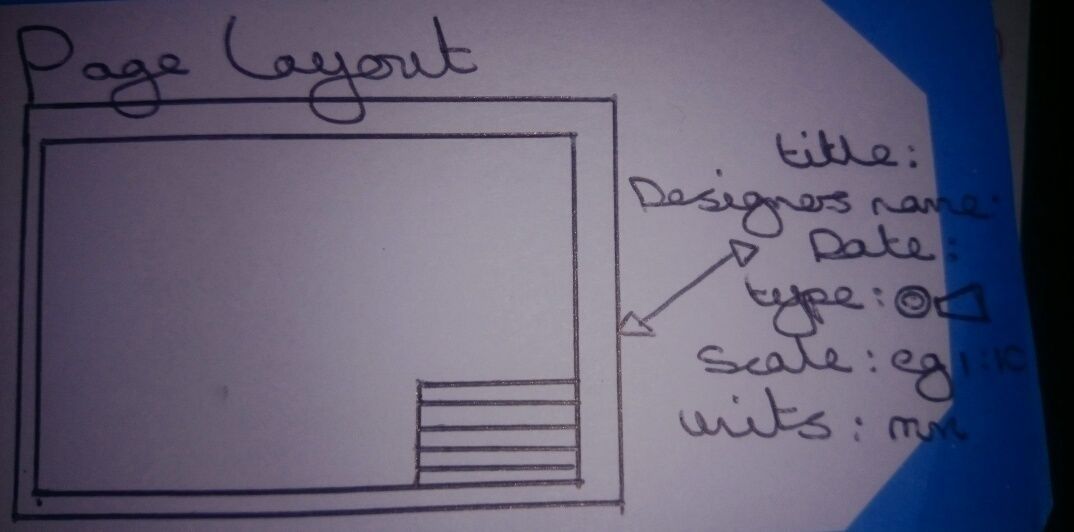
chain lines with arrows are used to show where a cross-section view is taken. - 7Page layout
- 8How are metals produced?Metals are usually produced by mining rocks of minerals containing metal from the earth.This is called ore. Metals usually are pure if extracted in industrial process.
Eg. copper and iron - 9What are the characteristics of ferrous metals?contain mainly iron
Rust easily
Are magnetic - 10What are the characteristics of non - ferrous metals?contain no iron
Do not rust to moisture
non magnetic
Eg. Copper, tin, zin and aluminium - 11What are the characteristics of alloys?- a mixture of 2 or more metals or materials
- Different metals are mixed to change the properties of the materials reducing the melting point.
Eg. Brass (which contains copper zinc) - 12Name 3 health and safety precaustions used to ensure safe use of a pillar drill.- wear goggles to protect eyes from material which may come of whilst drilling.
- Have a safety zone on the outside of the pillar drill to show where others cannot cross whilst the drill is in use.
- only use drill for a limited amount of time in one go to avoid over heating. - 13state the name of the tools to cut both internal and external screw threads, icluding the tools used to hold them.Tap -Tap wrench
Die - Die holder - 14What is yeild strength?the amount of stress needed to permenantly deform an object.
- 15What is ductility?the ability of a material to be streached without breaking
- 16What is mallebillity?The ability of a material to be defromed without rupturing or splitting.
- 17What is brittleness?The object is hard but is easy to break
- 18What is hardness?He ability of an object to withstand wear and abrasion.
- 19What is stiffnes?The ability of a material to resist bending (rigidity of it)also depends on shape
Eg. I beam - 20What is ultimate tensile strength?The amount of stress needed at which a material eventually breaks.
- 21What is toughness?The ability of a material to withstand an impact without breaking.
- 22What is tensile strength?the ability of a material to resist a streaching/pulling force.
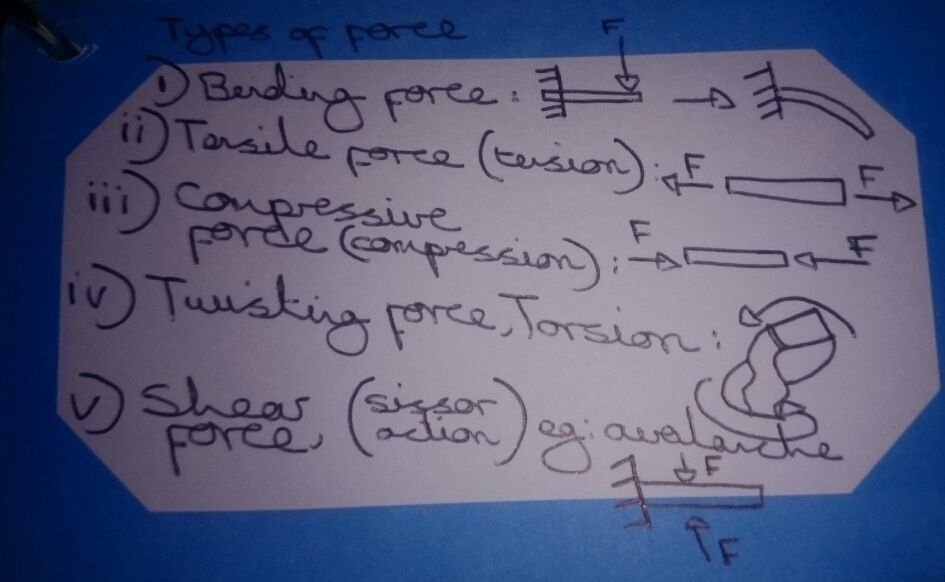
- 23Types of forces?
- 24What is a scriber?A hand tool used in metal working to mark lines on metal work pieces prior to machining.
- 25What is a steel ruler?A basic measuring tool made out of steel.
- 26What is a centre punch?Used to mark the centre of a point which is going to be drilled. A centre punch forms a large enough dample to 'guide' the tip of the drill.
- 27What is a micrometer?A small measuring device that is used to check small distances with extreme accuracy.
- 28What is a calliper?Used to measure internal and external size. once the measurment is taken by the calliper a ruler is used to take the measurment of the calliper.
- 29What is engineers ble used for?A blue pigment paste rubbed onto a metal surface which when dry, leaves a blue film. This can be marked out allowing marks to stand out during manufacturing.
- 30What are the properties of cast iron and what is it used for 3 - 3.5% carbon?Good compressive strength
hard but can be casted
brittle
rusts
low costs
used on anvils, engineering vices, machine tool beds - 31What are the properties of low carbon steel (mild steel) and what is used for less than 0.3% carbon?low strength but stronger than non-ferrous metals.
tough and low cost
cannot be harderned
used on nails, car bodies, sheet steel, steel structural components - 32What are the properties of high carbon steel and what is it used on 0.8% - 1.4% carbon?Strong, hard but not as tough as low carbon steel.
Difficult to form or work.
Can be harderned
used on tools such as saw blades, hammers, and chisels - 33What are the properties of stainless steel and what is it used for at least 11.5 chromium?Strong and hard
difficult to machine or work
does not rust
exspensive
Stainless steel is preferred for making kitchen utensils because it does not affect the flavour of food and is easy to clean. - 34Identify and compare the properties and uses of a variety of non-ferrous metals?Aluminium – light, ductile malleable,good conductor/resistance to corrosion; used on saucepans, aircraft bodies, cans
Copper – malleable, ductile and tough; excellent conductor; easily joined; corrosion resistant; used for electrical wire, hot water tanks
Brass – corrosion resistant, good conductor, easily joined, casts well; used on castings, exterior fixtures and (door handles, hinges)
Lead – soft and malleable; heavy; corrosion resistant; low melting point; easily joined and easy to work with; used on roof coverings and in soft solders
Zinc – poor strength; low melting point; highly resistant to corrosion; easy to work with; used to coat steel (galvanizing) - 35What is the name of one heat treatment used to join mild steel togetherWeilding
- 36Why is zinc ofen used for die casting rather than steel?- Zinc has a much lower melting point than steel.
- Therefore not as much energy is needed to melt it.
-Therefore it is cheaper to melt.
-Therefore it is often used for die castings, such as handles for car doors. - 37Why does hammering a metal change its propoerties?- Cold working a material causes the grains in the metal to be deformed, making them thinner and smaller.
- This makes the material harder and more brittle. - 38The factors affect the property of a metal?A
- 39What is work hardening?This is cold working which increases the strength, hardness and brittleness.
- 40What is annealing?This makes a metal softer by heating the metal to a suitable tempreture and keeping it at that tempreture for a given time thus allowing the grains to grow.
- 41What is normalizing?- Normalizing makes work hardened steel tougher and more ductile by heating it to a given tempreture and allowing it to cool naturally in air.
- 42What is hardening and quenching?Hardening and quenching is used with high carbon steels- the steel is heated to a specific tempreture, and held there to allow the atoms to rearrange before it is quenched (rapid cooling) by immersing in oil or brine. This gives a harder material that unfortunately is also very brittle.
- 43What is tempering?It is a heat treatment used to remove the brittleness of the material that has been harderned through quenching. Tempering involves heating the material to about 230-300oc then quenching - this removes some hardeness but also reduces the brittleness.
- 44What is corrosion and suggest how it can be reduced?- Corrosion is a reaction between the surfaces of a material and its enviroment that eats away some of the material.
- Aluminium reacts with the air to form an oxide layer that protects the metal from further material away
- Corrosion can be reduced by applying a coating to steel for example by painting, dip-coating or plating (galvanizing). - 45Why can a metal be normalised by heat treatment?-Normalizing is carried out on steel that has been work hardened.
-The steel should be heated and allowed to cool naturally in air
-This gives the atoms time to rearrange within the grains, resulting in a tougher steel with some ductility.
-However, the steel does not soften a great deal and reamins hard. - 46Explain which metal would be a good choice for cooking pans, used to heat food on gas cookers?- Need to be able to withstand a lot of heat without deforming (not brass or tin)
-Need to be able to resist reacting with food at tempretures which would lead to contamination (not lead)
-Need to be able to be washed in water without corroding (not low carbon or high carbon steel)
-Need to be tough and durable (not zinc, tin or lead)
-Need to be able to be formed into required shapes (not high carbon steel)
- Therefore could use copper, aluminium or stainless steel. - 47List the stock forms that metals are available in?-sheet
-Round bar rod
-Flat strip
-Angle
-I section
-Channel
-Square bar
- Heagon bar
-Tube - 48What does annealing involve and when is it used?• Annealing involves heating metal to a suitable temperature and holding it at that temperature for a given time
• This allows the grains in the metal to grow, making the metal softer and easier to work
• Also, any internal stresses and dislocations are either removed or relocated
• It is usually used on metals that have been work hardened.
• It is also used before bending metal into complicated shapes - 49How is steel annealed?• Heat to just below lower critical point
• Allow steel to soak at that temperature for a period of time, depending on part size
• Then allow material to slowly cool by leaving it in the switched off furnace - 50When is aluminium annealed and why must care be taken?• Aluminium alloys annealed after working
• Care needs to be taken because the annealing temperature is close to the melting temperature - 51How is copper annealed?• Copper is easy to anneal
• Hat copper until it is a dull red colour
• Leave to cool in air
• Black scale may form as it cools. This can be removed in a dilute acid bath, known as pickling - 52How is brass annealed?• Heat brass to a dull red colour, where it actually becomes brittle
• Cool very slowly (in air) to allow the material to soften.
• Pickling is needed to remove black scale - 53Why is steel normalised?• Normalising is carried out on steel that has been work hardened
• The steel is heated and then allowed to cool naturally in air
• Normalising allows the atoms in the steel to rearrange within the existing grains, resulting in steel that is tough with some ductility - 54What is hardening and quenching, and when is it used?• Hardening is a heat treatment that increases the hardness and strength of a metal due to a change in the arrangement of the atoms within it
• Only high carbon steel (0.8 – 1.4% carbon) can be hardened by heat treatment
• The steel is heated then held at that temperature so the atoms can rearrange
• The steel is then put through the process of quenching
• Quenching is the rapid cooling of a hot metal by immersing it in a liquid, often oil or brine - 55What is tempering, and when is it used?• Quenched steel is hard and brittle
• Tempering is a heat treatment to remove some of the brittleness in hardened steel, at the cost of some hardness
• Tempering also increases toughness - 56What is precipitation hardening, and when is it used?• Precipitation hardening is where alloying elements dissolve to form fine particles within a metal
• This increases the strength and hardness of the metal
• First the alloy is heated and then held at that temperature (“soaked”) to allow atoms of the alloying elements to dissolve
• The material is then quenched
• This is often used for high performance components, such as parts for aircraft. - 57Name at least 3 metals or alloys that can be annealed• Copper
• Brass
• Aluminium alloys
• Steel
Información
- Descripción
- Flashcards on Engineering 1, created by AsimAli Rehman on 24/11/2018.
- Creado por
- AsimAli Rehman
- Visitas
- 13
- Valoración