
Fichas
Rivers-Fluvial Landforms & Processes
Fichas del conjunto (38)
- 1Physical WeatheringFreeze thaw
Salt Crystal Growth
Pressure Release - 2Chemical WeatheringHydrolysis
Hydration
Oxidation
Carbonation Solution - 3Biological WeatheringInvolves both Physical and Chemical weathering
- 4SlidesDetached block remains large until the bottom of the slope where it is broken down on impact
- 5Sheetwash-The unchannelled flow of water over a soil surface
-Divided into areas of high and low velocities - 6In SituWithout any lateral movement (on the spot)
- 7PoolsThe deep part of the river located on the outer bend of a meander
- 8RifflesThe ridges- often formed of gravel- found in the straight part of a river between two meanders
- 9CavitationThe explosion of air in joints and cracks as a result of air at very high pressure
- 10Hydraulic RadiusCross-sectional area of a river divided by the wetted perimeter
- 11Wetted PerimeterTotal length of the bed and base of the river channel in contact with water in the river
- 12SuspensionSmallest particles (silt/clay) carried in suspended load
-important during times of flooding - 13SaltationLarge particles (sands/gravels) transported in a series of bounces as the salted load
- 14TractionLarger particles (pebbles) Shunted along the bed
- 15SolutionIn areas of calcareous (mostly or partly composed of calcium carbonate) rock, material carried in solution
- 16Sediment YieldThe amount of material (debris) carried away by water
- 17EntrainmentPicking up particles from the ground/ river bed
- 18Unconsolidated RocksLoose, broken material that is often easily eroded
- 19Consolidated RocksSolid rocks or sediment that have been bonded together by a sedimentary cement
- 20What is a Pothole? How are Potholes formed?-A pothole is a hole in the base of the stream of the river
-Formed through abrasion by pebbles held up by turbulent flow in the eddies of the stream - 21What is an Eddy?The swirling of a fluid and the reverse current created when the fluid flows past an obstacle
- 22Why are Meanders formed?When stream velocity has increased and the load is finer, in relatively straight channels, meanders develop as this is the only way the stream can use up the energy it now possesses equally throughout the channel reach
- 23ThalwegThe line of maximum velocity in the river
- 24Helicoidal FlowA corkscrew-like motion that occurs in a meander
- 25River CliffsThe steep-sided slopes on the outer ben of a meander
- 26Slip-off SlopeThe gentle slope deposited on the inner bend of a meander
- 27Bankfull StageWhere the variables of the river (depth, width, velocity) of a river are unable to cope with additional water
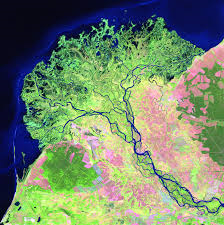
- 28—Delta
- 29—Oxbow Lake

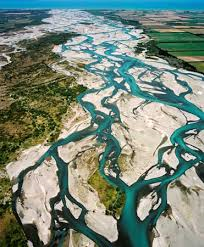
- 30—Braided Channels
- 31How is an Oxbow lake formed?-Lateral erosion (caused by centfrifugal forces) is concentrated on the outer, deeper bank of the meander
-During flooding erosion increases causing the river to break through and create a new steeper channel, the old meander is eventually closed off by deposition to form an oxbow lake - 32When do Braided channels occur?-When the river separates into multiple small interlocking channels
-Channel is now highly unstable and constantly changes form
-Occurs when the river capacity can't transport its load in a single channel, be straight or meandering - 33What are Floodplains?-Increased discharge due to heavy precipitation can lead to a bankfull stage
-Channel variables become unable to cope and river spills out into surrounding areas
-Repeated flooding leads to build up of alluvium and forms the floodplain
-Also created by bluffs (steep banks or cliffs) - 34What are Levees?-Raised ridges that run parallel to the edge of the channel and forms the repeated flooding of a river
-Rivers flooding causes its velocity to drop as the floodwaters spill out
-Heaviest and coarsest sediment are the first to be deposited and will build up over time - 35AlluviumFine sediment of silt and clay transported in suspension (very fertile)
- 36FlocculationThe process in which clay and silt particles combine when fresh water mixes with the salt water
- 37For Deltas to form a river needs to...-Carry a large volume of sediment
-Enter a still body of water (sea/lake)
IF STRONG CURRENTS SEDIMENT WOULD BE CARRIED BY LONGHSHORE DRIFT - 38How are Deltas formed?-Deposition increases if the water is salty; causes salt particles to group together and they become heavier
-Vegetation increases the rate of deposition by slowing down the water
-Coarser material deposited first and finest last
Información
- Descripción
- A Level (Rivers) Geography AS Fichas sobre Rivers-Fluvial Landforms & Processes, creado por Lucy Monger el 26/11/2014.
- Creado por
- Lucy Monger
- Visitas
- 50
- Etiquetas
- Valoración