
Fichas
BMS07-1030- Amino Acid and Protein Metabolism
Fichas del conjunto (28)
- 1What are the 3 functions of protein in the body?1. Blood glucose during starvation
2. Protein
3. Special compound synthesis (eg. purines, carnitine, creatine, neurotransmitters) - 2Why do we need dietary protein?There is no long term storage of protein, as is it constantly degraded and synthesised
Dietary protein needed as a result - 3Amino acids are present in low concentrations in cells/bloodstream that make up the amino acid pool-where does the surplus go?Catabolised into fats/carbs+nitrogen in the urea
- 4What are the 20 essential amino acids?Very Many (Hairy) Little Pigs live In The Toilet (Africa)
-Valine, methionine, histidine, lysine, phenylalanine, leucine, isoleucine, threonine, tryptophan, arginine - 5How many of the essential amino acids are synthesised naturally in the human body?10
- 6When intake/protein synthesis>excretion/protein breakdown, the nitrogen balance is .... When does this occur?The nitrogen balance is positive
Occurs during growth, pregnancy, convalescence - 7When intake/protein synthesisNegative
Occurs during starvation, illness, cancer, injury - 8How are endogenous (most) old/damaged proteins broken down?Via the Uniquitin breakdown system which:
- marks them via proteosome
- alters location
- alters protein interactions/cell activity - 9How are exogenous proteins (eg. muscle) broken down? What affects the rate of muscle breakdown?1. Taken into vesicles via endocytosis
2. Vesicles fuse with lysosomes
3. Proteolytic enzymes in lysosome break protein into amino acids
Hormones eg. cortisol increase - 10What are 5 major roles the liver plays in protein metabolism?1. Remove AA/Glucose/Fats from blood
2. Absorb amino acids to make cellular/plasma proteins, haem/purins, pyrimidines for DNA/RNA
3. Degrade AA
4. Convert NH3 to urea, excreted in kidney
5. Transport of AA/Ammonia - 11How do the rates of structural/hormonal protein breakdown differ?- Structural protein such as collagen have half lives of years
- Hormones & digestive enzymes degrade very rapidly, with half lives of minutes - 12What are the two ways amino acids are broken down?1. Transamination
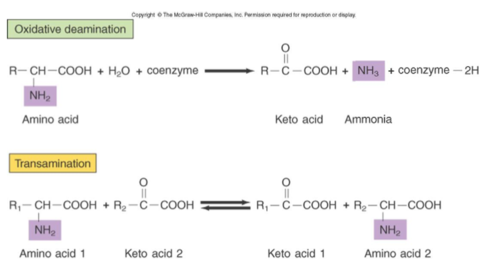
2. Deamination - 13What occurs during transamination, and what is this process important for? What catalyses this reaction?The amino group on one amino acid is transferred to a carbon skeleton (keto acid) to form a new amino acid
Important for creating amino acids not available
Aminotransferase - 14What does an amino acid become once its amino group it removed?Keto group (double bond O replaces amine group)
- 15What occurs during oxidative deamination? Which amino acid (s) are capable of undergoing this? What enzyme catalyses this?The amine group (NH2) is removed as NH3 (ammonia), which then goes to the urea cycle. Leaves behind a keto acid
Glutamate
Glutamate dehydrogenase - 16How is glutamate formed? The amino group from... is passed onto ... to form a carbon skeleton (...) and glutamateGlutamate is formed via transamination
Alanine
Oxologlutarate
Pyruvate - 17What happens to keto acids (formed after amino acids lose amino group)? What are these referred to as? Which two keto acids does this whole process not happen for?First converted to acetyl CoA
Then oxidised to CO2/H20 by TCA cycle to provide intermediates
Ketogenic Amino acids
Lysine and Leucine can only be degraded to acetyl CoA - 18Glucogenic Amino Acids are called this becauseThey can be converted back to glucose during periods of starvation by becoming pyruvate (Oxo acid)-->TCA Cycle-->Glucose+H20+CO2
- 19How many amino acids are glucogenic? Which two ketogenic amino acids also classify as glucogenic?13
Phenylalanine and tyrosine - 20Amino acids are transaminated in muscles and transported in the blood as these 4 amino acids:1. Alanine, which goes to the liver
- removal of amino group from alanine produces pyruvate for glucose/used as acetyl CoA in the TCA cycle
2. Glutamate
3. Glutamine (both 2/3 carry NH3)
4. Aspartate
- in urea cycle - 21What is the role of glutamate/glutamine, and why are they effective?They are carrier proteins for ammonia to the liver, where it will be converted to urea for excretion
They are
- safe
- Glutamine can carry 2 amino groups
(2-oxoglutarate <--> glutamate <--> glutamine) - 22What is NH2 carried in the blood as?Glutamine
- 23What is glutamine's role in pH regulation?Carries ammonia to kidney for pH regulation
- 24What is the equation for the urea cycle?NH4+ + CO2 + 2ATP
to
NH2CO(P)+ 2ADP+ Pi - 25What are the 4 end products of nitrogen metabolism?1. Urea from the urea cycle
2. Creatinine from creatinine phosphate breakdown (high energy phosphate reserve)
3. Uric acid from DNA/RNA breakdown
4. Ammonia from control of body pH - 26What is the simplified urea cycle?Ornithine-->cirtrulline
Citrulline+aspartate-->arginosuccinate via
Arginosuccinate-->arginine + fumarate (back into TCA)
Arginine-->Urea + ornithine - 27What can the neurotoxicity of ammonia lead to?Cerebral oedema, coma, death, cell death
- 28What is Hyperammonaemia? What are two things it is caused by?Impaired conversion of NH3 to urea
1. Liver failure
- Viral hepatitis
- Ischaemia
- Liver cirrhosis
- Toxins (aflatoxin in moodily peanuts)
2. Genetic defects
- Reduction in catalytic activity of any enzyme of the urea cycle
- ornithine transcarbamoylase deficiency X linked inheritance (1 in 30,000 live births)
Información
- Descripción
- biochemical basis for describing an amino acid as “essential”. terms protein turnover and nitrogen balance. common causes of negative and positive nitrogen balance. the pathways of protein degradation, including ubiquitin-dependent proteolysis. key biochemical pathways involved in amino acid metabolism and nitrogen disposal. processes of transamination and deamination and explain the term trans-deamination alanine, glutamate and glutamine importance
- Creado por
- Evian Chai
- Visitas
- 64
- Etiquetas
- Valoración