
Fichas
Additional Biology - Cells, Tissues and Organs
Fichas del conjunto (51)
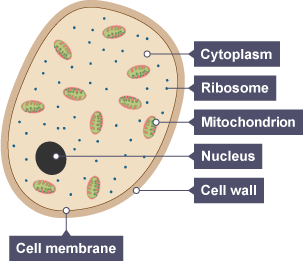
- 1What do most cells have?. A nucleus
. Cytoplasm
. A cell membrane
. Mitochondria
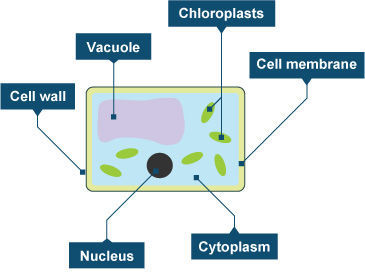
. Ribosomes - 2What do plant and algal cells also have?. A cell wall
. Chloroplasts
.Permanent vacuole - 3NucleusControls the cells activities
- 4CytoplasmWhere many chemical reactions take place
- 5Cell membraneControls the movement of materials in and out of the cell
- 6MitochondriaWhere energy is released during aerobic respiration
- 7RibosomesWhere protein synthesis takes place
- 8What is protein synthesis?The process by which proteins are made on the ribosomes based on information from the genes in the nucleus.
- 9What is an algal cell?The cells of algae, single celled or simple multicellular organisms, which can photosynthesise but are not plants
- 10Cell wallA rigid cell wall made of cellulose for support
- 11What is cellulose?A big carbohydrate molecule that makes up plant and algal cell walls.
- 12ChloroplastsChloroplasts contain chlorophyll for photosynthesis; the chloroplasts absorb light energy to make food.
- 13ChlorophyllThe green pigment contained in the chloroplasts
- 14Permanent vacuoleContains cell sap
- 15Animal Cell
- 16Plant Cell
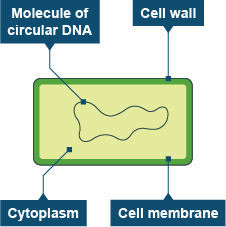
- 17Bacterial Cell
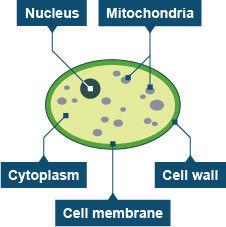
- 18Yeast Cell
- 19Bacterial Cell information.Bacteria are very small and can only be seen with a powerful microscope
.Bacterial cells have a cell membrane and a cell wall which is surrounded by cytoplasm.
.Bacteria do not have a nucleus so the genetic material is in the cytoplasm.
.When bacteria multiply, the form a colony - 20What is meant by 'genetic material'?The DNA that carries the instructions for making a new cell or new individual
- 21What is meant by a 'bacterial colony'?A population of billions of bacteria grown in a culture
- 22Yeast cell information. Yeast is a single-celled organism
. Yeast cells have a nucleus, cytoplasm and a membrane surrounded by a cell wall - 23What is meant by the term 'specialised cells'?Cells that are adapted for a particular function.
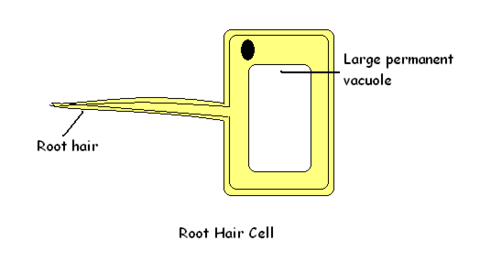
- 24A root hair cellBlack dot signifies a nuclues
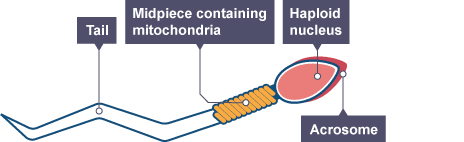
- 25A sperm cell
- 26If a cell has many mitochondria......It must need a lot of energy
e.g. muscle cell, sperm cell - 27If a cell has many ribosomes......It is making a lot of protein
e.g. gland cells which produce enzymes - 28Cells with tails......Are able to move
e.g. sperm cell - 29Receptor cells have special structures......which enable them to detect stimuli
e.g. the cone cells in the eye are light sensitive - 30Neurons are specialised to......carry impulses from receptors to the CNS
- 31Plant cells with many chloroplasts will be......photosynthesising
e.g. mesophyll cells of a leaf - 32Root hair cells increase the area of the root so that......it can absorb water and mineral ions efficiently
- 33What is meant by 'diffusion'?Diffusion is the spreading out of particles of a gas, or of any substance solution
- 34What is meant by 'net movement'?The overall movement of...
- 35What is meant by the term 'concentration gradient'?The gradient between an area where a substance is at a high concentration and an area where it is at a low concentration
- 36What is 'amino acid'?The building block of protein
- 37The larger the difference in concentration......the faster the rate of diffusion
- 38Examples of diffusion:. the diffusion of oxygen into cells of the body from the bloodstream as the cells are respiring (and using up oxygen)
. the diffusion of carbon dioxide into actively photosynthesising plant cells.
. the diffusion of simple sugars and amino acids from the gut through the cell membrane - 39What is meant by a 'multicellular organism'?An organism that is made up of many different cells which work together. Some of the cells are specialised for different functions in the organism.
- 40What is meant by the term 'differentiate'?Specialise for a particular function
- 41Animal tissues include:. muscle tissue
. glandular tissue
. epithelial tissue - 42Plant tissues include:. epidermal tissue
. mesophyll
. xylem and phloem - 43Muscle tissuecontracts to bring about movement
- 44Glandular tissueto produce substances such as enzymes and hormones
- 45Epithelial tissuewhich covers some parts of the body
- 46Epidermal tissuewhich covers the plant
- 47Mesophyllwhich can photosynthesise
- 48Xylem and Phloemwhich can transport substances around the plant
- 49Organs are made up of tissues. The stomach is an organ made of.... muscle tissue to churn the stomach contents
. glandular tissue to produce digestive juices
. epithelial tissue to cover the outside and inside of the stomach. - 50Equation for photosynthesisCarbon dioxide + water light glucose + oxygen
CO + H O light C H 0 + O - 51What is meant by the term 'insoluble molecules'?Molecules that will not dissolve in a particular solvent such as water.
Información
- Descripción
- GCSE Science Fichas sobre Additional Biology - Cells, Tissues and Organs, creado por Oliviax el 18/04/2015.
- Creado por
- Oliviax
- Visitas
- 81
- Etiquetas
- Valoración