
Fichas
biology as level 2015 AQA topic 1 and 2
Fichas del conjunto (57)
- 1what is a polymerlarge complex molecules made form monomer chains
- 2give 2 examples of monomersmonosaccharides and amino acids
- 3what do all carbohydrates containcarbon C
hydrogen H
oxygen O - 4what are carbohydrates made frommonosaccharides (sugars)
- 5give 3 examples of a monosaccharidesglucose
fructose
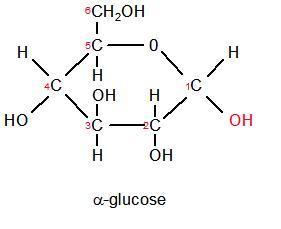
galactose - 6what is the difference between alpha and beta glucosethe H and OH swap round (alpha = H at the top)
- 7what does an alpha glucose look likeremember to number the carbons (C)
- 8describe a condensation reactionwhen two molecules join to form a new bond, releasing water as they do so. this forms a glycosidic bond
- 9describe hydrolysiswhen a dissacharide breaks into monosaccarhides
- 10name and describe 2 dissaccharidessucrose - glucose + fructose
lactose - glucose + galactose - 11what is a polysaccharidemany monosaccharides joined together with glycosidic bonds, through condensation reactions
- 12how to test for starchadd iodine. if it turns blue, there is starch present
- 13what is starch used forenergy store in plants, breaks down into glucose
- 14what is starch made fromamylose and amylopectin
- 15describe amylosehas 1-4 bonds,creates chains
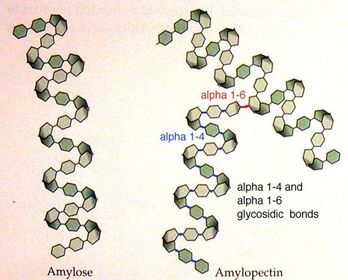
- 16describe amylopectinhas 1-4 and 1-6 bonds, creates branched chains and spirals, coils into storage
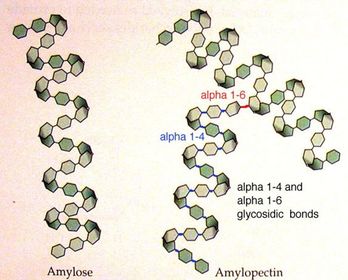
- 17why is starch good for storageits insoluble so doesn't affect water potential , AND its compact
- 18what is glycogen used forenergy storage in animals
- 19describe the structure of glycogensimilar to amylopectin, but more branches, its compact, and can release energy really quickly.
[1-4 and 1-6 bonds]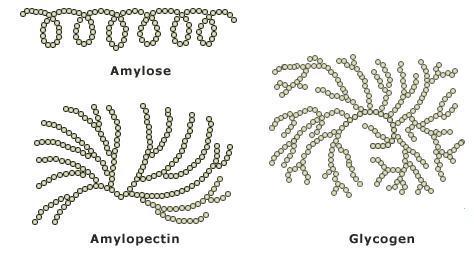
- 20describe the structure of celluloselong chains of BETA glucose, linked by hydrogen bonds. has 1-4 bonds, and every other one flips over when bonding.
- 21what is cellulose used forstructural support in cells
[chains of micro fibrils and fibres, cross over cell wall for support] - 22what is a tryglycerideone molecule of glycerol with 3 fatty acids joined to it
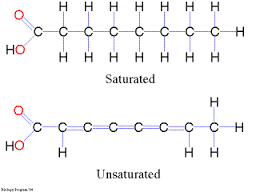
- 23what is the structure of a fatty acidC, O AND OH with R variable (hydrocarbon tail, which is hydrophobic)
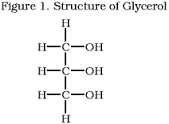
- 24what is the structure of a glycerol
- 25what is an ester bondwhen glycerol and a fatty acid join, giving off water (H2O)
- 26what is the difference between saturated and un- saturated triglycerides.saturated hydrocarbon tails have no double bonds, whereas un-saturated have at last one double bond
- 27what is a phospholipidsimilar to a triglyceride but has a phosphate group to replace one of the fatty acids.
- 28what is a phospholipid bilayer2 layers of phospholipids,
with tails facing in,
(fatty acids are hydrophobic)
and heads facing out
(phosphate Is hydrophilic) - 29what do all proteins havecarbon, hydrogen, oxygen AND NITROGEN
- 30what are proteins made ofchains of amino acids
- 31how many amino acids are there20 naturally occurring ones
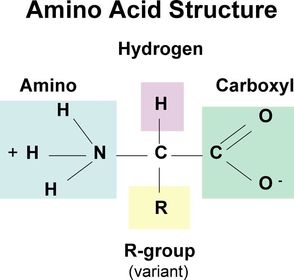
- 32what is the structure of every amino acid
- 33what is a dipeptide2 amino acids joined
- 34describe a peptide bondcondensation reaction occurs, C joins to N, and gives off H20
- 35describe the primary structure of a proteinthe sequence of amino acids, in specific order
- 36describe the secondary structure of a proteinhydrogen bonds form to give either an alpha helix or a beta pleated sheet
- 37describe the tertiary structure of a proteinstructure is folded further to form a 3D protein, and other bonds are formed (disulphide, ionic etc)
- 38describe the quaternary structure of a proteinfinal 3D shape, when multiple polypeptides bond together
- 39what are some examples of how proteins are usedcollagen, antibodies, haemoglobin, insulin
- 40describe haemoglobin4 chains (2 alpha, 2 beta)
highly soluble
outside = hydrophilic
inside = hydrophobic - 41what is a reducing sugara monosaccahride
- 42what is a non reducing sugarsucrose
- 43how to test for reducing sugarsadd benedict's
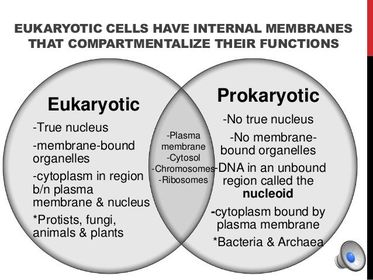
heat
watch colour change from blue to red
(if reducing sugars are present) - 44what is magnificationhow zoomed in it is
- 45what is resolutionsimilar to pixilation, smallest distance between 2 particles
- 46how to work out total magnificationobjective lens * eyepiece lens
- 47what are the resolving power orderscentimetre, millimetre, micrometre, nanometre
- 48how to jump between the resolving powerscm - mm = *10
mm - um = *1000
um - mm = *1000 - 49compare light to electron microscopeLIGHT - cheap, small, easy to use, no vacuum, but limited resolution and magnification, and stains are often needed to make cells visible
ELECTRON - complete opposite! - 50how to find size of celluse tiny ruler, convert mm to um, count cells across, divide size by number of cells
- 51what is the definition of an artefactsomething that cant be seen in detail, so is unrecognisable
- 52what is an eyepiece graticulea ruler inside the eyepiece, which needs to be adjusted when the lense is changed
- 53how to work out magnification factormagnification = image/actual
REMEMBER TO CONVERT IMAGE SIZE INTO UM (MICROMETERS) - 54what is a eukaryotic cella cell that has a true nucleus
- 55list all of the membrane bound organelles found in a eukaryotic cellnucleus, ribosomes, Golgi body, endoplasmic reticulum, lysosomes, vacuole, mitochondria, cytoskeleton
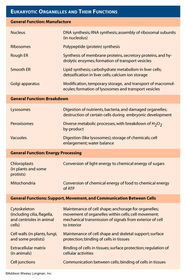
- 56what are the functions of each organelle
- 57compare eukaryotic to prokaryotic
Información
- Descripción
- AS level AS Biology Fichas sobre biology as level 2015 AQA topic 1 and 2, creado por Talya Hambling el 12/10/2015.
- Creado por
- Talya Hambling
- Visitas
- 70
- Etiquetas
- Valoración