
Fichas
Microevolution Flash Cards
Fichas del conjunto (60)
- 1MicroevolutionHeritable change in the genetic makeup of a population (ex: bacteria resisting to antibiotics over the years)
- 2PopulationAll the individuals (organisms) of the same species that live in the same place and time
- 3Phenotypic VariationAppearance and function variations based on biochemistry, physiology, behavioural, internal anatomy variations that are passed from one generation to another
- 4Quantitative variationsVarious little variations in certain traits that will be represented by bar graphs with a bell curve shape to identify the mean and the variation in the population. Ex: Variation of tow lengths between every human
- 5MeanUsed to describe the average value of the traits representation in the population
- 6Phenotypic polymorphism quantitevely% of the traits' frequency
- 7PolymorphismDiscontinuous genetic variation
2 different traits = occurrence of different forms and types in the same species - 8Artificial selectionProvoked breeding between same species to determine the genetic basis of certain traits. This will modify the average value which will confirm or not the correlation. Ex; the level of physical activity (the mice experiment)
- 9Genetic VariationGene frequency between populations caused by a variation of phenotypes and genotypes.
- 10Sources of genetic variation (2)1) Production of new alleles
2) Rearrangement of of existing alleles - 11Difference between... 1) Production of new alleles 2) Rearrangement of existing allelesNew alleles come from small-scale mutations in DNA
VS
Rearrangements come from Larger-scale changes in the chromosomal structure (ex: a genetic cross-over) - 12Gel ElectrophoresisCan estimate the genetic variation of a species by the identification of a protein polymorphism at its locus (its coding).
Underestimates the variations since it cannot identify the different amino acids of the protein - 13Diploid organismsindividuals that have pairs of homologous chromosomes
- 14Homologous chromosomeseach chromosome in pair are similar but not identical and carry the same traits, in the same order, but alleles of each trait may not be the same
- 15Gene PoolSum of alleles attached to each gene in every locus in all organisms in same population
- 16How to describe the structure of a gene pool1) Identify the genotypes of a sample in population
2)Calculate the genotypes frequency
3)Calculate the allele frequency - 17Genotype Frequency% of individual that posses each genotype
- 18Allele Frequencyp = frequency of 1 allele
q= frequency of the other allele
* It represents the common rarity of each allele in gene pool* - 19Hardy-Weinberg principles definitionMathematical model that describes how genotype frequency is established in sexually reproducing organisms. In other words.... They established principles that determine the occurrence of genetic equilibrium.
- 20Enumerate principle of hardy-weinberg1) no mutation
2)Population cannot have access to other pop. migration
3)infinite size of pop.
4)All genotypes in pop. reproduce and survive equally
5) organisms mate randomly with respect to there genotypes
*if all conditions are met = No microevolution will occur* - 21Null modelUsed in observational methods to give reference points that if it is seen, there will be no results. But if it isn't seen, the effect will occur.
- 22Genetic equilibriumThere are no changes in allele and genotype frequencies in subsequent generations.
- 23MutationHeritable change in DNA and does not have an immediate effect on the allele frequency
3 Effects
Neutral
Deleterious
Beneficial
2 Types
Point mutation
Chromosomal mutation - 24Neutral mutation1) Not harmful or useful
2) May change the organisms phenotype without influencing its survival or reproduction
3) May become harmful or beneficial later on when environment changes occur. - 25Deleterious mutationAlter's the individual's structure, behaviour or function in harmful ways (ex: collagen in humans - if altered it can cause eventual sudden death due to rupture of certain organs)
- 26Beneficial mutationNatural selection will preserve a beneficial trait and assures its frequency increases over time to be passed on from generation to another.
- 27Gene flowCreation of new alleles due to reproduction between two different populations
- 28Genetic driftRandom events that have unpredicted consequences on allele frequency causing dramatic effects on small populations, such as the bottleneck effect or the founder effect
- 29Bottleneck effectit is the reduction of genetic variation causing a drastic elimination of alleles caused by invading disease, starvation or drought (sécheresse)
- 30Founder effectCreation of a new population due to two small population that colonize together causing a change in gene pool.
- 31Natural selectionThe process of increasing the frequency of beneficially heritable traits in subsequent generations
3 modes
directional
stabilizing
disruptive - 32Relative fitnessThe surviving or reproductive rate of a genotype or phenotype VS the survival or reproductive rate of other genotypes or phenotypes in a population.
- 33Directional selection1) Have the highest relative fitness
2) Are situated near one end of the phenotypic spectrum
3) After selection, the trait moves away from the mean and towards the favoured extreme which will either increase or decrease the traits mean (mostly observed in artificial selection)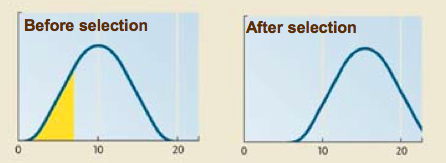
- 34Stabilizing selection1) Intermediate phenotype that have the highest fitness
2) Decreases genotypic and phenotypic variation
3)Increases frequency of the trait
4) eliminates extremes and allows a better survival of the trait.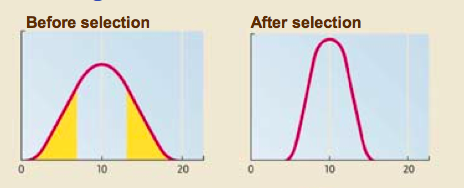
- 35Disruptive Selection1) Extreme phenotypes that have higher fitness
2) Causes Polymorphism (variation of a specific trait in same pop./species creating a distinction between the two individuals)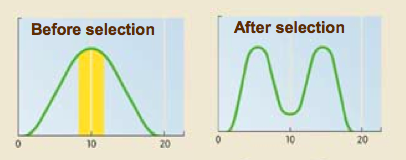
- 36Sexual SelectionThe natural process for sexually reproductive organismes do to choose their matting partner of the opposite gender. Usually the male "shows off" and female chooses.
- 37Male competition (explain different types)Combat = fight between males to have access to female (ex: Seals)
Sperm competition = Ex: Dragon Flies (male attaches to female long enough for sperm to reach reproductive place / Female can reject sperm if she wants.
Infanticide = One dominant male and kills all children of the other dominant male to ensure his genetic evolution. (Ex: Lions)
Female Choice = The male puts on a show for the female and the female chooses - 38Non Random-MattingInfluences the genotypic frequency by decreasing the amount of heterozygotes
Selection is done by identifying similar phenotypic traits - 39Diploid conditionReduces effectiveness of Natural selection
Eliminates harmful recessive alleles from a population - 40Balanced polymorphism2 or more phenotypes that do not change and stabilises over many generations
- 41Sickle cells / HBS/HBACodes for a defective form of hemoglobin in humans causing the deformation of the red blood cell which blocks transportation of oxygen in the body.
Sickle cells kill malaria which is why a lot of people are heterozugous for that trait in certain regions of the world - 42Heterozygous AdvantageHeterozygotes for a particular locus have a higher relative fitness than the homozygous
- 43InbreedingReproduction between genetically related individuals = increases homozygote traits
- 44Reproductive IsolationBiological process that prevents gene pools of two different species from mixing
2 ways:
Prezygotic isolation
Postzygotic Isolation - 45Prezygotic Isolation and explain 5 ways it is doneBarrier that occurs before fertilization
5 Ways:
1) Ecological = species do NOT live in same habitat but are in same geographic region
2) Temporal = Species do live in same habitat but do not mate in same periods of time
3) Behavioural = Signals that are sent from one species but not recognize by another
4)Mechanical = Incompatible sexual organs preventing successful breeding
5) Gametic = Sperm incompatibility of species with the eggs of another (ex. flowers) - 46Postzygotic isolation and explain 3 ways it is doneBarrier that occurs after fertilization
3 ways:
1) Hybrid inviability = incompatibility in the development process of the two similar species causing the death of the embryo (ex: sheep and goats)
2) Hybrid Sterility = Incompatibility in the chromosomal structure which does not allow proper chromosome pairing during meiosis.
3) Hybrid breakdown = Reproductive failure for the F2 generation of cross breeding between species or subspecies (the F2 generation will not be able to reproduce due to an incompatibility between interacting genes) - 47HybridizationTwo species that interbreed and produce fertile offspring
- 48Fertile offspringTwo organisms that are able to reproduce naturally
- 49Sterile HybridsTwo subspecies breed, but one of the parents traits will not be displayed to ensure a constant distinction between the two species.
- 50SubspeciesGeographically separated populations that show obvious phenotypic variation
- 51Ring speciesTwo populations that could interbreed and live in the same geographic environment but they don't which creates a geographic ring.
- 52Allopatric speciationNatural or artificial barrier that separates a population in two stages:
1) The two populations become geographically separated preventing gene flow
2) Reproduction isolation occurs - 53Second ContactCaused by the elimination of the barrier, allowing the two populations to reunite
- 54Hybrid zoneAreas where early stages of second contact occur and prezygotic reproduction isolation hasn't occurred yet, allowing the "different" species to mate between each other
- 55Sympatric speciationThe process of which new species occur from same ancestor but eventually grow apart creating different reproductive isolations caused by the accumulation of genetic changes trough time
- 56PolyploidyOrganisms that contain more than one set of the same homologous chromosomal pair in gametes.
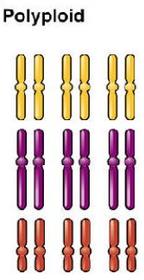
- 57Autopolyploidy - ConditionsA) Occurs within the same species
B) Error during meiosis causing a "Non-Disjonction"
C) Seen in plants that self-reproduce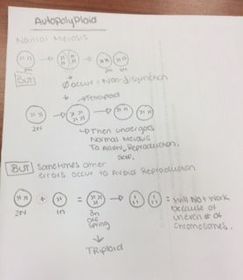
- 58Allopolyploidy conditionsA) Occurs within 2 different species
B) Mainly in plants
C) always looking for an even amount of chromosomes - 59Autopolyploidy stepsasfd
- 60Allopolyploidy steps1) Two gametes meet
Información
- Descripción
- 1130 (Microevolution) Biology Fichas sobre Microevolution Flash Cards, creado por Kelly-ann Laverg el 15/10/2015.
- Creado por
- Kelly-ann Laverg · oct 2015
- Actualizado
- 19 feb 2016
- Visitas
- 2
- Etiquetas
- Valoración