
Fichas
atomic strructure to limestone
Fichas del conjunto (42)
- 1How many elements are there?about 100
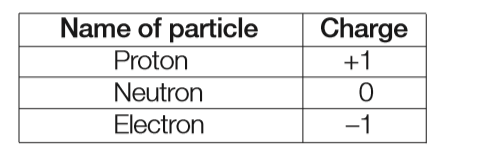
- 2describe the relative charges of protons neutrons and electrons
- 3Why do atoms have no overall chageBecause the numbers of electrons and protons are the same in a neutral atom
- 4What is the relative masses of the proton , neutron and electronproton = 1
neutron = 1
electron - 1/2000 or v small - 5How do you calculate the number of neutrons in an atomtake the atomic number from the mass number
- 6why are the noble gasses unreactiveThey are unreactive because
their atoms have stable arrangements of electrons. - 7what is conservation of mass theoryNo atoms are lost or made during a chemical reaction so the mass of the products equals
the mass of the reactants.
example - if you decompose 20 g of calcium carbonate you produce 11.2 g of calcium oxide and 8.8 g of carbon dioxide - 8What is limestone?Limestone, mainly composed of the compound calcium carbonate (CaCO3), is quarried and can be used as a building material.
- 9Describe the thermal decomposition of limestoneCalcium carbonate can be decomposed by
heating (thermal decomposition) to make calcium oxide and carbon dioxide. - 10Which other carbonates can be decomposed. ? can they all be decomposed in the lab ?The carbonates of magnesium, copper, zinc, calcium and sodium decompose on heating in a similar way.not all carbonates of metals in Group 1 of the periodic table decompose at the temperatures reached by a Bunsen burner.
- 11Describe the reaction between calcium oxide and waterCalcium oxide reacts with water to produce calcium hydroxide, which is an alkali that can be used in the
neutralisation of acids. - 12describe how lime water is used to test for carbon dioxide?A solution of calcium hydroxide in water (limewater) reacts with carbon dioxide to produce calcium carbonate. Limewater is used as a test for carbon dioxide. Carbon dioxide turns limewater cloudy.
- 13describe the reaction between carbonates and acidCarbonates react with acids to produce carbon dioxide, a salt and water. Limestone is damaged by acid rain.
- 14describe how cement , mortar and concrete are madeLimestone is heated with clay to make cement. Cement is mixed with sand to make mortar and with sand and aggregate to make concrete.
- 15what is the formula of calcium hydroxide?Ca(OH)2
- 16What is an ore ?Ores contain enough metal to make it economic to extract the metal. The economics of extraction may change over time.
- 17How are most metals found?Unreactive metals such as gold are found in the Earth as the metal itself, but most metals are found as compounds that require chemical reactions to extract the metal.
- 18How are metals less reactive than C extracted ?Metals that are less reactive than carbon can be extracted from their oxides by reduction with carbon, for example iron oxide is reduced in the blast furnace to make iron.
- 19What is reduction ?the removal of oxygen
- 20How are metals more reactive that C extracted and why are these metals more expensive?Metals that are more reactive than carbon, such as aluminium, are extracted by electrolysis of molten compounds. The use of large amounts of energy in the extraction of these metals makes them
expensive. - 21How is copper extracted ?Copper can be extracted from copper-rich ores by heating the ores in a furnace (smelting). The copper can be purified by electrolysis. The supply of copper-rich ores is limited.
- 22What is phytomining?Phytomining uses plants to absorb metal
compounds and that the plants are burned to produce ash that contains the metal compounds - 23What is bioleaching?bioleaching uses bacteria to produce leachate solutions that contain metal compounds.
- 24How is copper extracted from copper salts?Copper can be obtained from solutions of copper salts by electrolysis or by displacement using scrap iron.
- 25Why is the extraction of aluminium and titanium expensive?Aluminium and titanium cannot be extracted from their oxides by reduction with carbon. Current methods of extraction are expensive because:
■ there are many stages in the processes
■ large amounts of energy are needed. - 26Why should we recycle metals?We should recycle metals because extracting them uses limited resources and is expensive in terms of energy and effects on the environment.
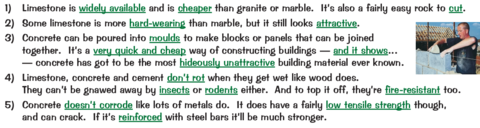
- 27List the advantages and disadvantages of limestone products
- 28describe the advantages of using limestone?
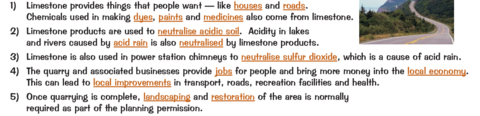
- 29describe the disadvantages of using limestone?
- 30what is an elementjust 1 type of atom
- 31what is a molecule2 or more atoms chemically joined - can be an element or compound !!
- 32what is a compound2 or more different elements chemically joined
- 33what sort bonds are formed between non - metalscovalent
- 34how are covalent bonds formedsharing of electrons to give atoms a full outer shell and stable arrangement
- 35what sort of bonds form between metals and non - metalsionic
- 36how do ionic bonds formmetal atoms lose one or more electrons to form positively charged ions. non-metal atoms gain electrons to form negatively charged ions. the oppositely charged ions attract each other strongly (electro static forces)
- 37limewater goes cloudy when mixed with carbon dioxide. explain why using an equationcalcium carbonate is formed and is insoluble
calcium hydroxide + carbon dioxide = calcium carbonate + water - 38explain why acids damage limestoneacids react with calcium carbonate producing carbon dioxide , salt and water. the salt dissolved in water and so the amount of limestone decreases
- 39farmers spread calcium hydroxide on fields with acidic soils. explain whycalcium hydroxide reacts with acids because calcium hydroxide is an alkali and the reaction is neutralisation, it increases the pH of the soil which is better for certain plants
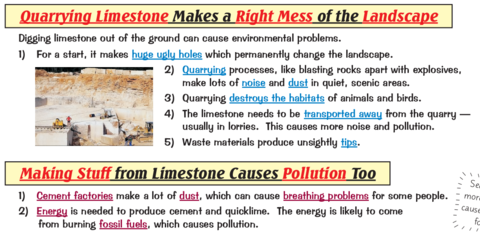
- 40what are the advantages and disadvantages for an area in which limestone is quarriedadvantages-
1.more employment
2.more customers and trade for local business
3. improved roads
disadvantages
1. dust and noise
2.more traffic
3. loss of wildlife habitat - 41how does limestone remove sulphur dioxide from power stationsit reacts with sulphur dioxide to form calcium sulfate (neutralisation)
- 42what does calcium carbonate + acid producesalt + water + carbon dioxide