
Fichas
Tib/Fib & Knee Procedures
Fichas del conjunto (63)
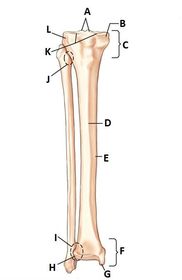
- 1—A. intercondyloid eminence
B. medial condyle
C. proximal extremity
D. anterior crest
E. body of tibia
F. distal extremity
G. medial malleolus
H. fibular notch (on tibia)
I. distal tibiofibular joint
J. proximal tibiofibular joint
K. articular facets
L. lateral condyle - 2—A. tibial plateau
B. body of tibia
C. medial malleolus
D. lateral malleolus
E. fibular body
F. neck
G. head
H. apex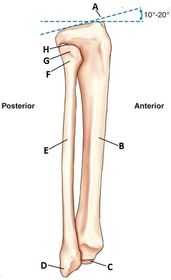
- 3—A. hip joint
B. femoral body
C. patella
D. trochlear groove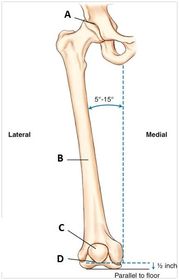
- 4—A. greater trochanter
B. intercondylar fossa (notch)
C. lateral epicondyle
D. lateral condyle
E. medial condyle
F. medial epicondyle
G. adductor tubercle
H. popliteal surface
I. lesser trochanter
J. neck
K. head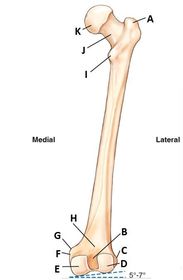
- 5—A. patellar surface
B. patella
C. popliteal surface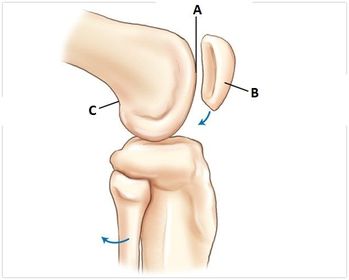
- 6—A. trochlear groove
B. lateral epicondyle
C. lateral condyle
D. intercondylar fossa
E. medial condyle
F. medial epicondyle
G. patellofemoral joint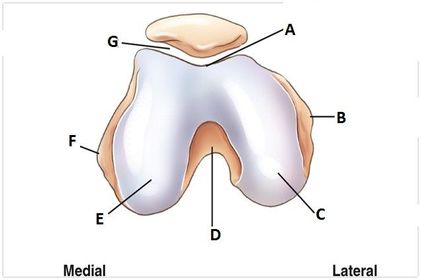
- 7—A. superior border (base)
B. posterior surface
C. apex (inferior surface)
D. anterior surface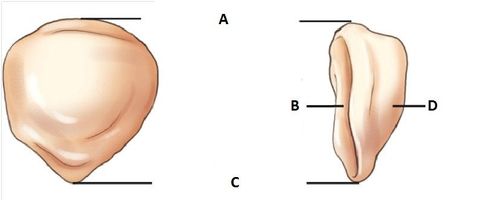
- 8—A. patellar surface
B. femur
C. PCL
D. medial condyle
E. medial meniscus
F. transverse ligament
G. tibial medial collateral ligament (MCL)
H. tibia
I. fibula
J. fibular lateral collateral ligament (LCL)
K. lateral meniscus
L. lateral condyle
M. ACL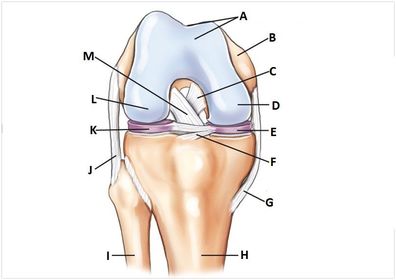
- 9—A. medial condyle (tibia)
B. tibia body
C. medial malleolus
D. lateral malleolus
E. fibula body
F. neck fibula
G. head fibula
H. apex fibula
I. lateral condyle tibia
J. intercondylar eminence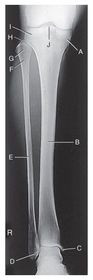
- 10—A. intercondylar eminence
B. tibial tuberosity
C. body tibia
D. body fibula
E. medial malleolus
F. lateral malleolus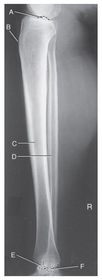
- 11—I. adductor tubercle
J. lateral condyle
K. medial condyle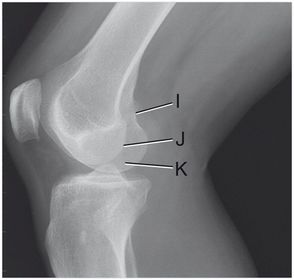
- 12—A. medial and lateral intercondylar tubercles
B. lateral epicondyle femur
C. lateral condyle femur
D. lateral condyle tibia
E. articular facets tibia (tibial plateau)
F. medial condyle tibia
G. medial condyle femur
H. medial epicondyle femur
I. patella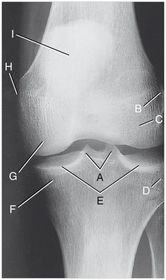
- 13—A. base of patella
B. apex of patella
C. tibial tuberosity
D. neck of fibula
E. head of fibula
F. apex of head of fibula
G. superimposed lateral and medial condyles
H. patellar surface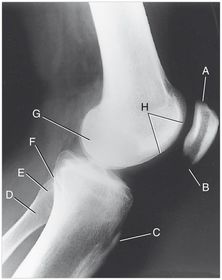
- 14—A. patella
B. femoropatellar joint
C. lateral condyle
D. patellar surface
E. medial condyle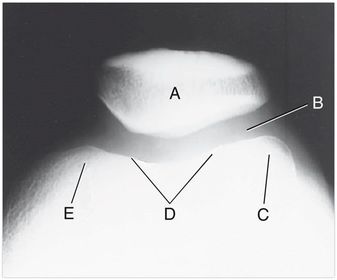
- 15The articular facets making up the tibial plateau slopes posteriorly at _____10-20 degrees
- 16Another term for the patellar surface of the distal femur is __________Intercondylar Sulcus
Trochlear Groove - 17Which bone is the longest and strongest bone in the body?Femur
- 18The adductor tubercle is viewed in only one projection, which is it?Lateral Knee
*under rotation of knee* - 19if you add a grid when you normally don't use one, how will you adjust your technique?increase kVp
- 20If you are x-raying through dense anatomy, how will you change your technique?Increase mAs
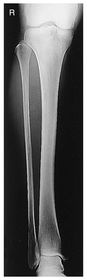
- 21AP Tib/Fib40 SID
14x17 IR tabletop
- pt supine w/ leg rotated inward 5 degrees w/ foot dorsiflexed for TRUE AP
- CR perpendicular @ midleg
*must see ankle and knee joints on image - you can overlap 2 images if 1 doesn't fit both joints*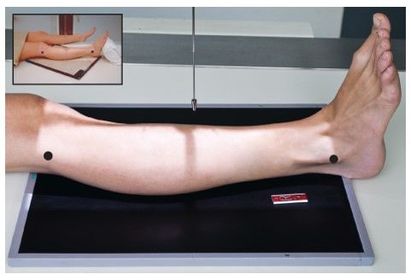
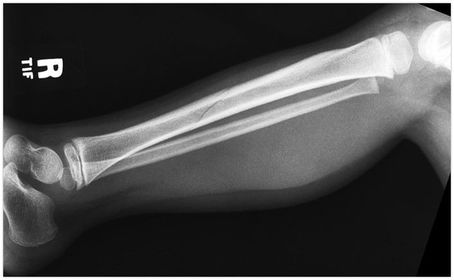
- 22Lateral TIb/Fib Mediolateral40 SID
14x17 IR tabletop
can angle IR diagonally to fit entire tib/fib on
- CR perpendicular @ midleg
*must see ankle and knee joints on image - you can overlap 2 images if 1 doesn't fit both joints*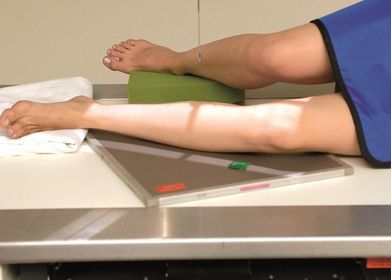
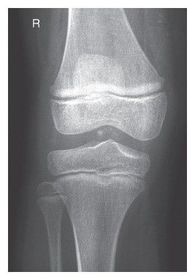
- 23AP Kneept supine w/ leg rotated internally 5 degrees to get knee in TRUE AP
- CR parallel to tibial plateau @ 1/2 in distal to apex of patella
*angle CR 3-5 degrees CAUDAL for ASTHENIC pts*
*angle CR 3-5 degrees CEPHALIC for HYPERSTHENIC pts*
leave CR angled 0 degrees for average sized pts.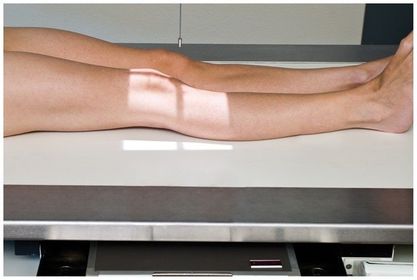
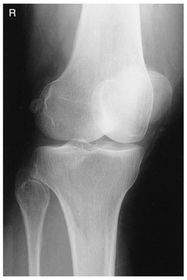
- 24AP Medial Oblique Kneept supine w/ knee rotated medially 45 degrees
- CR parallel to tibial plateau @ 1/2 in distal to apex of patella
*will see LATERAL condyles best along with the APEX OF FIBULA*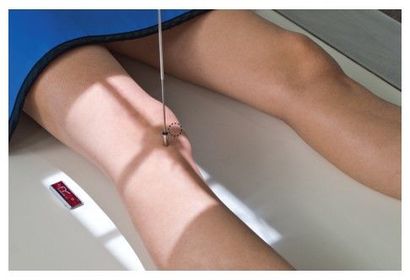
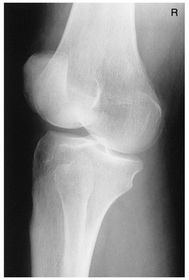
- 25AP Lateral Oblique Kneept supine w/ knee rotated externally 45 degrees
- CR parallel to tibial plateau @ 1/2 in distal to apex of patella
* will see MEDIAL condyles best along with 1/2 of patella free of superimposition of the condyles*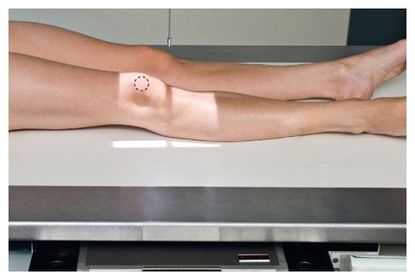
- 26Lateral Knee Mediolateral40 SID
10x12 IR in table BUCKY
- pt lateral recumbent w/ knee flexed 20-30 degrees so patella is perpendicular to IR
- CR angled 5-7 degrees cephalic @ 1 in distal to medial epicondyle
(Always angle for lateral)
*seeing the adductor tubercle indicates the pt is underrotated*
*seeing the distal borders of femoral condyles NOT superimposed indicates an incorrect cephalic CR angle*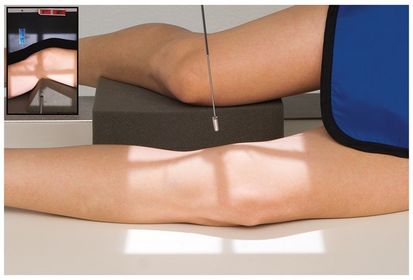
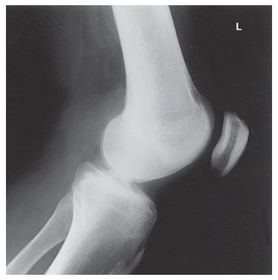
- 27AP Bilateral Weight Bearing Knees40 SID
14x17IR in wall BUCKY
MANUAL TECHNIQUE for bilateral
PHOTOTIME for unilateral
- CR perpendicular to IR @ 1/2 in below apex of patella for average sized pts
- CR angled 5-10 degrees cephalic for hypersthenic pts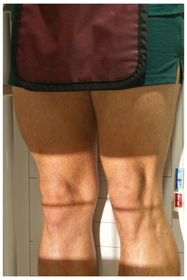
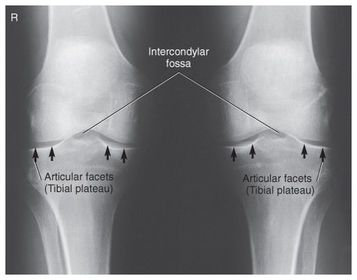
- 28Rosenberg Method PA Bilateral Knees40 SID
14x17IR in wall BUCKY
- pt erect squatted back so knees are flexed 45 degrees
- CR angled 10 degrees caudal @ popliteal crease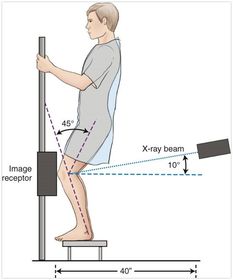
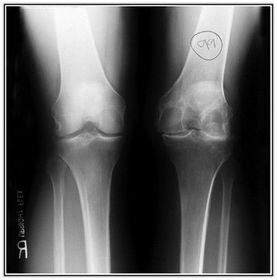
- 29Camp Coventry Intercondylar Fossa PA Axial Projection40 SID
14x17 IR in BUCKY
pt prone/knee flexed 40-50 on sponge
CR perpendicular to lower leg/ angled 40-50 degrees @ popliteal crease
*looking @ ICF*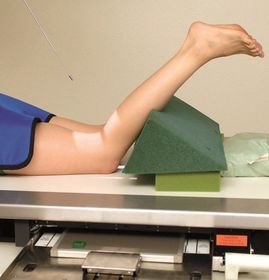
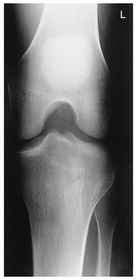
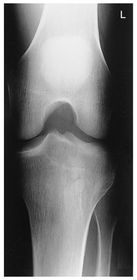
- 30Holmblad Method Intercondylar Fossa *alternative to camp coventry* PA Axial Alternativept on all fours w/ knees flexed 20-30 degrees
CR perpendicular to lower leg @ popliteal crease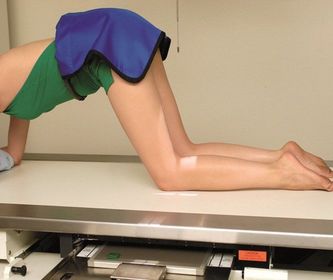
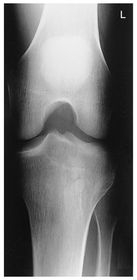
- 31Holmblad Method Intercondylar Fossa Variations *alternatives to Camp Coventry* PA Axial Alternativespt positions vary over table, wheelchair, or chair
- CR perpendicular to lower leg w/ leg flexed 20-30 degrees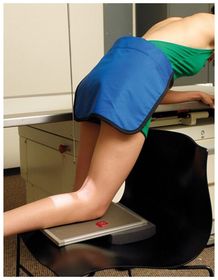
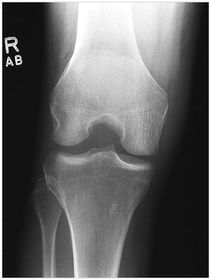
- 32Beclare AP Axial Intercondylar Fossa- 40 SID
- 8x10 IR tabletop built up on sponge
- pt supine/knee flexed 40-45 degrees
- CR perpendicular to lower leg angled 40-45 cephalic @ 1/2 in distal to apex of patella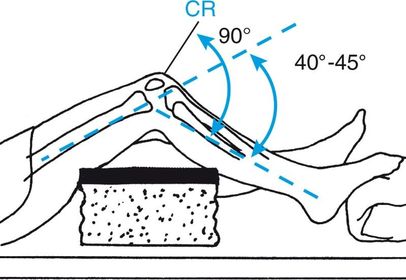
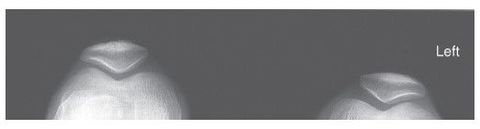
- 33Merchant Bilateral Method Patellapt seated with knees flexed 40 degrees on merchant board
- CR angled 30 degrees caudal @ midway between the patellae
*over flexion of knees will pull the patellae into the trochlear groove*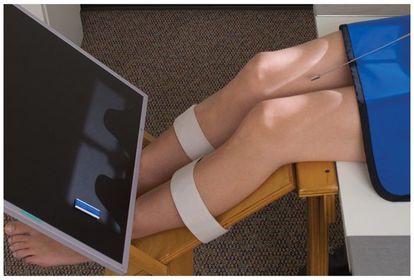
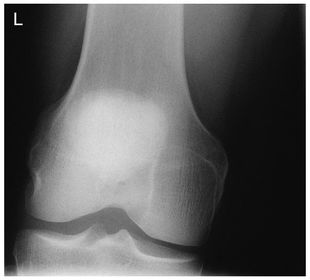
- 34PA Patellapt prone
CR perpendicular @ mid femoropatellar joint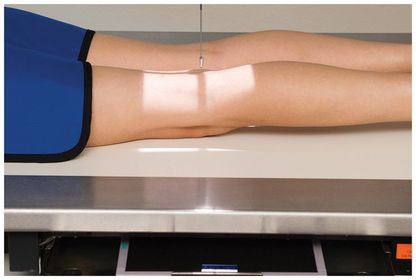
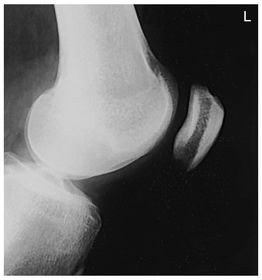
- 35Lateral Patella Mediolateralpt lateral recumbent, knee flexed 5-10 degrees ONLY
- CR perpendicular to mid femoropatellar joint
*adductor tubercle reveals underrotation of knee*
*distal borders of femoral condyles must be superimposed - if not it reveals incorrect CR angulation*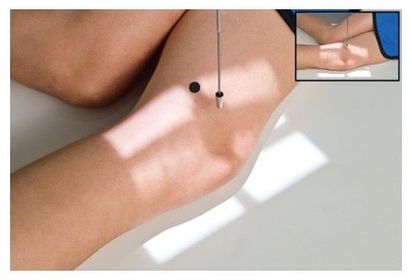
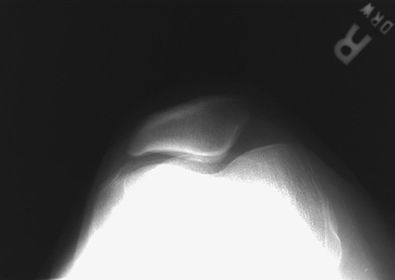
- 36Settegast Method Patellapt prone knee flexed 90 degrees
- CR angled 10-20 degrees to lower leg @ femoropatellar joint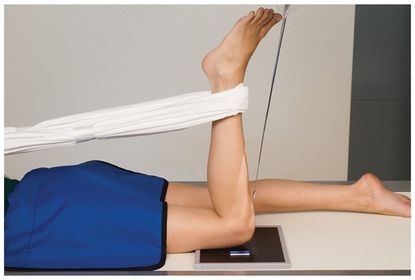
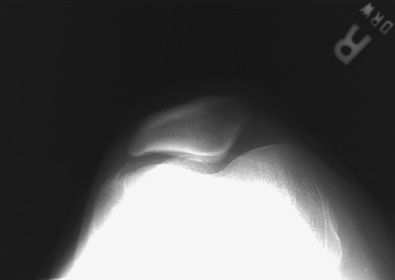
- 37Houghston Method Patellapt prone knee flexed 55 degrees
- CR angled 15-20 degrees to lower leg @ femoropatellar joint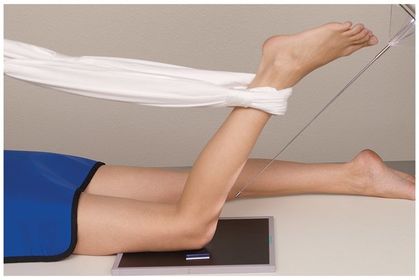
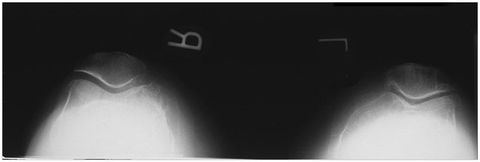
- 38Inferosuperior Bilateral Patellae Sunrise40-45 degree flexion of knees
- CR angled 10-15 degrees cephalic from perpendicular @ femoropatellar joint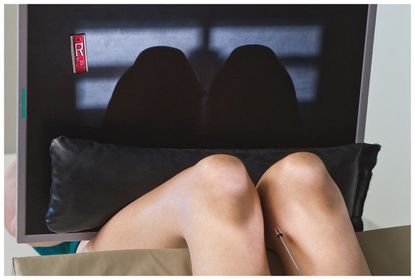
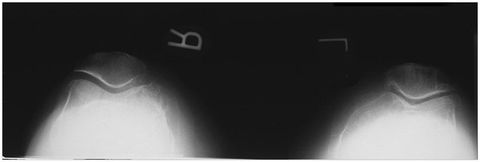
- 39Hobbs Modification Patella Alternative to Inferosupeior Bilateral Patellaept seated knees flexed slightly
- IR placed on foot stool to reduce OID
- 48-50 SID minimum
- CR perpendicular to IR @ mid femoropatellar joint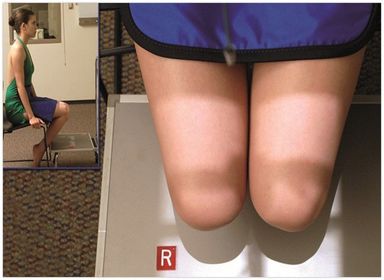
- 40A palpable landmark used to position the knee is the ______epicondyle
- 41Which structures serve as shock absorbers within the knee joint?Menisci
- 42For a mediolateral projection of the lower leg, the knee is flexed _______ degrees20-30 degrees
- 43For a mediolateral projection of the knee, the CR is angled ______ centered at ___ inch distal to the apex of the patella5-7 degrees cephalic
1/2 in. - 44For the PA axial projection - Camp-Coventry Method - for intercondyloid fossa, the knee is flexed ____40-50 degrees
- 45What does the annode-heel effect determine about projections of the lower leg?The heavier portion of the leg (knee->hip) should be on the cathode side of the table
- 46Which projections have the CR perpendicular to, and centered at mid-leg?AP leg
Lateral leg - 47Which projection of the patella has the patient prone with knee flexed 55 degrees?Hughston Method Patella
- 48How much are the knees flexed for the inferosuperior axial projection (sunrise) of the patella? How much is the CR angled?40-45 degrees
10-15 degrees cephalic @ mid femoropatellar joint - 49Which projection of the patella has the patient seated with knees flexed 40 degrees on a board or over the table? How much is the CR angled and in which direction?Merchant Bilateral Tangential Patellae
30 degrees caudal @ midway between patellae - 50How much is the knee flexed for the lateral-mediolateral projection of the patella?5-10 degrees
- 51Why is PA preferred over AP for the patella?Less OID with PA
- 52With the PA patella projection AND the AP knee projection, how much should the leg be rotated to get TRUE AP and PA?5 degrees internally
- 53Which projection of the Intercondylar Fossa has the patient supine with the IR built up on a kleenex box under the knee? How much is the CR angled?Beclere - AP Axial
CR perpendicular to lower leg : if leg is flexed 45 degrees, CR is angled 45 degrees - 54How is the CR angled for the Camp-Coventry - PA Axial projection of Intercondylar Fossa?CR is perpendicular to lower leg
leg flexed 40-45 degrees
CR angled 40-50 degrees caudal - 55Which projection of the knees has the patient erect on a stool squatted back with knees flexed 45 degreesRosenberg - PA Axial Bilateral Weight Bearing Knees
- 56Which projection of the knees has the CR perpendicular to the IR in the wall bucky?AP Bilateral Weight Bearing Knees
- 57How should the feet be positioned for the AP Bilateral Weight Bearing projection of the knees?rotated 5 degrees inward to get True AP
- 58What is seen on a projection of the lateral knee when it is under rotated?Adductor Tubercle
- 59What is seen on a projection of the lateral knee when the CR is not angled adequately?The distal borders of the femoral condyles will NOT be superimposed
- 60Which projection of the knee best visualizes the fibular apex?AP Oblique with Medial Rotation
- 61Which projection of the knee best visualizes 1/2 of the patella free of superimposition from the condyles of the femur?AP Oblique with Lateral Rotation
- 62How much will you angle the CR for knee projections on a patient that is hypersthenic? (greater than 24cm diameter)3-5 degrees cephalic
- 63How much will you angle the CR for knee projections on patients that are asthenic? (less than 19cm diameter)3-5 degrees caudal
Información
- Descripción
- ARRT Radiologic Procedures I Fichas sobre Tib/Fib & Knee Procedures, creado por RadTech Fairy el 29/11/2016.
- Creado por
- RadTech Fairy
- Visitas
- 1.124
- Valoración