
Fichas
AQA GCSE Psychology Memory unit (Essential studies & definitions)
Fichas del conjunto (45)
- 1What is encoding?Changing information
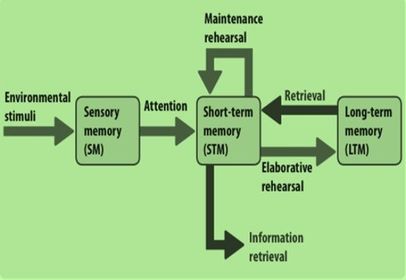
so it can be stored - 2What is storage?Holding information in the
memory system - 3What is retrievalRecovering information from storage
- 4What is the multi-store model of memory?The idea that information passes through a series of memory stores
- 5What is the sensory store?Holds information received from the sense for a very short period of time.
If attention is payed to it, it will flow into the Short Term Store - 6What is the short term store?Holds approximately 7 chunks of information for a limited amount of time
Maintenance rehearsal is needed for the information to stay in the short term store
If elaborative rehearsal is done, the information will flow into the long term store - 7What is the long term store?Holds a vast amount of information for a very long period of time
- 8Murdock aimTo provide evidence to support the multi-store explanation of memory
- 9Murdock methodParticipants had to learn a list of word presented one at a time, for two seconds each word, and then recall the words in any order.
- 10Murdock resultsThe words at the end of the list were recalled first (recency effect), and words from the beginning of the list were recalled quite well (primary effect). Middle words were not recalled very well at all.
- 11Murdock conclusionThis provides evidence for separate short-term and long-term stores.
Recency is evidence that the last few words were still in the short-term store
Primary effect is evidence that the first few words flowed into the long-term store - 12What is reconstructive memory?Altering our recollection if things so they make more sense to us
- 13Bartlett aimTo see if people, when given something unfamiliar to remember, would alter the information,
- 14Bartlett methodParticipants were asked to read a story called 'The War of the Ghosts' - a Native American legend..
Later they were asked to retell the story as accurately as possible. This retelling was repeated several times along the weeks that followed. - 15Bartlett resultsBartlett discovered that his participants found it difficult to remembers bits of the story about spirits and changed other bits so it made more sense to them.
Each time they retold the story, they changed it some more. - 16Bartlett conclusionMemory is influenced by our own beliefs
- 17What is structural processing?Thinking about the physical appearance of words to be learnt
- 18What is phonetic processing?Thinking about the sound of
words to be learnt - 19What is semantic processing?Thinking about the meaning of
words to be learnt - 20Craik and Tulving aimTo see if the type of question asked about words will have an effect on the number of words recalled
- 21Craik and Tulving methodParticipants were presented with a list of words, one at a time, and asked yes/no questions about each word.
The questions either required structural, phonetic or semantic processing.
They were then given a longer list of words and asked to identify words they had answered questions about. - 22Craik and Tulving resultsParticipants identified 70% of words that required semantic processing,
35% of words that required phonetic processing and
15% of words that requires structural processing. - 23Craik and Tulving conclusionThe more deeply the information is processed, the more likely it is to be remembered
- 24What is interference?Things that we have learnt that make it difficult to recall other information that we have learnt
- 25What is retroactive interference?When information we have recently learnt hinders our ability to recall information we have previously learnt
- 26What is proactive interference?When information we have already learnt hinders our ability to recall new information
- 27Underwood and Postman aimTo see if new learning interferes with previous learning
- 28Underwood and Postman methodParticipants were divided into 2 groups:
Group A were asked to learn a list of word pairs (cat -tree,).
They were then asked to learn a second list of word pairs (cat -glass)
Group B was only asked to learn the first list of word pairs.
Both groups were then asked to recall the first list of word pairs. - 29Underwood and Postman resultsGroup B's recall of the first list was more accurate than that of Group A.
- 30Underwood and Postman conclusionNew learning will cause people to recall previously learnt information less accurately
- 31What is context?The general setting or environment in which activities happen
- 32What is anterograde amnesia?Being unable to learn new information after suffering brain damage
- 33What is retrograde amnesia?Loss of memory for events that happened before brain damage occured
- 34Godden and Baddeley aimTo see if people who learn and are tested in the same environment will recall more information than those who learn and are tested in different environments
- 35Godden and Baddeley methodParticipants were deep-sea divers and were divided into 4 groups. They were all given the same list of words to learn.
Group 1 learned underwater & recalled underwater
Group 2 learned underwater & recalled on the shore
Group 3 learned on the shore & recalled on the shore
Group 4 learned on the shore & recalled underwater - 36Godden and Baddeley resultsGroups 1 & 3 (learned and recalled in the same environment) recalled 40% more words than Groups 2 & 4
- 37Godden and Baddeley conclusionRecall of information will be better if it happens in the same context
that learning takes place - 38Loftus and Palmer aimTo see if leading questions affect the accuracy of recall
- 39Loftus and Palmer method45 participants were divided into 5 groups and shown films of car accidents and asked questions about it.
Group 1 : How fast were the cars going when they smashed into each other?
Group 2 : How fast were the cars going when they collided into each other?
Group 3 : How fast were the cars going when they bumped into each other
Group 4 was asked: How fast were the cars going when they hit each other?
Group 5 was asked: How fast were the cars going when they made contact?
They were then asked to estimate the car's speed. - 40Loftus and Palmer resultsThe more 'dramatic' the word, the higher the speed estimate.
(Those who heard the word 'smashed' gave a higher speed estimate than those who heard the word 'hit') - 41Loftus and Palmer conclusionLeading questions will reduce the accuracy of recall.
- 42Bruce and Young aimTo see if familiarity affects the accuracy of identifying faces
- 43Bruce and Young methodPsychology lecturers were caught on security cameras at the entrance of a building. Participants were asked to identify the faces seen on the camera tape from a series of high-quality photographs
- 44Bruce and Young resultsThe lecturer's students made more correct identifications than other students and experienced police officers
- 45Bruce and Young conclusionPrevious familiarity helps
when identifying faces
Información
- Descripción
- All the key words and need-to-know studies on the AQA GCSE Psychology specification. Enjoy =)
- Creado por
- Diana Domingues
- Visitas
- 76
- Etiquetas
- Valoración