
Fichas
Innate Immunity II
Fichas del conjunto (27)
- 1IMMUNE EVASION 1) Molecular Mimicry:mimics the immune response
in order to INVADE the immune response - 2IMMUNE EVASION: Protein ModificationsGlycosylation:
key immune proteins, such as TCR, MHC, TLR and antibodies are glycosylated
**when pathogen is glycosylated, it sterically blocks the action of proteases and can ESCAPE - 3IMMUNE INVASION: Down-Regulate HLATUMORS & VIRUSES
target the HLA and wants to down regulate it so that the immune system cannot detect them - 4BRIDGING THE GAP B/W Innate and Adaptive ImmunityInnate immune response drive adaptive immune responses
-recognition of PRR drives inflammation and recruitment of neutrophils, macrophages, and dendritic cells
-Macrophages and dendritic cells and B cells are all APC's (professional)
APC's stimulate adaptive immunity (T cells) - 5HLA HUMAN LEUKOCYTE ANTIGENSPolymorphic
Multiple loci
Multiple alleles at loci
Codominantly expressed
Haplotypes (inherit 1/2 from mom and 1/2 from dad)
Linkage disequilibrium (certain genes are found at a more than random frequency)
Evolved to accommodate immune responses to enormous variety of foreign antigens (pathogens)
“Self Ags” = Potent inducers of humoral and cell mediated immune responses = primary stimulus for HVG and GVH responses - 6CONCEPT FOR MHC CLASSESMHC CLASS ONE = ONE LETTER ABBREVIATIONS
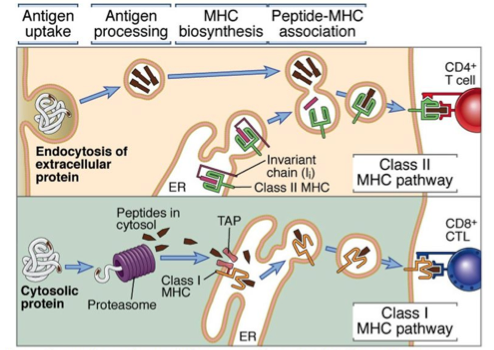
MHC CLASS TWO = TWO LETTER ABBREVIATIONS - 7ANTIGEN PRESENTATION TO T CELLS: MHC CLASS ONEINTRACELLULARLY derived peptides
(8-10 aa) anchored at ends
Expressed on ALL NUCLEATED CELLS except RBC's (phagocytes, etc.)
Presents to CD8+ T cells (1*8 = 8)
Ligand for KIR - 8ANTIGEN PRESENTATION TO T CELLS: MHC CLASS IIEXTRACELLULARLY derived peptides
(>13 aa) bound by peptide side chains protruding into pockets in binding groove
Expressed on APC (professionals-macrophages, dendritic, and B cells)
Presents to CD4+ T cells (2 * 8 = 8) - 9PATHWAYS OF ANTIGEN PROCESSINGMHC Class I: Protein antigen in cytoplasm (INTRACELLULAR) -EX: VIRUS
MHC Class II: Protein antigen in vesicles (ECTRACELLULAR) - 10Hypervariable Regions (HLA = responsible for enormous variety of response)MHC Class I: alpha 1, 2, and 3
MHC Class II: Beta 1 and 2
-variability on Amino Acid position - 11MHC RESTRICTIONT cells are RESTRICTED to what they can recognize!
MHC Class I: CD8+ T cytotoxic cells, intracellular (one letter abbreviations)
MHC Class II: CD4+ T helper cells, extracellular (two-letter abbreviations) - 12Thymic Education: POSITIVE SELECTIONPostive selection: will live if LOW AFFINITY (based on signaling/binding) for SELF
- 13Thymic Education: NEGATIVE SELECTIONNegative selection: if you bind with HIGH AFFINITY to SELF then you DIE
(do NOT want MHC to recognize self peptides) - 14IMPORTANCE OF HLA IN BONE MARROW TRANSPLANTHLA molecules from a donor are recognized by the recipient's immune system
-By direct and indirect methods of allorecognition triggering an alloimmune response
*WANT it to be INDIRECT - 15INDIRECT ALLORECOGNITION (in bone marrow transplantation)the recipient APC takes up the donor peptide and presents it to T cell / MHC
-BETTER because it takes more time for rejection to occur - 16DIRECT ALLORECOGNITION (in bone marrow transplantation)the recipient T cell and MHC DIRECTLY recognize donor peptide
-WORSE b/c it immediately rejects - 17HLA MATCHING AND HSC OUTCOME (stem cell transplant)KEY CONCEPT:
The better HLA MATCHED, the better stem cell transplant OUTCOME will be
EX: using family members - 18CELIAC DISEASE (pathogenesis)AUTOIMMUNE LIKE DISORDER of small intestine resulting from immune response to GLIADIN
Deamidation of glutamine residues (by tissue transglutaminase or TTG) in gliadin peptides generate epitopes that bind to HLA-DQ2 and DQ8 eliciting T cell responses
>95% of patients possess HLA-DQ2 or DQ8 - DQ2 = strongest genetic element (increases risk fro Celiac disease)
-30% of Caucasian population carry DQ2, most eat wheat but only 1 in 100 develop celiac disease - other genetic and environmental factors contribute to susceptibility
GWAS studies: IL21, IL2, TENR, KIAA1109 + 7 others with known immunologic function
**HLA explains 35% of heritability; other genes about 4% - 19IMMUNOPATHOGENESIS OF CELIAC DISEASE*Process DRIVEN by WHERE the protein came from!
-in this case = EXTRACELLULAR b/c GLIADIN came from outside the cell (CD4+ T helper cells / MHC Class II) - 20Drug Hypersensitivity Reactions: ABACAVIRHLA-B*57:01
anti-HIV drug - 21Abacavir hypersensitivity = Multisystem diseaseFever, constitutional symptoms, N/V/D, rash
4 – 8% of treated patients
Possible Mechanisms:
The hapten/prohapten model
The p-i model
The altered repertoire model - 22ABACAVIR HYPERSENSITIVITY (if (+) for HLA-B57:01, need to take another anti-HIV drug instead)Abacavir demonstrated to bind to floor of B*57:01 groove
**Alters self-peptide repertoire
LEADS TO POLYCLONAL T CELL RESPONSE
Mediated by CD8+ T cells releasing pro-inflammatory cytokines
-In vitro – IFN gamma production
-Ex vivo TNF in patient cells abrogated by CD8 depletion
CD8 T cells PROLIFERATE
Bx of patch test/skin from AHR show CD8 T cells
HLA-B*57:01 screening has 100% negative predictive value (55% PPV) - 23Drug Hypersensitivity Reactions: ALLOPURINOLHLA-B*58:01
- 24Drug Hypersensitivity Reactions: CARBAMAZEPINEHLA-B*15:02
- 25NATURAL KILLER (NK) CELLS (innate) {MHC Class I}-lymphocytes
-recognize infected or stressed cells
UNIQUE: b/c they can recognize your own cells if infected or have become cancerous
-kill by poking a hole and releasing an enzyme to trigger APOPTOSIS
SECRETE INF-GAMMA /TNF to ACTIVATE MACROPHAGES and DENDRITIC CELLS - 26NK (natural killer) CELL ACTIVATIONInnate because it is one of the ways to further fine-tune the recognition of self and non-self
-KILLS if the MHC Class I is MISSING or if there are TOO MANY stimulatory ligands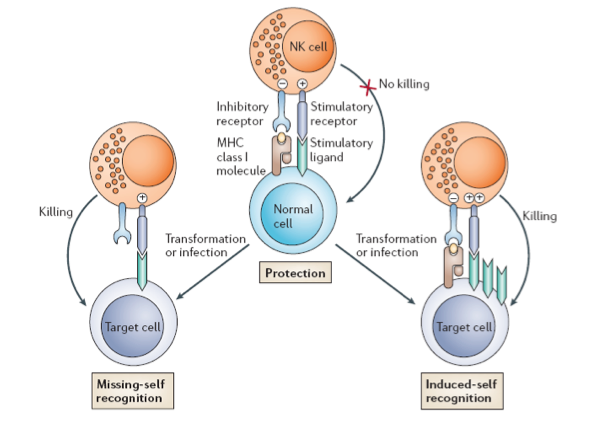
- 27ANTIGEN PROCESSING AND PRESENTATION1) PATHOGEN, PAMP, TLR (depending on the pathogen)
2) Particular APC depends on where the pathogen comes from:
A) MHC Class I: intracellular
B) MHC Class II: extracellular
3) T cell response/activation depending on corresponding MHC Class molecule
A) MHC Class I = CD8+ T cytotoxic (kill)
B) MHC Class II = CD4+ T helper (mediate killing, alert other T cells, etc.)