Fichas
Adaptive Immunity I
Fichas del conjunto (32)
- 1ANTIGEN PROCESSING/ PRESENTATIONADAPTIVE immunity driven by MHC Class I and MHC Class II molecules
1) MHC Class I: on ALL nucleated cells EXCEPT RBC's, intracellular (anybody can get a virus), CD8+ T cytotoxic cells
2) MHC Class II: PROFESSIONAL APC's (dendritic cells, macrophages, B cells), extracellular in vesicles, CD4+ T helper cells - 2INDUCTION & EFFECTOR PHASES OF CELL-MEDIATED IMMUNITY1. Uptake of antigen: APC'S
2. Recognition of antigen: HLA AND T cell receptor
3. Cellular expansion and differentiation: into effector and memory cells
4. Migration: interact w/other cells and go to site of infection
5. Exert cellular function - 3The IMMUNOLOGY LANGUAGE CD 3-8? CD 19-23?Cluster of Differentiation
>300 CDs
*MARKERS of particular cells
-organized in groups by cellular expression
CD3-8 = T cells
CD19-23 = B cells - 4CROSS-TALK b/w INNATE and ADAPTIVE*INNATE responses DRIVE ADAPTIVE immunity
*ADAPTIVE immune response ENHANCES INNATE immunity - 5PROFESSIONAL APC's Differences Dendritic: Macrophage: B cell:Dendritic: naive T cell activation (clonal expansion and differential into effector T cells)
Macrophages: Effector T cell activation = Macrophages are activated
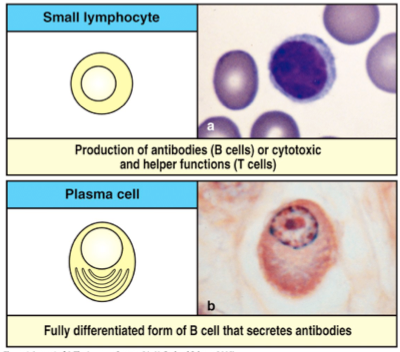
B cells: Effector T cell activation = B cell activation and antibody production (humoral response) - 6LYMPHOCYTES B lymphocytes T lymphocytesB and T cells important for ADAPTIVE immune response
- 7PHASES of T CELL RESPONSES*everything occurs in lymphoid organ EXCEPT Effector functions!
-Clonal expansion: have a few T cells SPECIFIC to one SPECIFIC antigen, then make MILLIONS of copies when activated
-Differentiation: 1) effector = direct function in time (CD8+) or mediation (CD4+)
2) Memory: not a lot of initial function, but allows for faster response when exposed again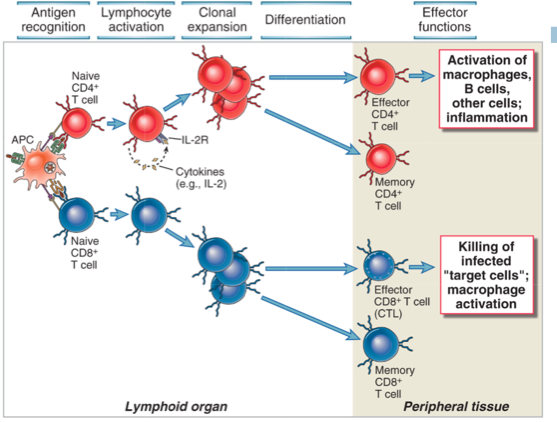
- 8THYMIC EDUCATION: CENTRAL TOLERANCET cells made in bone marrow but DEVELOP and MATURE in the THYMUS
TCR (T cell Receptor) specificities: randomly generated (to give rearrangements and diversity) many auto-reactive
T cells that recognize self components (self Ag's) in the thymus are removed
Non-self reactive cells selected, matured & exported - 9THYMIC EDUCATION: T CELL SELECTION Postive selectionPOSTITIVE SELECTION: Does it bind or not?
weak/no binding = DEATH
moderate/strong binding = LIVES and moves on to negative selection - 10THYMIC EDUCATION: T CELL SELECTION Negative selectionNEGATIVE SELECTION: How are you binding?
moderate binding = LIVES
TOO TIGHT = DIES (b/c self-reactive) - 11PERIPHERAL TOLERANCE "Post-thymic: continuing education"-not all self Ags present in the thymus
some auto-reactive cells CAN ESCAPE
Mechanisms
(more ways to keep it in CHECK):
-Inactivation (anergy)
-Suppression - 12Inactivation (anergy)do not respond to a particular antigen because you see it all the time
- 13SuppressionImmune-suppresive CYTOKINES
- 14T CELLS T HELPERHelper T cells (Th cells):
T cell Receptor (TCR)
CD4+
Produce cytokines & direct immune responses (mediating = quarterback)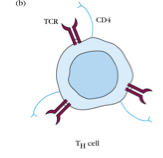
- 15T CELLS T CytotoxicCytotoxic T cells (Tc or CTL):
TCR+ (t cell receptor)
CD8+
Cytotoxic (does the KILLING) "soldiers"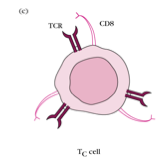
- 16CD4+ T helper cell subsetsnot direct killing: more mediating (MHC Class II)
TH IL17
TH1
TH2
TReg - 17CD4+ T helper cell subsets TH17IL17
PRO-INFLAMMATORY
PMN activation and defense against EXTRACELLULAR bacteria - 18CD4+ T helper cell subsets TH1Mainly IFN-Gamma (IL-2,TNF)
(ANTI-VIRAL) INTRACELLULAR microbes
macrophage activation - 19CD4+ T helper cell subsets TH2IL-4 and IL-5
(antibody production/macrophage activation)
IL 13
(helminth protection) - 20CD4+ T helper cell subsets T RegIL-10
(ANTI-Inflammatory)
TNF-Beta - 21CD8+ T cytotoxic Cells (CTL)-Activation leads to DEGRANULATION
MHC Class I (INTRACELLULAR)
Kill target cells mainly as a result of delivery of granule proteins into the target cells
2) Granzyme B: enzyme that triggers APOPTOSIS
1) Perforin: POKE HOLES
*Induction of cell death pathway via cell-cell interaction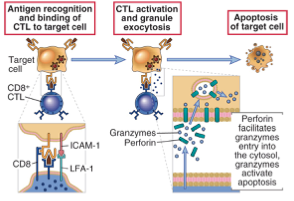
- 22T CELL ACTIVATION IL-2?CLONAL EXPANSION: Allows for generation of millions of cells specific for a particular antigen
**IL-2 = self-renewal and self-activating cytokine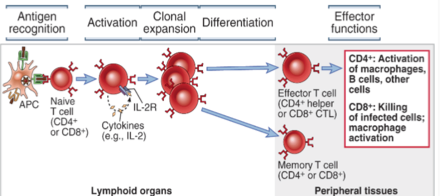
- 23T cell Activation OVERVIEW*CD8+ T cytotoxic cells: tend to expand A LOT MORE than CD4+ T helper cells
-CD4+ TH =quarter back w/larger net to throw out to coordinate the game plan, while the linemen (CD8+ Tcyt) execute the plan
*SET POINT is ALWAYS HIGHER than where you started due to MEMORY CELLS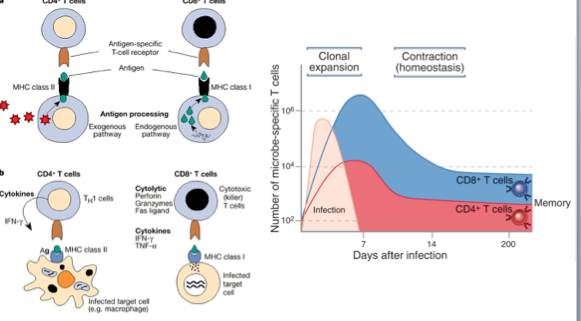
- 24T CELL ACTIVATION REQUIREMENTS*T cells require 3 SIGNALS!
-if they do not get all three signals, get angry and STOP responding (ANERGY)
Signal 1 = HLA and Antigen
Signal 2 = Co-stimulatory molecule interactions (CD20, CD28, CD86)
Signal 3 = Cytokines!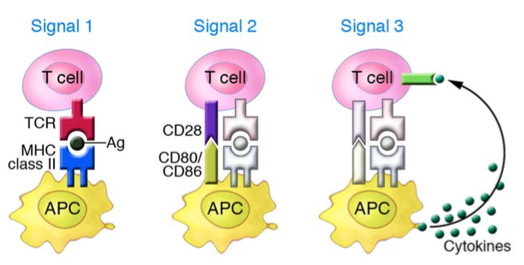
- 25T CELL FUNCTIONSCD4+ T Helper cells: Activate macrophages w/TNF-gamma cytokine
ALSO activate B cells so that B cells can become fully activated (optimally activated) for differentiation to occur (PLASMA cell)
-CD8+ Cytotoxic: directly kills (PERFORINS and GRANZYME B) - 26TH1 cell FUNCTIONSMOST IMPORTANT CYTOKINE – IFN-gamma
-Potent ACTIVATOR OF MACROPHAGES (also anti-viral)
Defect in TH1 lead to increase susceptibility to atypical mycobacteria
-Common in environment - 27TH2 cell FUNCTIONSMajor cytokines produced
IL-4 & IL-5 = antibody production
IL-10 =anti-inflammatory to turn OFF macrophages
-Efficacy of immune response determined by BALANCE between TH1/TH2 CELLS - 28REGULATORY T CELL INHIBITORY FUNCTIONSInhibit cellular functions through cytokine release of IL-10 (anti-inflammatory), TGF-β (A)
or
By direct cell-to-cell contact (D)
-STOP recognition of SIGNAL 2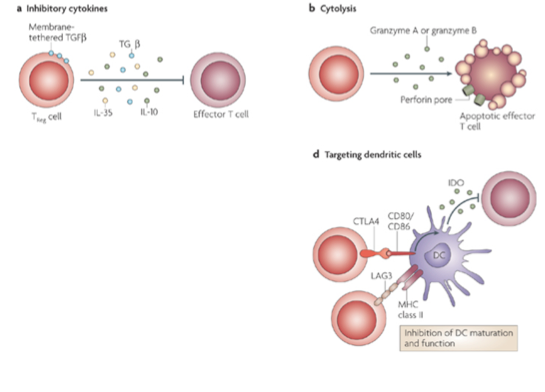
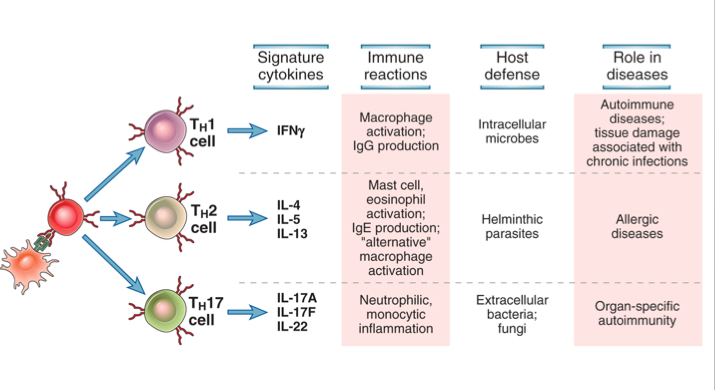
- 29T CELL SUBSETS SUMMARY
- 30IMMUNOLOGIC MEMORYHas to be SAME organism/pathogen (share SAME proteins)
-become activated more quickly and differentiate into effector cells to activate NOW - 31Immunologic Memory *Remember: the SET POINT is ALWAYS a little bit HIGHER than when you first encountered the antigen-Has to be the SAME pathogen/antigen
If you see an antigen 1st time: takes weeks to develop adaptive immune response
**2nd exposure to SAME antigen = Faster response and better quality (days instead of weeks)
-The MORE you do something the BETTER you get at it!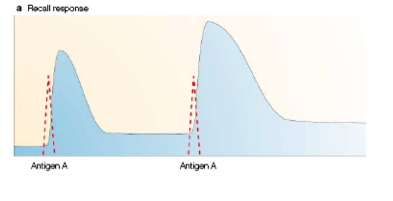
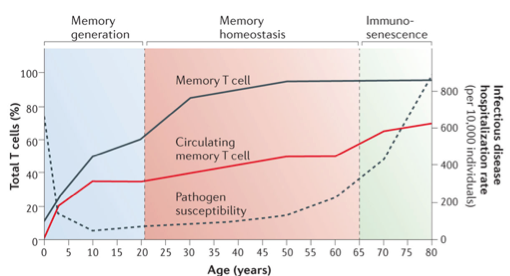
- 32MEMORY CELL and PATHOGEN SUSCEPTIBILITY*As you age, your memory T cell count INCREASES
BUT at age 65 and up: Immuno-senescence occurs and STOP making memory cells (why older people get sick easier)
-the SET POINT does not work as well anymore
ALSO, when you are born, your THYMUS is much bigger and @ 65 it is much smaller