
Fichas
Introductory Biology II: Nervous System
Fichas del conjunto (67)
- 13 meninges (in Humans)protective tissue that protect CNS; 3 layers include Dura Mater (outer), Arachnoid Mater (middle), and Pia Mater (inner)
- 2Cerebrospinal Fluidfluid-filled container that the brain floats in; NOT directly connected to blood
- 3(in mammals) CNS includes:brain and spinal cord
- 4(in mammals) PNS includes:neurons that communicate between CNS and periphery
- 5afferentincoming to the brain
- 6efferentoutgoing from the brain
- 7Cerebral Cortex featuressulci (folds) & gyri (smooth regions inbetween), both in a left and right hemisphere
- 8Spinal Nervesa part of the PERIPHERAL nervous system, carry signals between spinal cord and body
- 9Dorsal Rootswhere sensory information comes into the spinal nerves
- 10Dorsal Root Gangliacell bodies of sensory neurons located here (in PNS)
- 11Ventral Rootsmotor information leaves from here (in CNS)
- 12Congregations of neural cell bodiesGanglia
- 13NucleiMany ganglia within the brain
- 14Nissl Stainstains neurons, shows white vs grey matter in visual cortex
- 15White Matterlong bits of axon communication tracts between neurons
- 16Grey Mattercontains the cell bodies, dendrites, and axon terminals of neurons
- 17"The Neuron Doctrine"The idea that the brain is composed of individual cells
- 18Glial Cellscells that surround neurons in the CNS
- 19Glial Cell Functionsprovide support and protection to neurons, remove waste, supply nutrients, lay down axon tracts & provide charge
- 20Somacell body of neuron
- 21Dendritebranched part of neuron
- 22Myelintype of glial outgrowth that wraps around axons; helps speed up conduction and avoid degradation of signal
- 23Direction of information flow along neuron bodiesFROM the dendrites, along the axon, and TO the axon terminals
- 24ConductanceMeasure of an ion's ability to cross the membrane, can change by opening or closing ion channels
- 25How mV is measured:difference in charge "between the inside and the outside"
- 26Concentration DifferencesInfluences ions to diffuse down concentration gradient through open channels
- 27Electrical potential differenceNegative charged ions along inside and positive ions on outside --> attracts and repels ions across a membrane
- 28Ion PumpsNa+/K+ ATPase pumps Na+/K+ against their concentration/electrical gradient through this
- 29Concentration of Na+higher concentrations OUTSIDE the cell
- 30Concentration of K+higher concentrations INSIDE the cell
- 31At "rest" the membrane is permeable to this ionK+
- 32Resting Membrane Potentiala -70 mV charge produced by K+ leaving neurons through leak channels at rest & involvement of Na+/K+ ATPase
- 33Voltage Gated ChannelsReceptors that change conformation in response to cell depolarization/change in membrane potential
- 34Graded potentialsa small change in voltage, will decay along cell fibre if only passively conducted
- 35Action Potentialconformational change of voltage gated channel proteins releases Na+ into cell; activation gate opens after depolarization (-55mV) and then inactivation gate closes (at about +30mV); is the signal traveling across synapses!
- 36Threshold Potentialthe critical level to which a membrane potential must be depolarized in order to initiate an action potential
- 37Absolute Refractory periodperiod where it is impossible to start a second action potential, since a "reset" must first occur (activation gates close and inactivation gates open)
- 38Relative Refractory periodafter absolute refractory period, possible to generate AP but large stimulus needed
- 39hyper-polarizationbrief period before neuron reaches resting membrane potential once again, more polarized than at rest
- 40Direction of travel of Action PotentialFrom axon hillock to terminal boutons
- 41Unmyelinated AxonsSignal will degrade across these unless the axon diameter is large enough
- 42Types of glial cells that provide myelination for axonsOligodendrocytes and Schwann cells
- 43Nodes of Ranviergaps in myelin where voltage gated channels are located
- 44Myelin is composed of thisbilayers of phospholipids in glial cells
- 45Saltatory Conductionpropagation of action potentials along myelinated axons from one node to the next; can be considered "jumping"
- 46Synapsespoints of contact between nerve/nerve cells or nerve/muscle cells
- 47Electrical Synapsesgap junctions between plasma membranes of adjacent cells, bidirectional, instantaneous and direct transmission
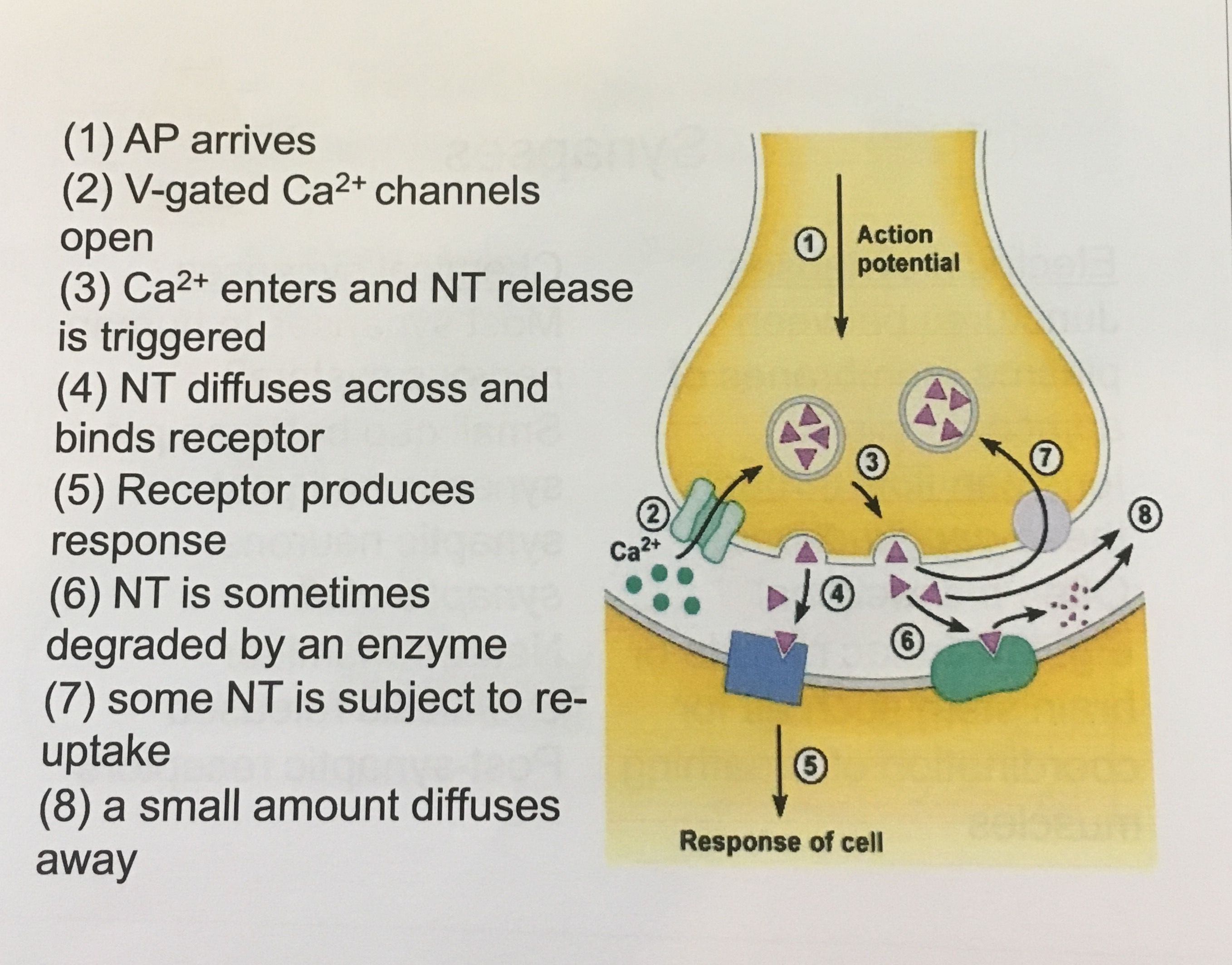
- 48Chemical synapsessynaptic clefts between pre- and post-synaptic neurons, neurotransmitter chemical released, unidirectional, delayed and excitatory/inhibitory transmission, humans mostly have this
- 49Activation of Chemical Synapses (step by step)
- 50Neurotransmitterschemicals that are released by one neuron and interact with a receptor on the synaptic partner
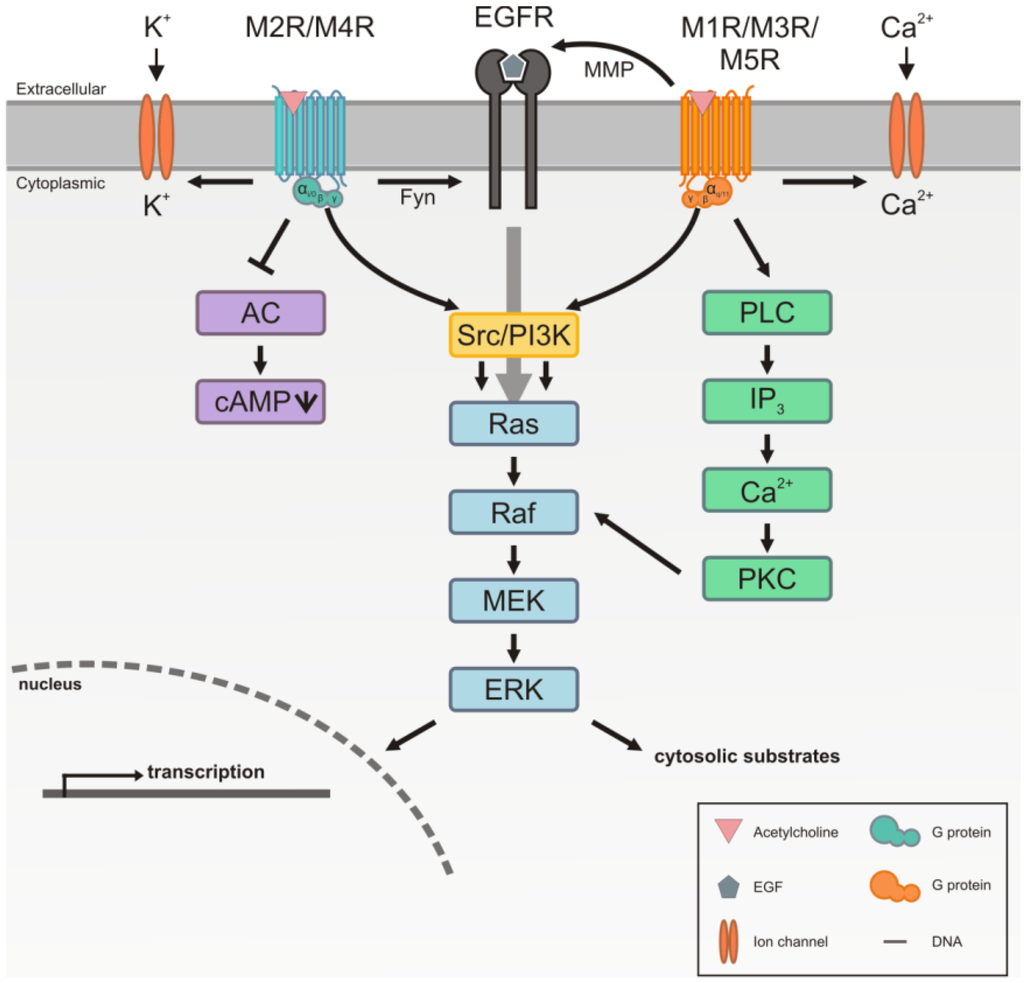
- 51Acetylcholine (ACh)main neurotransmitter at neuromuscular junctions, acts at nAChR and mAChR ion channel receptors
- 52Nicotinean agonist at nAChRs
- 53Muscarinean agonist at mAChRs
- 54Atropinean antagonist at mAChRs
- 55GABA-A receptorligand gated ion channel, when ligand bonds it conducts Cl- through its pore which hyper-polarizes the neuron and inhibits an action potential
*Picrotoxin blocks channel, can lead to convulsions* - 56D1 receptorsMetabotropic receptor that responds to bonding of dopamine --> G protein activates --> bonds to adenylyl cyclase (using ATP) --> produces cAMP--> downstream effects
- 57mAChRs5 subtypes of metabotropic receptors, inhibit cAMP and activate GTFs
- 58Photoreceptorscells in the eye that respond to light by change in voltage
- 59Rodsresponsible for vision at low light levels
- 60Conesresponsible for vision at higher light levels, capable of color vision and responsible for high spatial acuity
- 61Rhodopsinmembrane proteins that respond to different wavelengths of light
- 62Vitreous Humourgel space in between the lens (front) and the retina (back)
- 63Bipolar cellstransmit signals from photoreceptor cells to ganglion cells
*amacrine and horizontal cells help integrate the information* - 64Retinal Ganglion Cellsneurons in the inner surface of the retina; receive visual information from photoreceptors and then fire action potentials
- 65Optic Nervecomposed of retinal ganglion and glial cells; transmits all visual information from retina to the brain; FORM the optic nerve
- 66foveasmall pit packed with cones, responsible for sharp central vision
- 67Optic Chiasmwhere the "crossing over" of information occurs when being transmitted to the visual cortex
Información
- Descripción
- Nervous System pt 1 & 2
- Creado por
- Candice Young
- Visitas
- 37
- Etiquetas
- Valoración