
Mapa mental
i: immune system
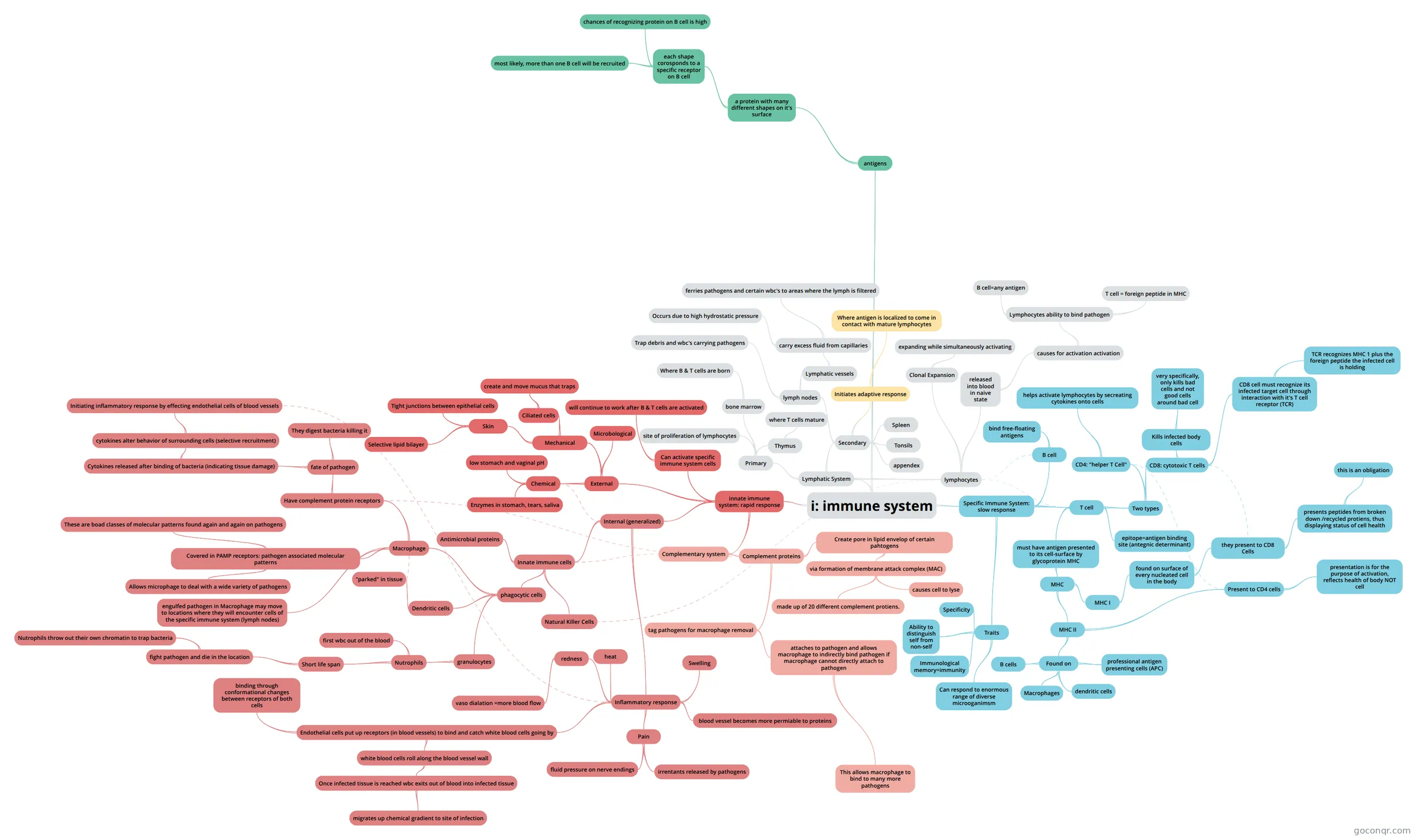
Mind map: immune system
Contenido del mapa
i: immune system
innate immune system: rapid response
- External
- Mechanical
- Skin
- Tight junctions between epithelial cells
- Selective lipid bilayer
- Ciliated cells
- create and move mucus that traps
- Skin
- Chemical
- low stomach and vaginal pH
- Enzymes in stomach, tears, saliva
- Microbological
- Mechanical
- Internal (generalized)
- Inflammatory response
- Endothelial cells put up receptors (in blood vessels) to bind and catch white blood cells going by
- white blood cells roll along the blood vessel wall
- Once infected tissue is reached wbc exits out of blood into infected tissue
- migrates up chemical gradient to site of infection
- Once infected tissue is reached wbc exits out of blood into infected tissue
- binding through conformational changes between receptors of both cells
- white blood cells roll along the blood vessel wall
- blood vessel becomes more permiable to proteins
- redness
- vaso dialation =more blood flow
- heat
- Swelling
- Pain
- fluid pressure on nerve endings
- irrentants released by pathogens
- Endothelial cells put up receptors (in blood vessels) to bind and catch white blood cells going by
- Innate immune cells
- Antimicrobial proteins
- Natural Killer Cells
- phagocytic cells
- Macrophage
- Have complement protein receptors
- fate of pathogen
- Cytokines released after binding of bacteria (indicating tissue damage)
- cytokines alter behavior of surrounding cells (selective recruitment)
- Initiating inflammatory response by effecting endothelial cells of blood vessels
- cytokines alter behavior of surrounding cells (selective recruitment)
- They digest bacteria killing it
- Cytokines released after binding of bacteria (indicating tissue damage)
- fate of pathogen
- Covered in PAMP receptors: pathogen associated molecular patterns
- These are boad classes of molecular patterns found again and again on pathogens
- Allows microphage to deal with a wide variety of pathogens
- engulfed pathogen in Macrophage may move to locations where they will encounter cells of the specific immune system (lymph nodes)
- Have complement protein receptors
- Dendritic cells
- "parked" in tissue
- granulocytes
- Nutrophils
- first wbc out of the blood
- Short life span
- fight pathogen and die in the location
- Nutrophils throw out their own chromatin to trap bacteria
- fight pathogen and die in the location
- Nutrophils
- Macrophage
- Inflammatory response
- Can activate specific immune system cells
- will continue to work after B & T cells are activated
- Complementary system
- Complement proteins
- tag pathogens for macrophage removal
- attaches to pathogen and allows macrophage to indirectly bind pathogen if macrophage cannot directly attach to pathogen
- This allows macrophage to bind to many more pathogens
- attaches to pathogen and allows macrophage to indirectly bind pathogen if macrophage cannot directly attach to pathogen
- Create pore in lipid envelop of certain pahtogens
- via formation of membrane attack complex (MAC)
- made up of 20 different complement protiens.
- causes cell to lyse
- via formation of membrane attack complex (MAC)
- tag pathogens for macrophage removal
- Complement proteins
- External
Specific Immune System: slow response
- Traits
- Specificity
- Can respond to enormous range of diverse microoganimsm
- Ability to distinguish self from non-self
- Immunological memory=immunity
- B cell
- bind free-floating antigens
- T cell
- Two types
- CD4: "helper T Cell"
- helps activate lymphocytes by secreating cytokines onto cells
- CD8: cytotoxic T cells
- Kills infected body cells
- very specifically, only kills bad cells and not good cells around bad cell
- CD8 cell must recognize its infected target cell through interaction with it's T cell receptor (TCR)
- TCR recognizes MHC 1 plus the foreign peptide the infected cell is holding
- Kills infected body cells
- CD4: "helper T Cell"
- must have antigen presented to its cell-surface by glycoprotein MHC
- Major Histocompatibility Complexes
- MHC
- MHC I
- found on surface of every nucleated cell in the body
- they present to CD8 Cells
- presents peptides from broken down /recycled protiens, thus displaying status of cell health
- this is an obligation
- presents peptides from broken down /recycled protiens, thus displaying status of cell health
- they present to CD8 Cells
- found on surface of every nucleated cell in the body
- MHC II
- Present to CD4 cells
- presentation is for the purpose of activation, reflects health of body NOT cell
- Found on
- professional antigen presenting cells (APC)
- B cells
- Macrophages
- dendritic cells
- Present to CD4 cells
- MHC I
- epitope=antigen binding site (antegnic determinant)
- Two types
- Traits
Lymphatic System
- Primary
- Thymus
- where T cells mature
- bone marrow
- Where B & T cells are born
- site of proliferation of lymphocytes
- Thymus
- Secondary
- lymph nodes
- Trap debris and wbc's carrying pathogens
- Lymphatic vessels
- carry excess fluid from capillaries
- Occurs due to high hydrostatic pressure
- ferries pathogens and certain wbc's to areas where the lymph is filtered
- carry excess fluid from capillaries
- Spleen
- Tonsils
- appendex
- Initiates adaptive response
- Where antigen is localized to come in contact with mature lymphocytes
- lymph nodes
- lymphocytes
- released into blood in naive state
- causes for activation activation
- Lymphocytes ability to bind pathogen
- B cell=any antigen
- T cell = foreign peptide in MHC
- Lymphocytes ability to bind pathogen
- causes for activation activation
- Clonal Expansion
- expanding while simultaneously activating
- released into blood in naive state
- Primary
antigens
- a protein with many different shapes on it's surface
- each shape corosponds to a specific receptor on B cell
- chances of recognizing protein on B cell is high
- most likely, more than one B cell will be recruited
- each shape corosponds to a specific receptor on B cell
- a protein with many different shapes on it's surface
Información
- Descripción
- I Biology Mapa Mental sobre i: immune system, creado por Christina . el 11/11/2017.
- Creado por
- Christina .
- Visitas
- 2
- Valoración
Más sobre Innate and adaptive immunity