
Mapa mental
Adaptations
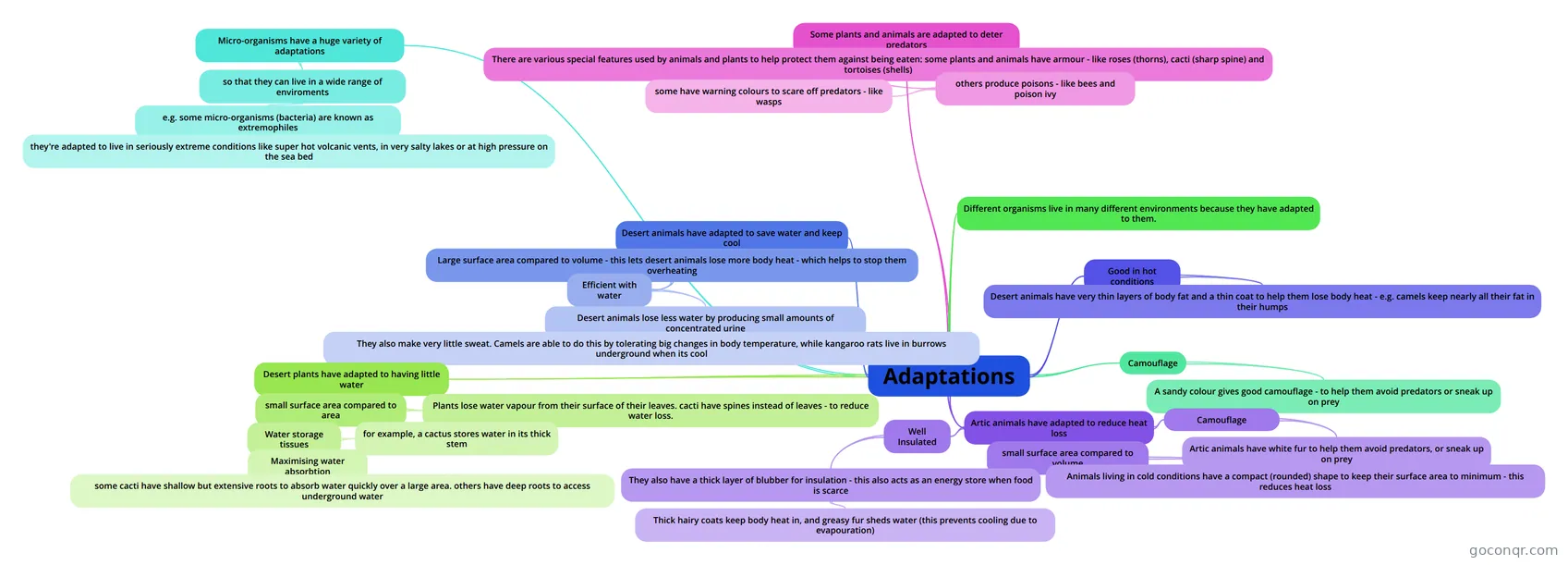
Mind map: Adaptations
Contenido del mapa
Adaptations
Different organisms live in many different environments because they have adapted to them.
Desert animals have adapted to save water and keep cool
- Large surface area compared to volume - this lets desert animals lose more body heat - which helps to stop them overheating
- Efficient with water
- Desert animals lose less water by producing small amounts of concentrated urine
- They also make very little sweat. Camels are able to do this by tolerating big changes in body temperature, while kangaroo rats live in burrows underground when its cool
- Desert animals lose less water by producing small amounts of concentrated urine
- Efficient with water
- Large surface area compared to volume - this lets desert animals lose more body heat - which helps to stop them overheating
Good in hot conditions
- Desert animals have very thin layers of body fat and a thin coat to help them lose body heat - e.g. camels keep nearly all their fat in their humps
Camouflage
- A sandy colour gives good camouflage - to help them avoid predators or sneak up on prey
Artic animals have adapted to reduce heat loss
- small surface area compared to volume
- Animals living in cold conditions have a compact (rounded) shape to keep their surface area to minimum - this reduces heat loss
- Well Insulated
- They also have a thick layer of blubber for insulation - this also acts as an energy store when food is scarce
- Thick hairy coats keep body heat in, and greasy fur sheds water (this prevents cooling due to evapouration)
- They also have a thick layer of blubber for insulation - this also acts as an energy store when food is scarce
- Camouflage
- Artic animals have white fur to help them avoid predators, or sneak up on prey
- small surface area compared to volume
Desert plants have adapted to having little water
- small surface area compared to area
- Plants lose water vapour from their surface of their leaves. cacti have spines instead of leaves - to reduce water loss.
- Water storage tissues
- for example, a cactus stores water in its thick stem
- Maximising water absorbtion
- some cacti have shallow but extensive roots to absorb water quickly over a large area. others have deep roots to access underground water
- small surface area compared to area
Some plants and animals are adapted to deter predators
- There are various special features used by animals and plants to help protect them against being eaten: some plants and animals have armour - like roses (thorns), cacti (sharp spine) and tortoises (shells)
- others produce poisons - like bees and poison ivy
- some have warning colours to scare off predators - like wasps
- others produce poisons - like bees and poison ivy
- There are various special features used by animals and plants to help protect them against being eaten: some plants and animals have armour - like roses (thorns), cacti (sharp spine) and tortoises (shells)
Micro-organisms have a huge variety of adaptations
- so that they can live in a wide range of enviroments
- e.g. some micro-organisms (bacteria) are known as extremophiles
- they're adapted to live in seriously extreme conditions like super hot volcanic vents, in very salty lakes or at high pressure on the sea bed
- e.g. some micro-organisms (bacteria) are known as extremophiles
- so that they can live in a wide range of enviroments
Información
- Descripción
- Mapa Mental sobre Adaptations, creado por Paige Knight el 12/06/2013.
- Creado por
- Paige Knight
- Visitas
- 24
- Valoración