
Mapa mental
A POISON TREE
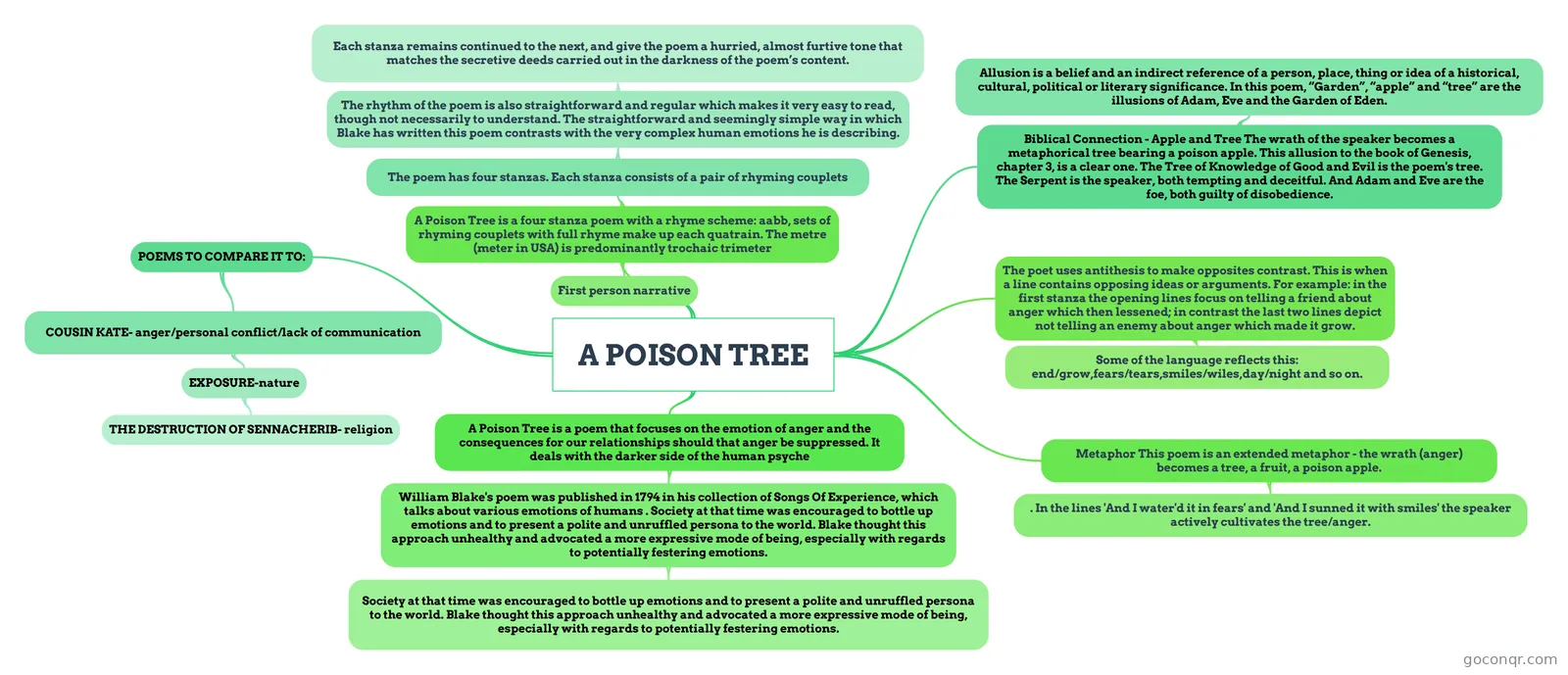
Mind map: A Poison Tree poem analysis
Contenido del mapa
A POISON TREE
A Poison Tree is a poem that focuses on the emotion of anger and the consequences for our relationships should that anger be suppressed. It deals with the darker side of the human psyche
- William Blake's poem was published in 1794 in his collection of Songs Of Experience, which talks about various emotions of humans . Society at that time was encouraged to bottle up emotions and to present a polite and unruffled persona to the world. Blake thought this approach unhealthy and advocated a more expressive mode of being, especially with regards to potentially festering emotions.
- Society at that time was encouraged to bottle up emotions and to present a polite and unruffled persona to the world. Blake thought this approach unhealthy and advocated a more expressive mode of being, especially with regards to potentially festering emotions.
- William Blake's poem was published in 1794 in his collection of Songs Of Experience, which talks about various emotions of humans . Society at that time was encouraged to bottle up emotions and to present a polite and unruffled persona to the world. Blake thought this approach unhealthy and advocated a more expressive mode of being, especially with regards to potentially festering emotions.
A Poison Tree is a four stanza poem with a rhyme scheme: aabb, sets of rhyming couplets with full rhyme make up each quatrain. The metre (meter in USA) is predominantly trochaic trimeter
- The poem has four stanzas. Each stanza consists of a pair of rhyming couplets
- The rhythm of the poem is also straightforward and regular which makes it very easy to read, though not necessarily to understand. The straightforward and seemingly simple way in which Blake has written this poem contrasts with the very complex human emotions he is describing.
- Each stanza remains continued to the next, and give the poem a hurried, almost furtive tone that matches the secretive deeds carried out in the darkness of the poem’s content.
- The rhythm of the poem is also straightforward and regular which makes it very easy to read, though not necessarily to understand. The straightforward and seemingly simple way in which Blake has written this poem contrasts with the very complex human emotions he is describing.
- First person narrative
- The poem has four stanzas. Each stanza consists of a pair of rhyming couplets
The poet uses antithesis to make opposites contrast. This is when a line contains opposing ideas or arguments. For example: in the first stanza the opening lines focus on telling a friend about anger which then lessened; in contrast the last two lines depict not telling an enemy about anger which made it grow.
- Some of the language reflects this: end/grow,fears/tears,smiles/wiles,day/night and so on.
Metaphor This poem is an extended metaphor - the wrath (anger) becomes a tree, a fruit, a poison apple.
- . In the lines 'And I water'd it in fears' and 'And I sunned it with smiles' the speaker actively cultivates the tree/anger.
Biblical Connection - Apple and Tree The wrath of the speaker becomes a metaphorical tree bearing a poison apple. This allusion to the book of Genesis, chapter 3, is a clear one. The Tree of Knowledge of Good and Evil is the poem's tree. The Serpent is the speaker, both tempting and deceitful. And Adam and Eve are the foe, both guilty of disobedience.
- Allusion is a belief and an indirect reference of a person, place, thing or idea of a historical, cultural, political or literary significance. In this poem, “Garden”, “apple” and “tree” are the illusions of Adam, Eve and the Garden of Eden.
POEMS TO COMPARE IT TO:
- COUSIN KATE- anger/personal conflict/lack of communication
- EXPOSURE-nature
- THE DESTRUCTION OF SENNACHERIB- religion
- EXPOSURE-nature
- COUSIN KATE- anger/personal conflict/lack of communication
Información
- Descripción
- GCSE English Mapa Mental sobre A POISON TREE, creado por Deanna Lendor el 26/08/2019.
- Creado por
- Deanna Lendor
- Visitas
- 3
- Valoración
Más sobre Songs of Innocence and of Experience