
Mapa mental
Liability in Negligence
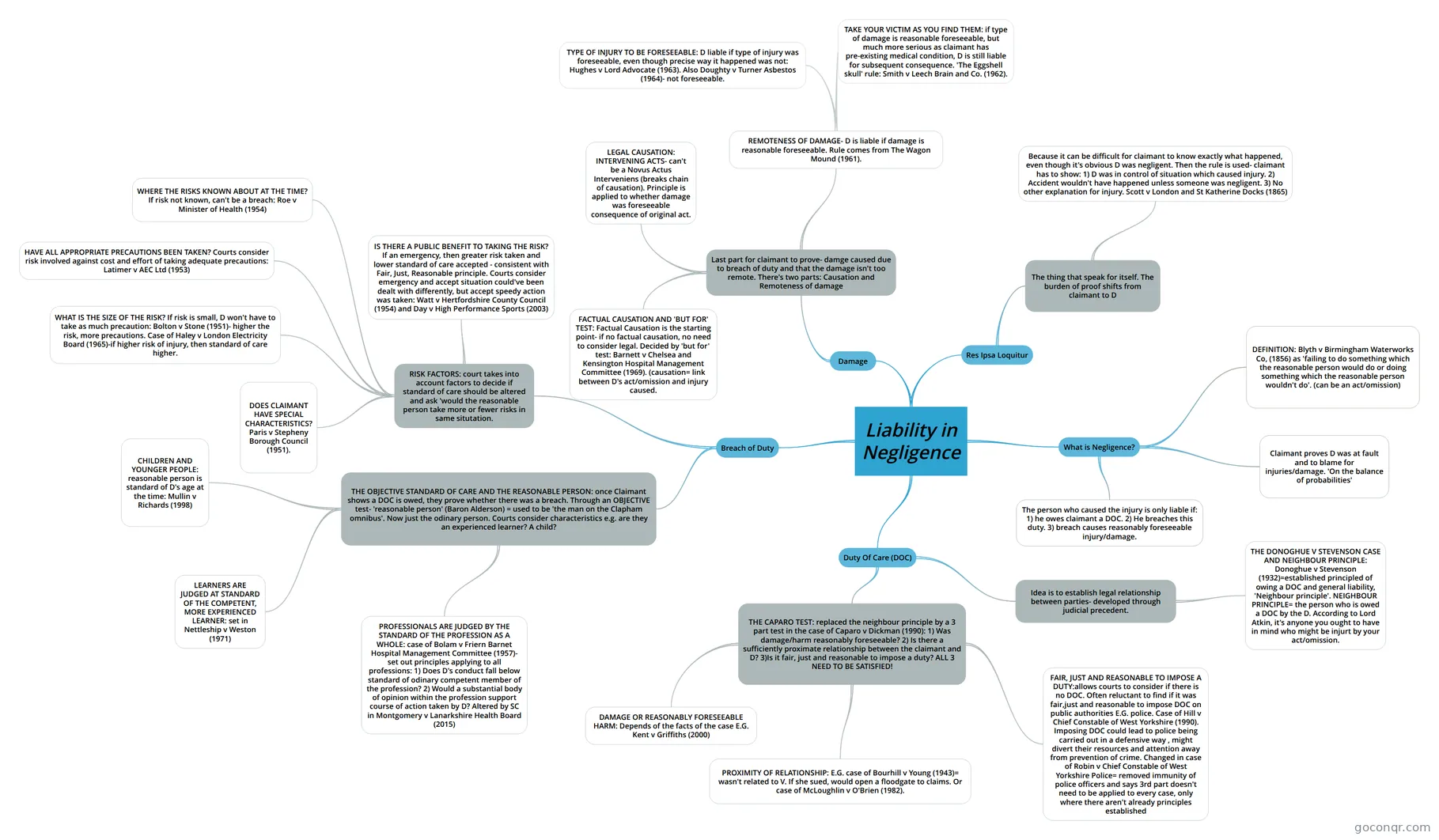
Mind map: Liability in negligence
Contenido del mapa
Liability in Negligence
What is Negligence?
- DEFINITION: Blyth v Birmingham Waterworks Co, (1856) as 'failing to do something which the reasonable person would do or doing something which the reasonable person wouldn't do'. (can be an act/omission)
- Claimant proves D was at fault and to blame for injuries/damage. 'On the balance of probabilities'
- The person who caused the injury is only liable if: 1) he owes claimant a DOC. 2) He breaches this duty. 3) breach causes reasonably foreseeable injury/damage.
Duty Of Care (DOC)
- Idea is to establish legal relationship between parties- developed through judicial precedent.
- THE DONOGHUE V STEVENSON CASE AND NEIGHBOUR PRINCIPLE: Donoghue v Stevenson (1932)=established principled of owing a DOC and general liability, 'Neighbour principle'. NEIGHBOUR PRINCIPLE= the person who is owed a DOC by the D. According to Lord Atkin, it's anyone you ought to have in mind who might be injurt by your act/omission.
- THE CAPARO TEST: replaced the neighbour principle by a 3 part test in the case of Caparo v Dickman (1990): 1) Was damage/harm reasonably foreseeable? 2) Is there a sufficiently proximate relationship between the claimant and D? 3)Is it fair, just and reasonable to impose a duty? ALL 3 NEED TO BE SATISFIED!
- DAMAGE OR REASONABLY FORESEEABLE HARM: Depends of the facts of the case E.G. Kent v Griffiths (2000)
- PROXIMITY OF RELATIONSHIP: E.G. case of Bourhill v Young (1943)= wasn't related to V. If she sued, would open a floodgate to claims. Or case of McLoughlin v O'Brien (1982).
- FAIR, JUST AND REASONABLE TO IMPOSE A DUTY:allows courts to consider if there is no DOC. Often reluctant to find if it was fair,just and reasonable to impose DOC on public authorities E.G. police. Case of Hill v Chief Constable of West Yorkshire (1990). Imposing DOC could lead to police being carried out in a defensive way , might divert their resources and attention away from prevention of crime. Changed in case of Robin v Chief Constable of West Yorkshire Police= removed immunity of police officers and says 3rd part doesn't need to be applied to every case, only where there aren't already principles established
- Idea is to establish legal relationship between parties- developed through judicial precedent.
Breach of Duty
- THE OBJECTIVE STANDARD OF CARE AND THE REASONABLE PERSON: once Claimant shows a DOC is owed, they prove whether there was a breach. Through an OBJECTIVE test- 'reasonable person' (Baron Alderson) = used to be 'the man on the Clapham omnibus'. Now just the odinary person. Courts consider characteristics e.g. are they an experienced learner? A child?
- PROFESSIONALS ARE JUDGED BY THE STANDARD OF THE PROFESSION AS A WHOLE: case of Bolam v Friern Barnet Hospital Management Committee (1957)- set out principles applying to all professions: 1) Does D's conduct fall below standard of odinary competent member of the profession? 2) Would a substantial body of opinion within the profession support course of action taken by D? Altered by SC in Montgomery v Lanarkshire Health Board (2015)
- LEARNERS ARE JUDGED AT STANDARD OF THE COMPETENT, MORE EXPERIENCED LEARNER: set in Nettleship v Weston (1971)
- CHILDREN AND YOUNGER PEOPLE: reasonable person is standard of D's age at the time: Mullin v Richards (1998)
- RISK FACTORS: court takes into account factors to decide if standard of care should be altered and ask 'would the reasonable person take more or fewer risks in same situtation.
- DOES CLAIMANT HAVE SPECIAL CHARACTERISTICS? Paris v Stepheny Borough Council (1951).
- WHAT IS THE SIZE OF THE RISK? If risk is small, D won't have to take as much precaution: Bolton v Stone (1951)- higher the risk, more precautions. Case of Haley v London Electricity Board (1965)-if higher risk of injury, then standard of care higher.
- HAVE ALL APPROPRIATE PRECAUTIONS BEEN TAKEN? Courts consider risk involved against cost and effort of taking adequate precautions: Latimer v AEC Ltd (1953)
- WHERE THE RISKS KNOWN ABOUT AT THE TIME? If risk not known, can't be a breach: Roe v Minister of Health (1954)
- IS THERE A PUBLIC BENEFIT TO TAKING THE RISK? If an emergency, then greater risk taken and lower standard of care accepted - consistent with Fair, Just, Reasonable principle. Courts consider emergency and accept situation could've been dealt with differently, but accept speedy action was taken: Watt v Hertfordshire County Council (1954) and Day v High Performance Sports (2003)
- THE OBJECTIVE STANDARD OF CARE AND THE REASONABLE PERSON: once Claimant shows a DOC is owed, they prove whether there was a breach. Through an OBJECTIVE test- 'reasonable person' (Baron Alderson) = used to be 'the man on the Clapham omnibus'. Now just the odinary person. Courts consider characteristics e.g. are they an experienced learner? A child?
Damage
- Last part for claimant to prove- damge caused due to breach of duty and that the damage isn't too remote. There's two parts: Causation and Remoteness of damage
- FACTUAL CAUSATION AND 'BUT FOR' TEST: Factual Causation is the starting point- if no factual causation, no need to consider legal. Decided by 'but for' test: Barnett v Chelsea and Kensington Hospital Management Committee (1969). (causation= link between D's act/omission and injury caused.
- LEGAL CAUSATION: INTERVENING ACTS- can't be a Novus Actus Interveniens (breaks chain of causation). Principle is applied to whether damage was foreseeable consequence of original act.
- REMOTENESS OF DAMAGE- D is liable if damage is reasonable foreseeable. Rule comes from The Wagon Mound (1961).
- TYPE OF INJURY TO BE FORESEEABLE: D liable if type of injury was foreseeable, even though precise way it happened was not: Hughes v Lord Advocate (1963). Also Doughty v Turner Asbestos (1964)- not foreseeable.
- TAKE YOUR VICTIM AS YOU FIND THEM: if type of damage is reasonable foreseeable, but much more serious as claimant has pre-existing medical condition, D is still liable for subsequent consequence. 'The Eggshell skull' rule: Smith v Leech Brain and Co. (1962).
- Last part for claimant to prove- damge caused due to breach of duty and that the damage isn't too remote. There's two parts: Causation and Remoteness of damage
Res Ipsa Loquitur
- The thing that speak for itself. The burden of proof shifts from claimant to D
- Because it can be difficult for claimant to know exactly what happened, even though it's obvious D was negligent. Then the rule is used- claimant has to show: 1) D was in control of situation which caused injury. 2) Accident wouldn't have happened unless someone was negligent. 3) No other explanation for injury. Scott v London and St Katherine Docks (1865)
- The thing that speak for itself. The burden of proof shifts from claimant to D
Información
- Descripción
- A level Law Mapa Mental sobre Liability in Negligence, creado por Olivia Godson el 24/04/2020.
- Creado por
- Olivia Godson
- Visitas
- 4
- Valoración