
Mapa mental
Respiration
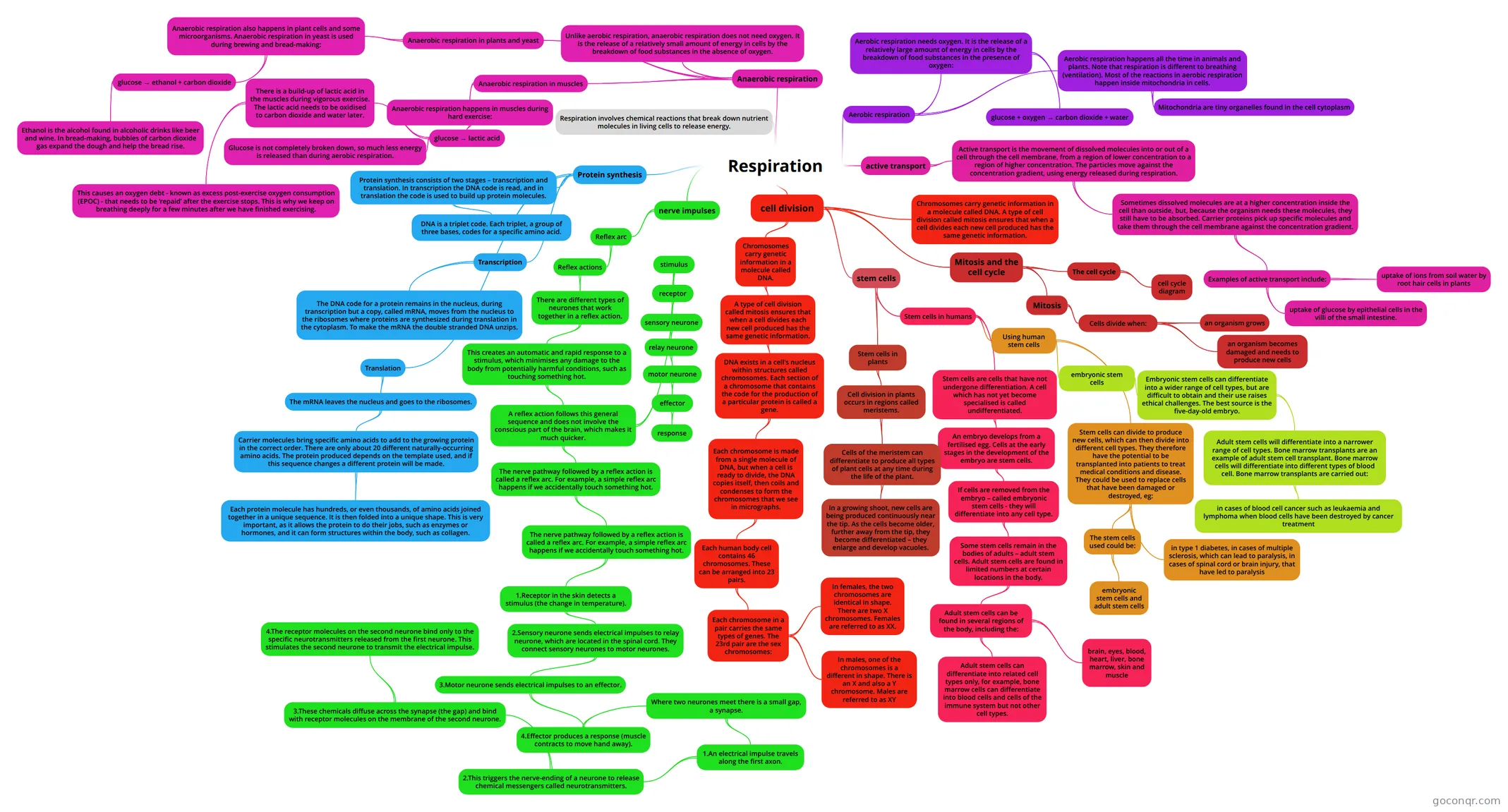
Mind map: Respiration
Contenido del mapa
Respiration
cell division
- Chromosomes carry genetic information in a molecule called DNA.
- A type of cell division called mitosis ensures that when a cell divides each new cell produced has the same genetic information.
- DNA exists in a cell's nucleus within structures called chromosomes. Each section of a chromosome that contains the code for the production of a particular protein is called a gene.
- Each chromosome is made from a single molecule of DNA, but when a cell is ready to divide, the DNA copies itself, then coils and condenses to form the chromosomes that we see in micrographs.
- Each human body cell contains 46 chromosomes. These can be arranged into 23 pairs.
- Each chromosome in a pair carries the same types of genes. The 23rd pair are the sex chromosomes:
- In females, the two chromosomes are identical in shape. There are two X chromosomes. Females are referred to as XX.
- In males, one of the chromosomes is a different in shape. There is an X and also a Y chromosome. Males are referred to as XY
- Each chromosome in a pair carries the same types of genes. The 23rd pair are the sex chromosomes:
- Each human body cell contains 46 chromosomes. These can be arranged into 23 pairs.
- Each chromosome is made from a single molecule of DNA, but when a cell is ready to divide, the DNA copies itself, then coils and condenses to form the chromosomes that we see in micrographs.
- DNA exists in a cell's nucleus within structures called chromosomes. Each section of a chromosome that contains the code for the production of a particular protein is called a gene.
- A type of cell division called mitosis ensures that when a cell divides each new cell produced has the same genetic information.
- Chromosomes carry genetic information in a molecule called DNA. A type of cell division called mitosis ensures that when a cell divides each new cell produced has the same genetic information.
- Mitosis and the cell cycle
- Mitosis
- Cells divide when:
- an organism grows
- an organism becomes damaged and needs to produce new cells
- Cells divide when:
- The cell cycle
- cell cycle diagram
- Mitosis
- stem cells
- Stem cells in humans
- Stem cells are cells that have not undergone differentiation. A cell which has not yet become specialised is called undifferentiated.
- An embryo develops from a fertilised egg. Cells at the early stages in the development of the embryo are stem cells.
- If cells are removed from the embryo – called embryonic stem cells - they will differentiate into any cell type.
- Some stem cells remain in the bodies of adults – adult stem cells. Adult stem cells are found in limited numbers at certain locations in the body.
- Adult stem cells can be found in several regions of the body, including the:
- brain, eyes, blood, heart, liver, bone marrow, skin and muscle
- Adult stem cells can differentiate into related cell types only, for example, bone marrow cells can differentiate into blood cells and cells of the immune system but not other cell types.
- Adult stem cells can be found in several regions of the body, including the:
- Some stem cells remain in the bodies of adults – adult stem cells. Adult stem cells are found in limited numbers at certain locations in the body.
- If cells are removed from the embryo – called embryonic stem cells - they will differentiate into any cell type.
- An embryo develops from a fertilised egg. Cells at the early stages in the development of the embryo are stem cells.
- Using human stem cells
- Stem cells can divide to produce new cells, which can then divide into different cell types. They therefore have the potential to be transplanted into patients to treat medical conditions and disease. They could be used to replace cells that have been damaged or destroyed, eg:
- in type 1 diabetes, in cases of multiple sclerosis, which can lead to paralysis, in cases of spinal cord or brain injury, that have led to paralysis
- The stem cells used could be:
- embryonic stem cells and adult stem cells
- embryonic stem cells
- Embryonic stem cells can differentiate into a wider range of cell types, but are difficult to obtain and their use raises ethical challenges. The best source is the five-day-old embryo.
- Adult stem cells will differentiate into a narrower range of cell types. Bone marrow transplants are an example of adult stem cell transplant. Bone marrow cells will differentiate into different types of blood cell. Bone marrow transplants are carried out:
- in cases of blood cell cancer such as leukaemia and lymphoma when blood cells have been destroyed by cancer treatment
- Adult stem cells will differentiate into a narrower range of cell types. Bone marrow transplants are an example of adult stem cell transplant. Bone marrow cells will differentiate into different types of blood cell. Bone marrow transplants are carried out:
- Embryonic stem cells can differentiate into a wider range of cell types, but are difficult to obtain and their use raises ethical challenges. The best source is the five-day-old embryo.
- Stem cells can divide to produce new cells, which can then divide into different cell types. They therefore have the potential to be transplanted into patients to treat medical conditions and disease. They could be used to replace cells that have been damaged or destroyed, eg:
- Stem cells are cells that have not undergone differentiation. A cell which has not yet become specialised is called undifferentiated.
- Stem cells in plants
- Cell division in plants occurs in regions called meristems.
- Cells of the meristem can differentiate to produce all types of plant cells at any time during the life of the plant.
- In a growing shoot, new cells are being produced continuously near the tip. As the cells become older, further away from the tip, they become differentiated – they enlarge and develop vacuoles.
- Cells of the meristem can differentiate to produce all types of plant cells at any time during the life of the plant.
- Cell division in plants occurs in regions called meristems.
- Stem cells in humans
- Chromosomes carry genetic information in a molecule called DNA.
Protein synthesis
- Protein synthesis consists of two stages – transcription and translation. In transcription the DNA code is read, and in translation the code is used to build up protein molecules.
- DNA is a triplet code. Each triplet, a group of three bases, codes for a specific amino acid.
- Transcription
- The DNA code for a protein remains in the nucleus, during transcription but a copy, called mRNA, moves from the nucleus to the ribosomes where proteins are synthesized during translation in the cytoplasm. To make the mRNA the double stranded DNA unzips.
- Translation
- The mRNA leaves the nucleus and goes to the ribosomes.
- Carrier molecules bring specific amino acids to add to the growing protein in the correct order. There are only about 20 different naturally-occurring amino acids. The protein produced depends on the template used, and if this sequence changes a different protein will be made.
- Each protein molecule has hundreds, or even thousands, of amino acids joined together in a unique sequence. It is then folded into a unique shape. This is very important, as it allows the protein to do their jobs, such as enzymes or hormones, and it can form structures within the body, such as collagen.
- Carrier molecules bring specific amino acids to add to the growing protein in the correct order. There are only about 20 different naturally-occurring amino acids. The protein produced depends on the template used, and if this sequence changes a different protein will be made.
- The mRNA leaves the nucleus and goes to the ribosomes.
- Protein synthesis consists of two stages – transcription and translation. In transcription the DNA code is read, and in translation the code is used to build up protein molecules.
active transport
- Active transport is the movement of dissolved molecules into or out of a cell through the cell membrane, from a region of lower concentration to a region of higher concentration. The particles move against the concentration gradient, using energy released during respiration.
- Sometimes dissolved molecules are at a higher concentration inside the cell than outside, but, because the organism needs these molecules, they still have to be absorbed. Carrier proteins pick up specific molecules and take them through the cell membrane against the concentration gradient.
- Examples of active transport include:
- uptake of glucose by epithelial cells in the villi of the small intestine.
- uptake of ions from soil water by root hair cells in plants
- Examples of active transport include:
- Sometimes dissolved molecules are at a higher concentration inside the cell than outside, but, because the organism needs these molecules, they still have to be absorbed. Carrier proteins pick up specific molecules and take them through the cell membrane against the concentration gradient.
- Active transport is the movement of dissolved molecules into or out of a cell through the cell membrane, from a region of lower concentration to a region of higher concentration. The particles move against the concentration gradient, using energy released during respiration.
nerve impulses
- Reflex arc
- Reflex actions
- There are different types of neurones that work together in a reflex action.
- This creates an automatic and rapid response to a stimulus, which minimises any damage to the body from potentially harmful conditions, such as touching something hot.
- A reflex action follows this general sequence and does not involve the conscious part of the brain, which makes it much quicker.
- stimulus
- receptor
- sensory neurone
- relay neurone
- motor neurone
- effector
- response
- effector
- motor neurone
- relay neurone
- sensory neurone
- receptor
- The nerve pathway followed by a reflex action is called a reflex arc. For example, a simple reflex arc happens if we accidentally touch something hot.
- The nerve pathway followed by a reflex action is called a reflex arc. For example, a simple reflex arc happens if we accidentally touch something hot.
- 1.Receptor in the skin detects a stimulus (the change in temperature).
- 2.Sensory neurone sends electrical impulses to relay neurone, which are located in the spinal cord. They connect sensory neurones to motor neurones.
- 3.Motor neurone sends electrical impulses to an effector.
- 4.Effector produces a response (muscle contracts to move hand away).
- Where two neurones meet there is a small gap, a synapse.
- 1.An electrical impulse travels along the first axon.
- 2.This triggers the nerve-ending of a neurone to release chemical messengers called neurotransmitters.
- 3.These chemicals diffuse across the synapse (the gap) and bind with receptor molecules on the membrane of the second neurone.
- 4.The receptor molecules on the second neurone bind only to the specific neurotransmitters released from the first neurone. This stimulates the second neurone to transmit the electrical impulse.
- 3.These chemicals diffuse across the synapse (the gap) and bind with receptor molecules on the membrane of the second neurone.
- 2.This triggers the nerve-ending of a neurone to release chemical messengers called neurotransmitters.
- 1.An electrical impulse travels along the first axon.
- Where two neurones meet there is a small gap, a synapse.
- 4.Effector produces a response (muscle contracts to move hand away).
- 3.Motor neurone sends electrical impulses to an effector.
- 2.Sensory neurone sends electrical impulses to relay neurone, which are located in the spinal cord. They connect sensory neurones to motor neurones.
- 1.Receptor in the skin detects a stimulus (the change in temperature).
- The nerve pathway followed by a reflex action is called a reflex arc. For example, a simple reflex arc happens if we accidentally touch something hot.
- stimulus
- A reflex action follows this general sequence and does not involve the conscious part of the brain, which makes it much quicker.
- This creates an automatic and rapid response to a stimulus, which minimises any damage to the body from potentially harmful conditions, such as touching something hot.
- There are different types of neurones that work together in a reflex action.
- Reflex actions
- Reflex arc
Respiration involves chemical reactions that break down nutrient molecules in living cells to release energy.
Aerobic respiration
- Aerobic respiration needs oxygen. It is the release of a relatively large amount of energy in cells by the breakdown of food substances in the presence of oxygen:
- glucose + oxygen → carbon dioxide + water
- Aerobic respiration happens all the time in animals and plants. Note that respiration is different to breathing (ventilation). Most of the reactions in aerobic respiration happen inside mitochondria in cells.
- Mitochondria are tiny organelles found in the cell cytoplasm
- Aerobic respiration needs oxygen. It is the release of a relatively large amount of energy in cells by the breakdown of food substances in the presence of oxygen:
Anaerobic respiration
- Unlike aerobic respiration, anaerobic respiration does not need oxygen. It is the release of a relatively small amount of energy in cells by the breakdown of food substances in the absence of oxygen.
- Anaerobic respiration in muscles
- Anaerobic respiration happens in muscles during hard exercise:
- glucose → lactic acid
- Glucose is not completely broken down, so much less energy is released than during aerobic respiration.
- There is a build-up of lactic acid in the muscles during vigorous exercise. The lactic acid needs to be oxidised to carbon dioxide and water later.
- This causes an oxygen debt - known as excess post-exercise oxygen consumption (EPOC) - that needs to be ‘repaid’ after the exercise stops. This is why we keep on breathing deeply for a few minutes after we have finished exercising.
- glucose → lactic acid
- Anaerobic respiration happens in muscles during hard exercise:
- Anaerobic respiration in plants and yeast
- Anaerobic respiration also happens in plant cells and some microorganisms. Anaerobic respiration in yeast is used during brewing and bread-making:
- glucose → ethanol + carbon dioxide
- Ethanol is the alcohol found in alcoholic drinks like beer and wine. In bread-making, bubbles of carbon dioxide gas expand the dough and help the bread rise.
- glucose → ethanol + carbon dioxide
- Anaerobic respiration also happens in plant cells and some microorganisms. Anaerobic respiration in yeast is used during brewing and bread-making:
Información
- Descripción
- Biology Mapa Mental sobre Respiration, creado por Harry Nash el 20/05/2020.
- Creado por
- Harry Nash
- Visitas
- 1
- Valoración