
Mapa mental
Rocks
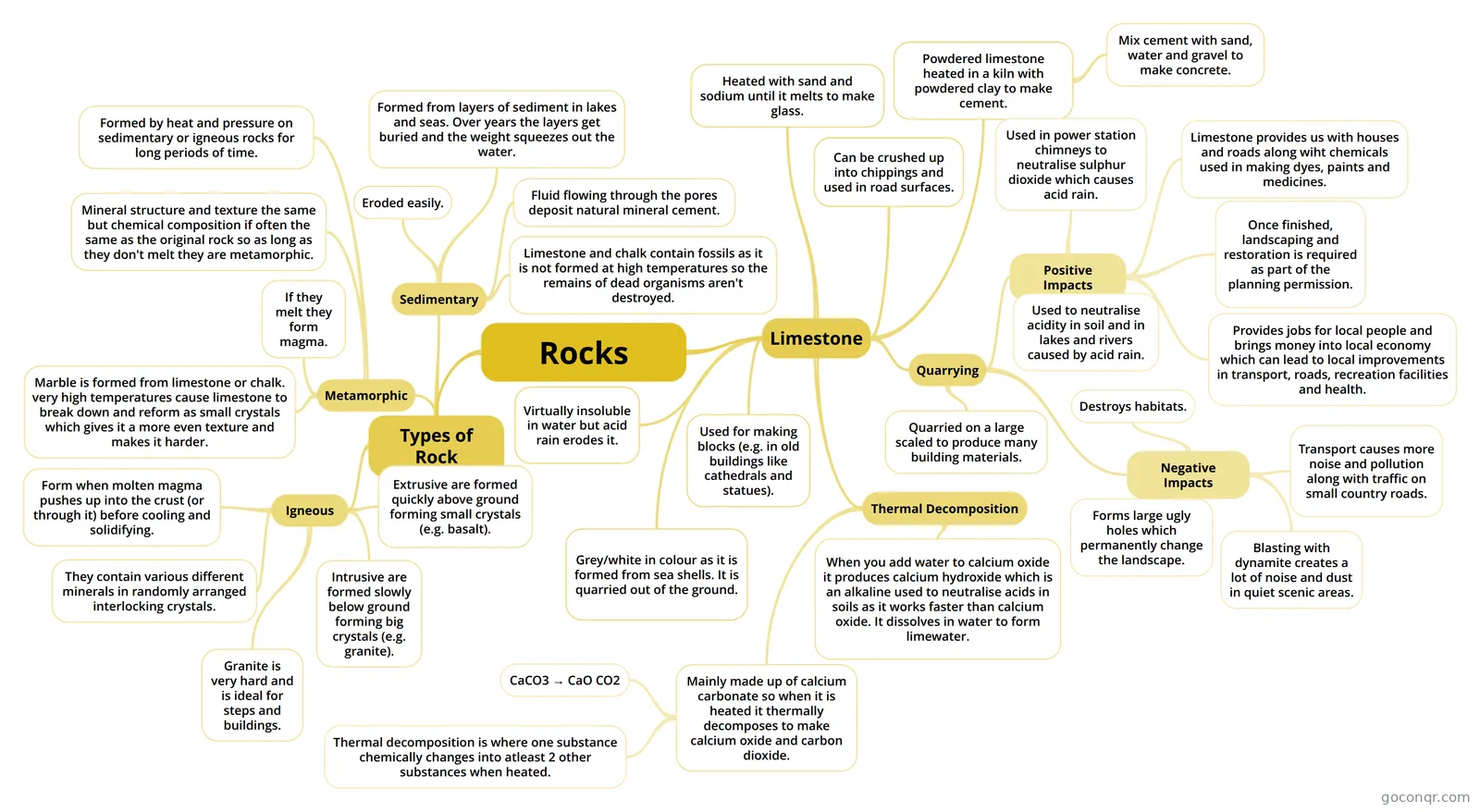
Mind map: rocks and limestone
Contenido del mapa
Rocks
Types of Rock
- Sedimentary
- Formed from layers of sediment in lakes and seas. Over years the layers get buried and the weight squeezes out the water.
- Fluid flowing through the pores deposit natural mineral cement.
- Limestone and chalk contain fossils as it is not formed at high temperatures so the remains of dead organisms aren't destroyed.
- Eroded easily.
- Metamorphic
- Formed by heat and pressure on sedimentary or igneous rocks for long periods of time.
- Mineral structure and texture the same but chemical composition if often the same as the original rock so as long as they don't melt they are metamorphic.
- If they melt they form magma.
- Marble is formed from limestone or chalk. very high temperatures cause limestone to break down and reform as small crystals which gives it a more even texture and makes it harder.
- Igneous
- Form when molten magma pushes up into the crust (or through it) before cooling and solidifying.
- They contain various different minerals in randomly arranged interlocking crystals.
- Extrusive are formed quickly above ground forming small crystals (e.g. basalt).
- Intrusive are formed slowly below ground forming big crystals (e.g. granite).
- Granite is very hard and is ideal for steps and buildings.
- Sedimentary
Limestone
- Grey/white in colour as it is formed from sea shells. It is quarried out of the ground.
- Used for making blocks (e.g. in old buildings like cathedrals and statues).
- Virtually insoluble in water but acid rain erodes it.
- Can be crushed up into chippings and used in road surfaces.
- Powdered limestone heated in a kiln with powdered clay to make cement.
- Mix cement with sand, water and gravel to make concrete.
- Heated with sand and sodium until it melts to make glass.
- Quarrying
- Quarried on a large scaled to produce many building materials.
- Negative Impacts
- Forms large ugly holes which permanently change the landscape.
- Blasting with dynamite creates a lot of noise and dust in quiet scenic areas.
- Destroys habitats.
- Transport causes more noise and pollution along with traffic on small country roads.
- Positive Impacts
- Limestone provides us with houses and roads along wiht chemicals used in making dyes, paints and medicines.
- Used to neutralise acidity in soil and in lakes and rivers caused by acid rain.
- Used in power station chimneys to neutralise sulphur dioxide which causes acid rain.
- Provides jobs for local people and brings money into local economy which can lead to local improvements in transport, roads, recreation facilities and health.
- Once finished, landscaping and restoration is required as part of the planning permission.
- Thermal Decomposition
- Mainly made up of calcium carbonate so when it is heated it thermally decomposes to make calcium oxide and carbon dioxide.
- CaCO3 → CaO CO2
- Thermal decomposition is where one substance chemically changes into atleast 2 other substances when heated.
- When you add water to calcium oxide it produces calcium hydroxide which is an alkaline used to neutralise acids in soils as it works faster than calcium oxide. It dissolves in water to form limewater.
- Mainly made up of calcium carbonate so when it is heated it thermally decomposes to make calcium oxide and carbon dioxide.
Información
- Descripción
- GCSE (C1) Chemistry Mapa Mental sobre Rocks, creado por rebeccachelsea el 21/03/2015.
- Creado por
- rebeccachelsea
- Visitas
- 1
- Valoración