
Mapa mental
Exercise Programmes for Different Clients
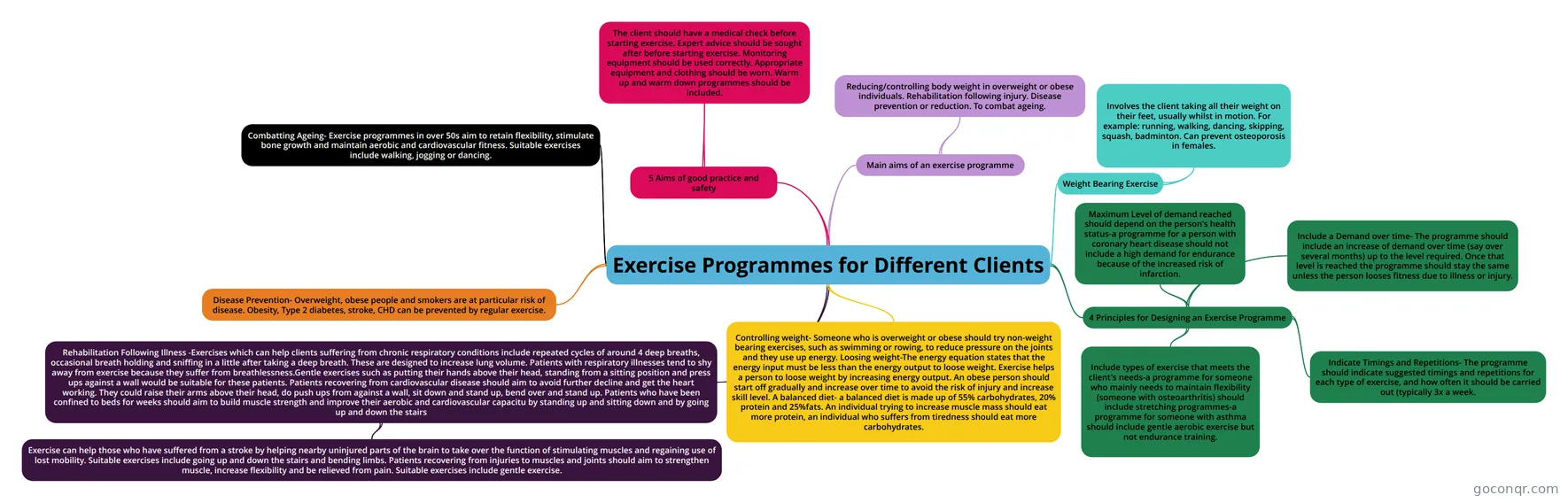
Mind map: Exercise programmes for different clients
Contenido del mapa
Exercise Programmes for Different Clients
5 Aims of good practice and safety
- The client should have a medical check before starting exercise. Expert advice should be sought after before starting exercise. Monitoring equipment should be used correctly. Appropriate equipment and clothing should be worn. Warm up and warm down programmes should be included.
Main aims of an exercise programme
- Reducing/controlling body weight in overweight or obese individuals. Rehabilitation following injury. Disease prevention or reduction. To combat ageing.
Weight Bearing Exercise
- Involves the client taking all their weight on their feet, usually whilst in motion. For example: running, walking, dancing, skipping, squash, badminton. Can prevent osteoporosis in females.
4 Principles for Designing an Exercise Programme
- Include types of exercise that meets the client's needs-a programme for someone who mainly needs to maintain flexibility (someone with osteoarthritis) should include stretching programmes-a programme for someone with asthma should include gentle aerobic exercise but not endurance training.
- Include a Demand over time- The programme should include an increase of demand over time (say over several months) up to the level required. Once that level is reached the programme should stay the same unless the person looses fitness due to illness or injury.
- Indicate Timings and Repetitions- The programme should indicate suggested timings and repetitions for each type of exercise, and how often it should be carried out (typically 3x a week.
- Maximum Level of demand reached should depend on the person's health status-a programme for a person with coronary heart disease should not include a high demand for endurance because of the increased risk of infarction.
Controlling weight- Someone who is overweight or obese should try non-weight bearing exercises, such as swimming or rowing, to reduce pressure on the joints and they use up energy. Loosing weight-The energy equation states that the energy input must be less than the energy output to loose weight. Exercise helps a person to loose weight by increasing energy output. An obese person should start off gradually and increase over time to avoid the risk of injury and increase skill level. A balanced diet- a balanced diet is made up of 55% carbohydrates, 20% protein and 25%fats. An individual trying to increase muscle mass should eat more protein, an individual who suffers from tiredness should eat more carbohydrates.
Rehabilitation Following Illness -Exercises which can help clients suffering from chronic respiratory conditions include repeated cycles of around 4 deep breaths, occasional breath holding and sniffing in a little after taking a deep breath. These are designed to increase lung volume. Patients with respiratory illnesses tend to shy away from exercise because they suffer from breathlessness.Gentle exercises such as putting their hands above their head, standing from a sitting position and press ups against a wall would be suitable for these patients. Patients recovering from cardiovascular disease should aim to avoid further decline and get the heart working. They could raise their arms above their head, do push ups from against a wall, sit down and stand up, bend over and stand up. Patients who have been confined to beds for weeks should aim to build muscle strength and improve their aerobic and cardiovascular capacitu by standing up and sitting down and by going up and down the stairs
- Exercise can help those who have suffered from a stroke by helping nearby uninjured parts of the brain to take over the function of stimulating muscles and regaining use of lost mobility. Suitable exercises include going up and down the stairs and bending limbs. Patients recovering from injuries to muscles and joints should aim to strengthen muscle, increase flexibility and be relieved from pain. Suitable exercises include gentle exercise.
Disease Prevention- Overweight, obese people and smokers are at particular risk of disease. Obesity, Type 2 diabetes, stroke, CHD can be prevented by regular exercise.
Combatting Ageing- Exercise programmes in over 50s aim to retain flexibility, stimulate bone growth and maintain aerobic and cardiovascular fitness. Suitable exercises include walking, jogging or dancing.
Información
- Descripción
- A Levels Health and Social Care Mapa Mental sobre Exercise Programmes for Different Clients, creado por Sarah Rose Humphreys el 28/05/2015.
- Creado por
- Sarah Rose Humphreys
- Visitas
- 0
- Valoración
Más sobre Exercise Screening and Prescription