
Mapa mental
Secrecy, Dishonesty and Deception
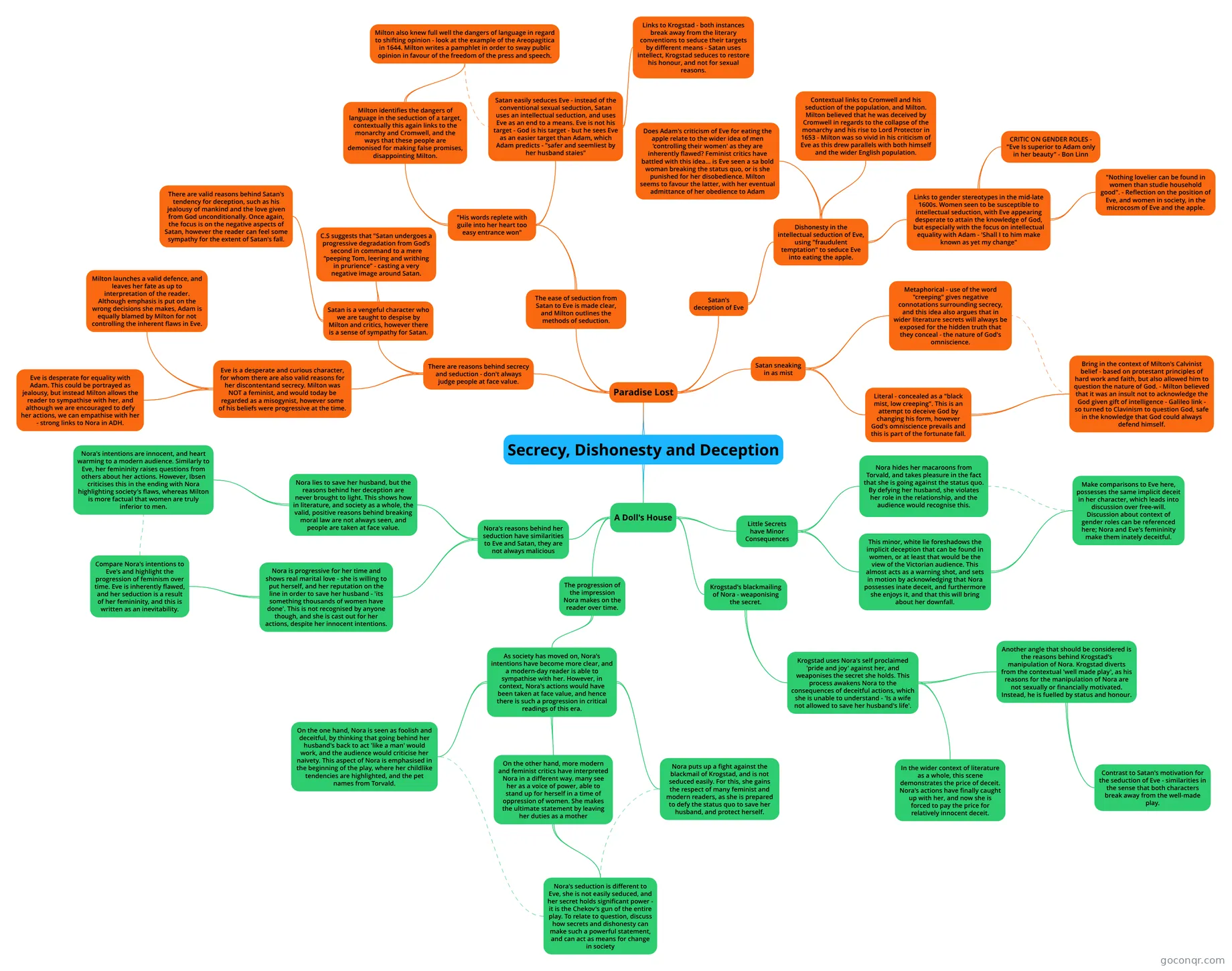
Mind map: Secrecy, dishonesty and deception
Contenido del mapa
Secrecy, Dishonesty and Deception
Paradise Lost
- Satan sneaking in as mist
- Literal - concealed as a "black mist, low creeping". This is an attempt to deceive God by changing his form, however God's omniscience prevails and this is part of the fortunate fall.
- Bring in the context of Milton's Calvinist belief - based on protestant principles of hard work and faith, but also allowed him to question the nature of God. - Milton believed that it was an insult not to acknowledge the God given gift of intelligence - Galileo link - so turned to Clavinism to question God, safe in the knowledge that God could always defend himself.
- Metaphorical - use of the word "creeping" gives negative connotations surrounding secrecy, and this idea also argues that in wider literature secrets will always be exposed for the hidden truth that they conceal - the nature of God's omniscience.
- Literal - concealed as a "black mist, low creeping". This is an attempt to deceive God by changing his form, however God's omniscience prevails and this is part of the fortunate fall.
- Satan's deception of Eve
- Dishonesty in the intellectual seduction of Eve, using "fraudulent temptation" to seduce Eve into eating the apple.
- Links to gender stereotypes in the mid-late 1600s. Women seen to be susceptible to intellectual seduction, with Eve appearing desperate to attain the knowledge of God, but especially with the focus on intellectual equality with Adam - 'Shall I to him make known as yet my change"
- CRITIC ON GENDER ROLES - "Eve Is superior to Adam only in her beauty" - Bon Linn
- "Nothing lovelier can be found in women than studie household good". - Reflection on the position of Eve, and women in society, in the microcosm of Eve and the apple.
- Contextual links to Cromwell and his seduction of the population, and Milton. Milton believed that he was deceived by Cromwell in regards to the collapse of the monarchy and his rise to Lord Protector in 1653 - Milton was so vivid in his criticism of Eve as this drew parallels with both himself and the wider English population.
- Does Adam's criticism of Eve for eating the apple relate to the wider idea of men 'controlling their women' as they are inherently flawed? Feminist critics have battled with this idea... is Eve seen a sa bold woman breaking the status quo, or is she punished for her disobedience. Milton seems to favour the latter, with her eventual admittance of her obedience to Adam
- Links to gender stereotypes in the mid-late 1600s. Women seen to be susceptible to intellectual seduction, with Eve appearing desperate to attain the knowledge of God, but especially with the focus on intellectual equality with Adam - 'Shall I to him make known as yet my change"
- Dishonesty in the intellectual seduction of Eve, using "fraudulent temptation" to seduce Eve into eating the apple.
- The ease of seduction from Satan to Eve is made clear, and Milton outlines the methods of seduction.
- "His words replete with guile into her heart too easy entrance won"
- Satan easily seduces Eve - instead of the conventional sexual seduction, Satan uses an intellectual seduction, and uses Eve as an end to a means. Eve is not his target - God is his target - but he sees Eve as an easier target than Adam, which Adam predicts - "safer and seemliest by her husband staies"
- Links to Krogstad - both instances break away from the literary conventions to seduce their targets by different means - Satan uses intellect, Krogstad seduces to restore his honour, and not for sexual reasons.
- Milton identifies the dangers of language in the seduction of a target, contextually this again links to the monarchy and Cromwell, and the ways that these people are demonised for making false promises, disappointing Milton.
- Milton also knew full well the dangers of language in regard to shifting opinion - look at the example of the Areopagitica in 1644. Milton writes a pamphlet in order to sway public opinion in favour of the freedom of the press and speech.
- Satan easily seduces Eve - instead of the conventional sexual seduction, Satan uses an intellectual seduction, and uses Eve as an end to a means. Eve is not his target - God is his target - but he sees Eve as an easier target than Adam, which Adam predicts - "safer and seemliest by her husband staies"
- "His words replete with guile into her heart too easy entrance won"
- There are reasons behind secrecy and seduction - don't always judge people at face value.
- Satan is a vengeful character who we are taught to despise by Milton and critics, however there is a sense of sympathy for Satan.
- C.S suggests that "Satan undergoes a progressive degradation from God’s second in command to a mere “peeping Tom, leering and writhing in prurience” - casting a very negative image around Satan.
- There are valid reasons behind Satan's tendency for deception, such as his jealousy of mankind and the love given from God unconditionally. Once again, the focus is on the negative aspects of Satan, however the reader can feel some sympathy for the extent of Satan's fall.
- Eve is a desperate and curious character, for whom there are also valid reasons for her discontentand secrecy. Milton was NOT a feminist, and would today be regarded as a misogynist, however some of his beliefs were progressive at the time.
- Milton launches a valid defence, and leaves her fate as up to interpretation of the reader. Although emphasis is put on the wrong decisions she makes, Adam is equally blamed by Milton for not controlling the inherent flaws in Eve.
- Eve is desperate for equality with Adam. This could be portrayed as jealousy, but instead Milton allows the reader to sympathise with her, and although we are encouraged to defy her actions, we can empathise with her - strong links to Nora in ADH.
- Satan is a vengeful character who we are taught to despise by Milton and critics, however there is a sense of sympathy for Satan.
- Satan sneaking in as mist
A Doll's House
- Little Secrets have Minor Consequences
- Nora hides her macaroons from Torvald, and takes pleasure in the fact that she is going against the status quo. By defying her husband, she violates her role in the relationship, and the audience would recognise this.
- This minor, white lie foreshadows the implicit deception that can be found in women, or at least that would be the view of the Victorian audience. This almost acts as a warning shot, and sets in motion by acknowledging that Nora possesses inate deceit, and furthermore she enjoys it, and that this will bring about her downfall.
- Make comparisons to Eve here, possesses the same implicit deceit in her character, which leads into discussion over free-will. Discussion about context of gender roles can be referenced here; Nora and Eve's femininity make them inately deceitful.
- Krogstad's blackmailing of Nora - weaponising the secret.
- Krogstad uses Nora's self proclaimed 'pride and joy' against her, and weaponises the secret she holds. This process awakens Nora to the consequences of deceitful actions, which she is unable to understand - 'Is a wife not allowed to save her husband's life'.
- In the wider context of literature as a whole, this scene demonstrates the price of deceit. Nora's actions have finally caught up with her, and now she is forced to pay the price for relatively innocent deceit.
- Another angle that should be considered is the reasons behind Krogstad's manipulation of Nora. Krogstad diverts from the contextual 'well made play', as his reasons for the manipulation of Nora are not sexually or financially motivated. Instead, he is fuelled by status and honour.
- Contrast to Satan's motivation for the seduction of Eve - similarities in the sense that both characters break away from the well-made play.
- Krogstad uses Nora's self proclaimed 'pride and joy' against her, and weaponises the secret she holds. This process awakens Nora to the consequences of deceitful actions, which she is unable to understand - 'Is a wife not allowed to save her husband's life'.
- Nora's reasons behind her seduction have similarities to Eve and Satan, they are not always malicious
- Nora lies to save her husband, but the reasons behind her deception are never brought to light. This shows how in literature, and society as a whole, the valid, positive reasons behind breaking moral law are not always seen, and people are taken at face value.
- Nora's intentions are innocent, and heart warming to a modern audience. Similarly to Eve, her femininity raises questions from others about her actions. However, Ibsen criticises this in the ending with Nora highlighting society's flaws, whereas Milton is more factual that women are truly inferior to men.
- Nora is progressive for her time and shows real marital love - she is willing to put herself, and her reputation on the line in order to save her husband - 'its something thousands of women have done'. This is not recognised by anyone though, and she is cast out for her actions, despite her innocent intentions.
- Compare Nora's intentions to Eve's and highlight the progression of feminism over time. Eve is inherently flawed, and her seduction is a result of her femininity, and this is written as an inevitability.
- Nora lies to save her husband, but the reasons behind her deception are never brought to light. This shows how in literature, and society as a whole, the valid, positive reasons behind breaking moral law are not always seen, and people are taken at face value.
- The progression of the impression Nora makes on the reader over time.
- As society has moved on, Nora's intentions have become more clear, and a modern-day reader is able to sympathise with her. However, in context, Nora's actions would have been taken at face value, and hence there is such a progression in critical readings of this era.
- On the one hand, Nora is seen as foolish and deceitful, by thinking that going behind her husband's back to act 'like a man' would work, and the audience would criticise her naivety. This aspect of Nora is emphasised in the beginning of the play, where her childlike tendencies are highlighted, and the pet names from Torvald.
- On the other hand, more modern and feminist critics have interpreted Nora in a different way. many see her as a voice of power, able to stand up for herself in a time of oppression of women. She makes the ultimate statement by leaving her duties as a mother
- Nora's seduction is different to Eve, she is not easily seduced, and her secret holds significant power - it is the Chekov's gun of the entire play. To relate to question, discuss how secrets and dishonesty can make such a powerful statement, and can act as means for change in society
- Nora puts up a fight against the blackmail of Krogstad, and is not seduced easily. For this, she gains the respect of many feminist and modern readers, as she is prepared to defy the status quo to save her husband, and protect herself.
- As society has moved on, Nora's intentions have become more clear, and a modern-day reader is able to sympathise with her. However, in context, Nora's actions would have been taken at face value, and hence there is such a progression in critical readings of this era.
- Little Secrets have Minor Consequences
Información
- Descripción
- A level English Mapa Mental sobre Secrecy, Dishonesty and Deception, creado por Adam Parkes el 26/04/2021.
- Creado por
- Adam Parkes
- Visitas
- 0
- Valoración
Más sobre Paradise Lost Themes