
Mapa mental
Viruses
Contenido del mapa
Viruses
What are they?
- Obligate, intracellular parasites (need living cells to replicate)
- Can't be grown in artificial culture media (unlike bacteria)
- Need to be cultured in live cells/within animal/embryonated eggs
- Can't be grown in artificial culture media (unlike bacteria)
- V. small (>300nm)
- Not visible via light microscopy, only by electron microscopy
- Consist of nucleic acids and proteins
- No mitochondria or ribosomes
- Only one type of nucleic acid: RNA or DNA
- Can be virion or virus
- Virion is the extracellular infectious particle
- Viruses are intracellular active form w/in cells
- Obligate, intracellular parasites (need living cells to replicate)
Structure?
- Viral genome=small so can encode only small no. structural genes -> identical repeating structural proteins used to form virion
- Capsomeres=type of repeating unit -> forms capsid around genome
- Called a nucleocapsid; takes diff. shapes
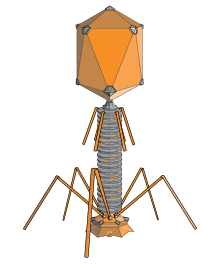
- Prolate (elongated icosahedral)
- Image shows an elongated icosahedral head of a bacteriophage. Consists of ten elongated triangles forming a cylinder, capped at each end with shorter triangles formed into a cap
- Often a component of bacteriophages
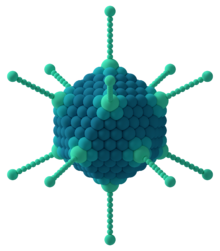
- Icosahedral
- Extremely common viral structure
- 20 triangular faces delimited by 12 fivefold vertexes, with 60 asymmetrical units. Thus icosahedral viruses are made up of 60N protein subunits
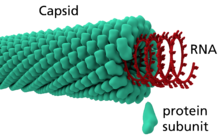
- Helical
- Composed of a single type of capsomere stacked around central axis
- Forms rod shaped viruses commonly
- Some viruses have complex capsids formed of combinations of diff. shapes + additional structures (protein tails/ complex outer wall/etc)
- Prolate (elongated icosahedral)
- Functions of a (nucleo)capsid
- Protect the genome (from lethal chemical/physical agents)
- Natural radiation
- Temperature extremes
- pH extremes
- Proteolytic/ nucleolytic enzymes
- Deliver the genome (into host cell)
- Interact with the host cell
- Protect the genome (from lethal chemical/physical agents)
- Some viruses envelope themselves in a modified form of the host cell membrane (external or intracellular) -> viral envelope, acts as capsid
- Called a nucleocapsid; takes diff. shapes
- Capsomeres=type of repeating unit -> forms capsid around genome
- Viral genome
- Enormous variety seen between viral species
- Viral genome=small so can encode only small no. structural genes -> identical repeating structural proteins used to form virion
How do they replicate?
- Not via division -> acellular
- They make copies using host cell machinery + metabolism
- Lifecycle varies greatly btwn species but some steps preserved
- Six basic steps can be applied to most viruses
- Attachment
- Specific binding btwn viral capsid proteins and specific receptors on host cellular surface This determines host cell specificity and developed so that virions only infect cells they can replicate in (any viral particles that infected hosts they could not replicate in did not spread and so died out/adapted quickly).Successful attachment results in induction of changes to the viral envelope which causes fusion of viral and host cell membrane OR changes to non-enveloped viral surface proteins that allow the virus to enter
- Penetration/ Viral entry
- Virions enter host cell via receptor mediated endocytosis or membrane fusion. Different for plant cells/bacteria/fungi. plant cells/fungi=strong cell wall, viruses usually only enter when cell wall damaged. Bacteria also have strong cell walls but less strong so some specialised viruses can inject themselves directly into cell,, shedding capsid before entry. Bacteria
- Uncoating
- Process by which the viral capsid is removed (if not left outside host) Might happen via degradation by viral or host enzymes or by simple dissociation - end result is release of viral genomic nucleic acids.
- Replication
- Primarily involves multiplication of the viral genome. Starts with immediate early genes which code for the early genes. Early genes allow for the synthesis of mRNA (except in positive-sense RNA viruses). Then viral protein synthesis, sometimes protein assembly, viral genome replication mediated by early or regulatory protein expression. If virus is complex, this could be followed with more rounds of mRNA synthesis. Late gene expression usually occurs in structural or virion proteins.
- Assembly
- Following mediated self-assembly process viruses undergo, some modification of proteins may occur. In some viruses (i.e. HIV) this modification. known as maturation, occurs after the viral particles have been released.
- Release
- Virus often released from host cell by lysis. Lysis is a process which kills the cell and frees the virus by bursting the cell membrane and wall if present. Some viruses undergo a lysogenic cycle. Viral genome incorporated by genetic recombination into a specific place on a host chromosome. This is known then as a provirus (or prophage in bacteria). Whenever the host cell divides, viral genome replicated with it. In this case, viral genome silent within host for varying amounts of time. At some point might give rise to active virus which may lyse the host cells. Alternatively, enveloped viruses are released from host cell by budding. During budding, virus gains its envelope, derived from host cell plasma membrane or organelle membrane. .
- The genetic material within a virus and the method by which it is replicated varies considerably between diff. types of virus
- Uses virus receptors on host cells
- Specific molecule on surface of cell which a virus attaches to prior to penetration/viral entry
- Attachment
- Six basic steps can be applied to most viruses
Imágenes y archivos del mapa
Información
- Descripción
- Undergrad Medical Microbiology Mapa Mental sobre Viruses, creado por Liberty Grisman-Hughes el 04/10/2021.
- Creado por
- Liberty Grisman-Hughes
- Visitas
- 1
- Valoración