
Mapa mental
Observational Methods and Techniques
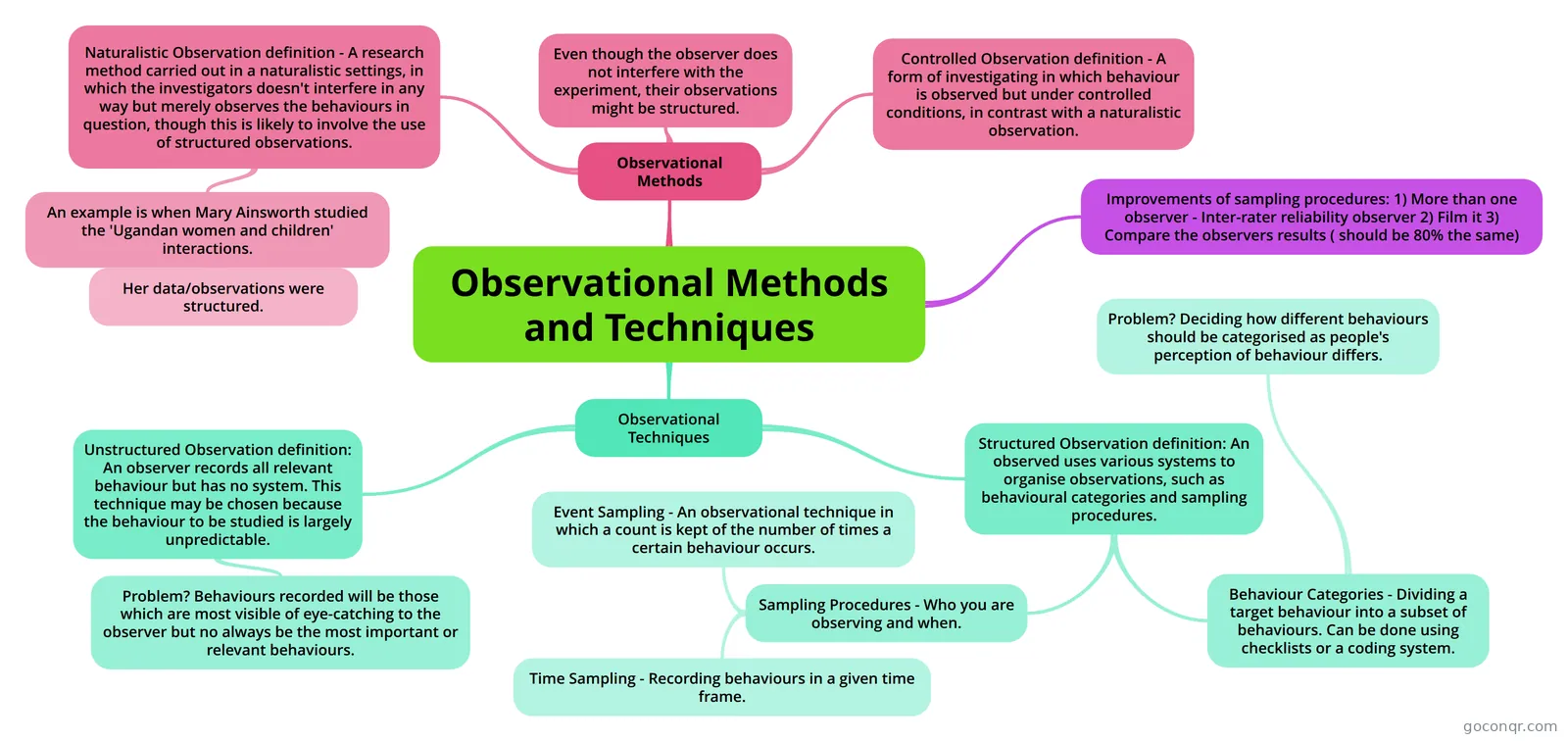
Mind map: Observational methods and techniques
Contenido del mapa
Observational Methods and Techniques
Observational Methods
- Naturalistic Observation definition - A research method carried out in a naturalistic settings, in which the investigators doesn't interfere in any way but merely observes the behaviours in question, though this is likely to involve the use of structured observations.
- An example is when Mary Ainsworth studied the 'Ugandan women and children' interactions.
- Her data/observations were structured.
- An example is when Mary Ainsworth studied the 'Ugandan women and children' interactions.
- Even though the observer does not interfere with the experiment, their observations might be structured.
- Controlled Observation definition - A form of investigating in which behaviour is observed but under controlled conditions, in contrast with a naturalistic observation.
- Naturalistic Observation definition - A research method carried out in a naturalistic settings, in which the investigators doesn't interfere in any way but merely observes the behaviours in question, though this is likely to involve the use of structured observations.
Observational Techniques
- Unstructured Observation definition: An observer records all relevant behaviour but has no system. This technique may be chosen because the behaviour to be studied is largely unpredictable.
- Problem? Behaviours recorded will be those which are most visible of eye-catching to the observer but no always be the most important or relevant behaviours.
- Structured Observation definition: An observed uses various systems to organise observations, such as behavioural categories and sampling procedures.
- Behaviour Categories - Dividing a target behaviour into a subset of behaviours. Can be done using checklists or a coding system.
- Problem? Deciding how different behaviours should be categorised as people's perception of behaviour differs.
- Sampling Procedures - Who you are observing and when.
- Event Sampling - An observational technique in which a count is kept of the number of times a certain behaviour occurs.
- Time Sampling - Recording behaviours in a given time frame.
- Behaviour Categories - Dividing a target behaviour into a subset of behaviours. Can be done using checklists or a coding system.
- Unstructured Observation definition: An observer records all relevant behaviour but has no system. This technique may be chosen because the behaviour to be studied is largely unpredictable.
Improvements of sampling procedures: 1) More than one observer - Inter-rater reliability observer 2) Film it 3) Compare the observers results ( should be 80% the same)
Información
- Descripción
- A-Level (Research Methods) Psychology Mapa Mental sobre Observational Methods and Techniques, creado por Lily Gray el 10/11/2013.
- Creado por
- Lily Gray
- Visitas
- 91
- Etiquetas
- Valoración