
Mapa mental
Contemporary Media
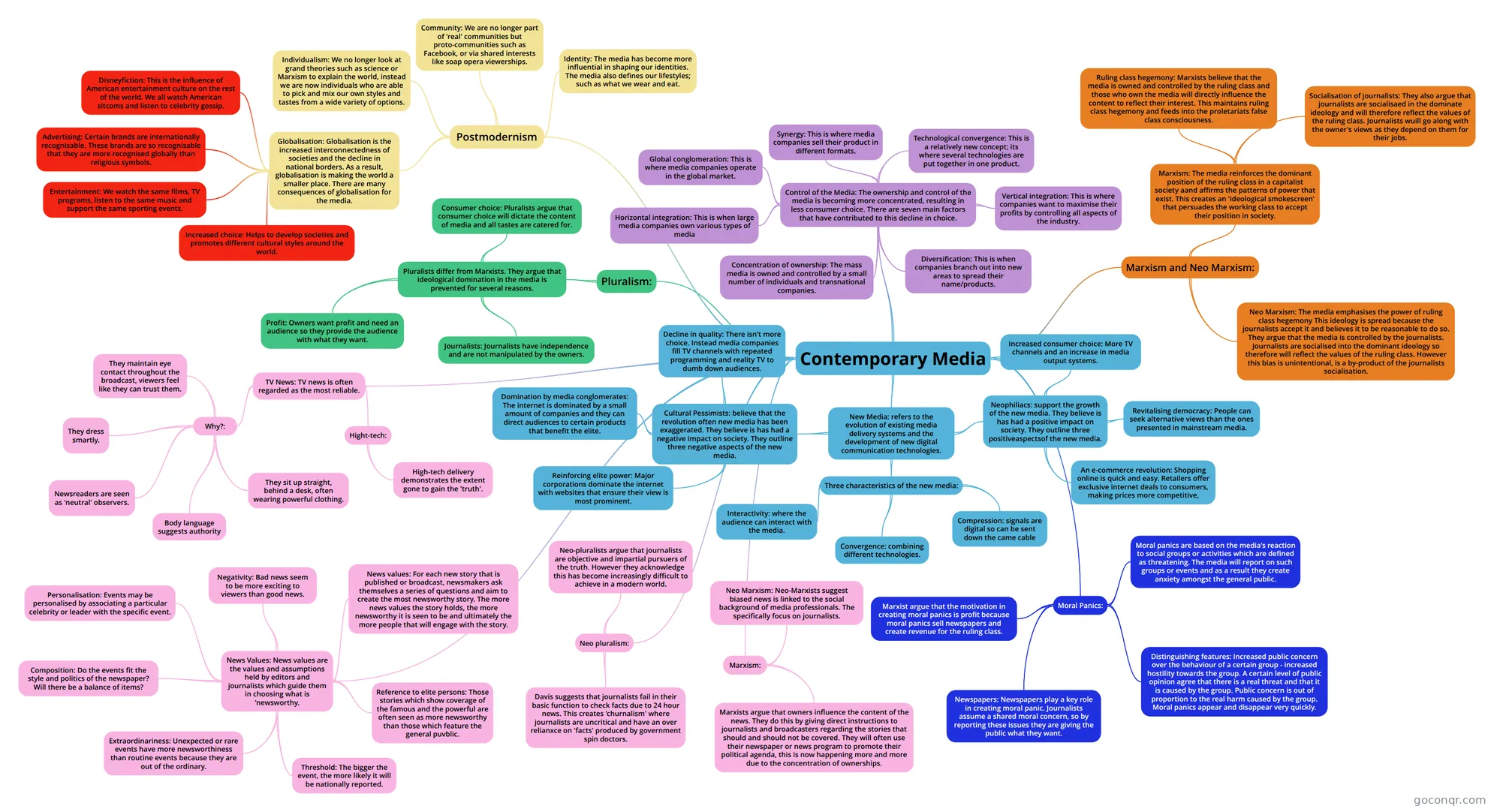
Mind map: Contemporary media
Contenido del mapa
Contemporary Media
New Media: refers to the evolution of existing media delivery systems and the development of new digital communication technologies.
- Three characteristics of the new media:
- Convergence: combining different technologies.
- Compression: signals are digital so can be sent down the came cable
- Interactivity: where the audience can interact with the media.
- Neophiliacs: support the growth of the new media. They believe is has had a positive impact on society. They outline three positiveaspectsof the new media.
- An e-commerce revolution: Shopping online is quick and easy. Retailers offer exclusive internet deals to consumers, making prices more competitive,
- Revitalising democracy: People can seek alternative views than the ones presented in mainstream media.
- Increased consumer choice: More TV channels and an increase in media output systems.
- Cultural Pessimists: believe that the revolution often new media has been exaggerated. They believe is has had a negative impact on society. They outline three negative aspects of the new media.
- Domination by media conglomerates: The internet is dominated by a small amount of companies and they can direct audiences to certain products that benefit the elite.
- Decline in quality: There isn't more choice. Instead media companies fill TV channels with repeated programming and reality TV to dumb down audiences.
- Reinforcing elite power: Major corporations dominate the internet with websites that ensure their view is most prominent.
- Three characteristics of the new media:
Control of the Media: The ownership and control of the media is becoming more concentrated, resulting in less consumer choice. There are seven main factors that have contributed to this decline in choice.
- Concentration of ownership: The mass media is owned and controlled by a small number of individuals and transnational companies.
- Horizontal integration: This is when large media companies own various types of media
- Global conglomeration: This is where media companies operate in the global market.
- Diversification: This is when companies branch out into new areas to spread their name/products.
- Vertical integration: This is where companies want to maximise their profits by controlling all aspects of the industry.
- Technological convergence: This is a relatively new concept; its where several technologies are put together in one product.
- Synergy: This is where media companies sell their product in different formats.
Marxism and Neo Marxism:
- Marxism: The media reinforces the dominant position of the ruling class in a capitalist society aand affirms the patterns of power that exist. This creates an 'ideological smokescreen' that persuades the working class to accept their position in society.
- Ruling class hegemony: Marxists believe that the media is owned and controlled by the ruling class and those who own the media will directly influence the content to reflect their interest. This maintains ruling class hegemony and feeds into the proletariats false class consciousness.
- Socialisation of journalists: They also argue that journalists are socialisaed in the dominate ideology and will therefore reflect the values of the ruling class. Journalists wuill go along with the owner's views as they depend on them for their jobs.
- Neo Marxism: The media emphasises the power of ruling class hegemony This ideology is spread because the journalists accept it and believes it to be reasonable to do so. They argue that the media is controlled by the journalists. Journalists are socialised into the dominant ideology so therefore will reflect the values of the ruling class. However this bias is unintentional, is a by-product of the journalists socialisation.
- Marxism: The media reinforces the dominant position of the ruling class in a capitalist society aand affirms the patterns of power that exist. This creates an 'ideological smokescreen' that persuades the working class to accept their position in society.
Pluralism:
- Pluralists differ from Marxists. They argue that ideological domination in the media is prevented for several reasons.
- Consumer choice: Pluralists argue that consumer choice will dictate the content of media and all tastes are catered for.
- Profit: Owners want profit and need an audience so they provide the audience with what they want.
- Journalists: Journalists have independence and are not manipulated by the owners.
- Pluralists differ from Marxists. They argue that ideological domination in the media is prevented for several reasons.
Postmodernism
- Globalisation: Globalisation is the increased interconnectedness of societies and the decline in national borders. As a result, globalisation is making the world a smaller place. There are many consequences of globalisation for the media.
- Disneyfiction: This is the influence of American entertainment culture on the rest of the world. We all watch American sitcoms and listen to celebrity gossip.
- Advertising: Certain brands are internationally recognisable. These brands are so recognisable that they are more recognised globally than religious symbols.
- Entertainment: We watch the same films, TV programs, listen to the same music and support the same sporting events.
- Increased choice: Helps to develop societies and promotes different cultural styles around the world.
- Identity: The media has become more influential in shaping our identities. The media also defines our lifestyles; such as what we wear and eat.
- Community: We are no longer part of 'real' communities but proto-communities such as Facebook, or via shared interests like soap opera viewerships.
- Individualism: We no longer look at grand theories such as science or Marxism to explain the world, instead we are now individuals who are able to pick and mix our own styles and tastes from a wide variety of options.
- Globalisation: Globalisation is the increased interconnectedness of societies and the decline in national borders. As a result, globalisation is making the world a smaller place. There are many consequences of globalisation for the media.
TV News: TV news is often regarded as the most reliable.
- Why?:
- Newsreaders are seen as 'neutral' observers.
- They dress smartly.
- They maintain eye contact throughout the broadcast, viewers feel like they can trust them.
- Body language suggests authority
- They sit up straight, behind a desk, often wearing powerful clothing.
- Hight-tech:
- High-tech delivery demonstrates the extent gone to gain the 'truth'.
- Why?:
News Values: News values are the values and assumptions held by editors and journalists which guide them in choosing what is 'newsworthy.
- News values: For each new story that is published or broadcast, newsmakers ask themselves a series of questions and aim to create the most newsworthy story. The more news values the story holds, the more newsworthy it is seen to be and ultimately the more people that will engage with the story.
- Composition: Do the events fit the style and politics of the newspaper? Will there be a balance of items?
- Extraordinariness: Unexpected or rare events have more newsworthiness than routine events because they are out of the ordinary.
- Threshold: The bigger the event, the more likely it will be nationally reported.
- Reference to elite persons: Those stories which show coverage of the famous and the powerful are often seen as more newsworthy than those which feature the general puvblic.
- Negativity: Bad news seem to be more exciting to viewers than good news.
- Personalisation: Events may be personalised by associating a particular celebrity or leader with the specific event.
Neo pluralism:
- Neo-pluralists argue that journalists are objective and impartial pursuers of the truth. However they acknowledge this has become increasingly difficult to achieve in a modern world.
- Davis suggests that journalists fail in their basic function to check facts due to 24 hour news. This creates 'churnalism' where journalists are uncritical and have an over relianxce on 'facts' produced by government spin doctors.
Marxism:
- Marxists argue that owners influence the content of the news. They do this by giving direct instructions to journalists and broadcasters regarding the stories that should and should not be covered. They will often use their newspaper or news program to promote their political agenda, this is now happening more and more due to the concentration of ownerships.
- Neo Marxism: Neo-Marxists suggest biased news is linked to the social background of media professionals. The specifically focus on journalists.
Moral Panics:
- Moral panics are based on the media's reaction to social groups or activities which are defined as threatening. The media will report on such groups or events and as a result they create anxiety amongst the general public.
- Newspapers: Newspapers play a key role in creating moral panic. Journalists assume a shared moral concern, so by reporting these issues they are giving the public what they want.
- Marxist argue that the motivation in creating moral panics is profit because moral panics sell newspapers and create revenue for the ruling class.
- Distinguishing features: Increased public concern over the behaviour of a certain group - increased hostility towards the group. A certain level of public opinion agree that there is a real threat and that it is caused by the group. Public concern is out of proportion to the real harm caused by the group. Moral panics appear and disappear very quickly.
Información
- Descripción
- A level Sociology Mapa Mental sobre Contemporary Media, creado por Hayley Starmer el 24/05/2022.
- Creado por
- Hayley Starmer
- Visitas
- 0
- Valoración
Más sobre History and Characteristics of New Media