
Mapa mental
Liberalism
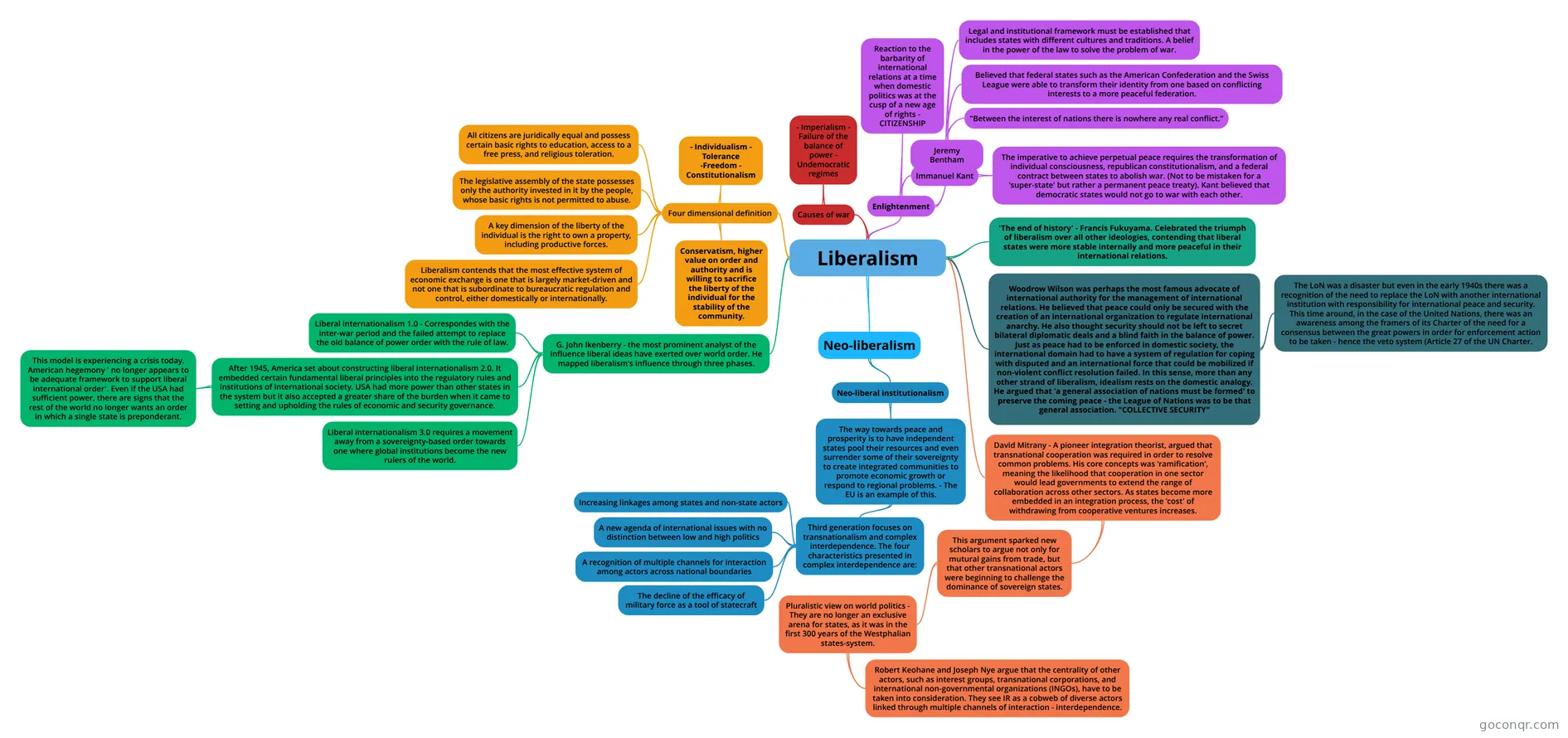
Mind map: Liberalism
Contenido del mapa
Liberalism
Four dimensional definition
- All citizens are juridically equal and possess certain basic rights to education, access to a free press, and religious toleration.
- The legislative assembly of the state possesses only the authority invested in it by the people, whose basic rights is not permitted to abuse.
- A key dimension of the liberty of the individual is the right to own a property, including productive forces.
- Liberalism contends that the most effective system of economic exchange is one that is largely market-driven and not one that is subordinate to bureaucratic regulation and control, either domestically or internationally.
- - Individualism - Tolerance -Freedom - Constitutionalism
- Conservatism, higher value on order and authority and is willing to sacrifice the liberty of the individual for the stability of the community.
Causes of war
- - Imperialism - Failure of the balance of power - Undemocratic regimes
Enlightenment
- Immanuel Kant
- The imperative to achieve perpetual peace requires the transformation of individual consciousness, republican constitutionalism, and a federal contract between states to abolish war. (Not to be mistaken for a 'super-state' but rather a permanent peace treaty). Kant believed that democratic states would not go to war with each other.
- Jeremy Bentham
- Legal and institutional framework must be established that includes states with different cultures and traditions. A belief in the power of the law to solve the problem of war.
- Believed that federal states such as the American Confederation and the Swiss League were able to transform their identity from one based on conflicting interests to a more peaceful federation.
- "Between the interest of nations there is nowhere any real conflict."
- Reaction to the barbarity of international relations at a time when domestic politics was at the cusp of a new age of rights - CITIZENSHIP
- Immanuel Kant
'The end of history' - Francis Fukuyama. Celebrated the triumph of liberalism over all other ideologies, contending that liberal states were more stable internally and more peaceful in their international relations.
Woodrow Wilson was perhaps the most famous advocate of international authority for the management of international relations. He believed that peace could only be secured with the creation of an international organization to regulate international anarchy. He also thought security should not be left to secret bilateral diplomatic deals and a blind faith in the balance of power. Just as peace had to be enforced in domestic society, the international domain had to have a system of regulation for coping with disputed and an international force that could be mobilized if non-violent conflict resolution failed. In this sense, more than any other strand of liberalism, idealism rests on the domestic analogy. He argued that 'a general association of nations must be formed' to preserve the coming peace - the League of Nations was to be that general association. "COLLECTIVE SECURITY"
- The LoN was a disaster but even in the early 1940s there was a recognition of the need to replace the LoN with another international institution with responsibility for international peace and security. This time around, in the case of the United Nations, there was an awareness among the framers of its Charter of the need for a consensus between the great powers in order for enforcement action to be taken - hence the veto system (Article 27 of the UN Charter.
David Mitrany - A pioneer integration theorist, argued that transnational cooperation was required in order to resolve common problems. His core concepts was 'ramification', meaning the likelihood that cooperation in one sector would lead governments to extend the range of collaboration across other sectors. As states become more embedded in an integration process, the 'cost' of withdrawing from cooperative ventures increases.
- This argument sparked new scholars to argue not only for mutural gains from trade, but that other transnational actors were beginning to challenge the dominance of sovereign states.
- Pluralistic view on world politics - They are no longer an exclusive arena for states, as it was in the first 300 years of the Westphalian states-system.
- Robert Keohane and Joseph Nye argue that the centrality of other actors, such as interest groups, transnational corporations, and international non-governmental organizations (INGOs), have to be taken into consideration. They see IR as a cobweb of diverse actors linked through multiple channels of interaction - interdependence.
- Pluralistic view on world politics - They are no longer an exclusive arena for states, as it was in the first 300 years of the Westphalian states-system.
- This argument sparked new scholars to argue not only for mutural gains from trade, but that other transnational actors were beginning to challenge the dominance of sovereign states.
G. John Ikenberry - the most prominent analyst of the influence liberal ideas have exerted over world order. He mapped liberalism's influence through three phases.
- Liberal internationalism 1.0 - Correspondes with the inter-war period and the failed attempt to replace the old balance of power order with the rule of law.
- After 1945, America set about constructing liberal internationalism 2.0. It embedded certain fundamental liberal principles into the regulatory rules and institutions of international society. USA had more power than other states in the system but it also accepted a greater share of the burden when it came to setting and upholding the rules of economic and security governance.
- This model is experiencing a crisis today. American hegemony ' no longer appears to be adequate framework to support liberal international order'. Even if the USA had sufficient power, there are signs that the rest of the world no longer wants an order in which a single state is preponderant.
- Liberal internationalism 3.0 requires a movement away from a sovereignty-based order towards one where global institutions become the new rulers of the world.
Neo-liberalism
- Neo-liberal institutionalism
- The way towards peace and prosperity is to have independent states pool their resources and even surrender some of their sovereignty to create integrated communities to promote economic growth or respond to regional problems. - The EU is an example of this.
- Third generation focuses on transnationalism and complex interdependence. The four characteristics presented in complex interdependence are:
- Increasing linkages among states and non-state actors
- A new agenda of international issues with no distinction between low and high politics
- A recognition of multiple channels for interaction among actors across national boundaries
- The decline of the efficacy of military force as a tool of statecraft
- Third generation focuses on transnationalism and complex interdependence. The four characteristics presented in complex interdependence are:
- The way towards peace and prosperity is to have independent states pool their resources and even surrender some of their sovereignty to create integrated communities to promote economic growth or respond to regional problems. - The EU is an example of this.
- Neo-liberal institutionalism
Información
- Descripción
- Mapa Mental sobre Liberalism, creado por Rosanna Andresdottir el 26/02/2016.
- Creado por
- Rosanna Andresdottir
- Visitas
- 1
- Valoración
Más sobre Liberalism in International Relations