
Mapa mental
Year 9
Contenido del mapa
Year 9
Hierarchy of cells
- Smallest: Organelles (1)
- Examples: Mitochondria, Cell wall
- Different structures in a cell which work together to perform a specific function
- (2) Cells
- Eg. Palisade cells, sperm cells
- A group of different organelles working together to perform a specific function
- (3) Tissue
- Eg. Muscle tissue, lining of intestine
- A group of similar cells working together to perform a certain function
- (4) Organ
- Eg. Stomach, heart
- A group of similar tissues which all work together to perform a specific function
- (5) Organ systems
- Eg. Circulatory system, Digestive system
- A group of similar organs which work together to create and perform a certain job.
- Smallest: Organelles (1)
Homeostasis
- The control of sugar levels, temperature and water levels
- Vasoconstriction- when you get cold
- Hair stand up to trap hot air
- Shiver
- When you move you release energy, which your body converts to heat energy
- Veins constrict
- Blood vessels get narrower, allowing less blood to flow through and reducing heat loss
- Vasodilation- when you get hot
- Hairs lay flat to allow hot air to escape easily
- Sweat
- Sweat evaporates taking heat with it
- Your veins dilate
- Blood vessels get wider, so more blood flows through, increasing heat loss
- Controlled by the haemoglobin
- Vasoconstriction- when you get cold
- The control of sugar levels, temperature and water levels
Decomposition
- Process of composting:
- Stage 1
- Heat- mostly done by fungi and bacteria. They multiply quickly and break down organic matter by digesting it, making the compost very hot.
- Stage 2
- After stage one is over and the compost has cooled down, worms and earthworms move into break down what's left, mixing it with their guts. This could be as fast as two weeks.
- Stage 3
- Ripening- over the period of 6 months to a year, soil organisms sift through the rest of the compost, turning it into a crumbly hummus.
- Stage 1
- Heat
- Healthy compost generates a lot of heat
- Air
- Composting is completed by aerobic bacteria and worms which both need air to survive.
- Moisture
- Make sure the compost doesn't get too dry or too waterlogged (no air will be able to get in) as both are bad for your compost.
- Process of composting:
Nervous systems
- Peripheral Nervous system
- Everything else in the body
- Central nervous system
- The brain and the spine
- The reflex arc
- Stimulus - Receptor - Sensory Neuron - Relay Neuron - Motor Neuron - Effector - Response
- Stimulus - something which triggers the reflex arc. Eg. touching something hot.Receptor - The sense which picks up on the stimulus. In this case, touch.Sensory Neuron - Sends an electric signal through to the relay neuron.The relay neuron sends it to the brain, who processes it, and sends it back down the relay neuron.Then the motor neuron carries the response on.The effector picks up on this and Does the response, in this case moving away.
- Stimulus - Receptor - Sensory Neuron - Relay Neuron - Motor Neuron - Effector - Response
- Synapse Reaction
- Neurons aren't really connected, instead they have the synapse reaction
- !) There are electronic signals in the first neuron.
- 2) The first neuron has vesicles which release chemicals called Neuro Transmitters
- 3) Receptors on the other neuron pick up on the chemicals as they bind themselves to them.
- 4) The signal carries on.
- Peripheral Nervous system
Auxin and plant hormones
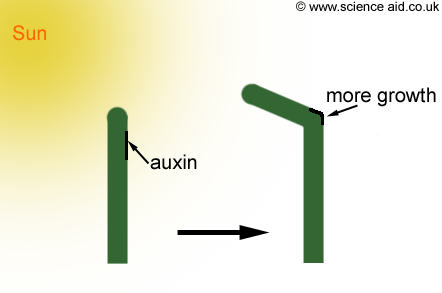
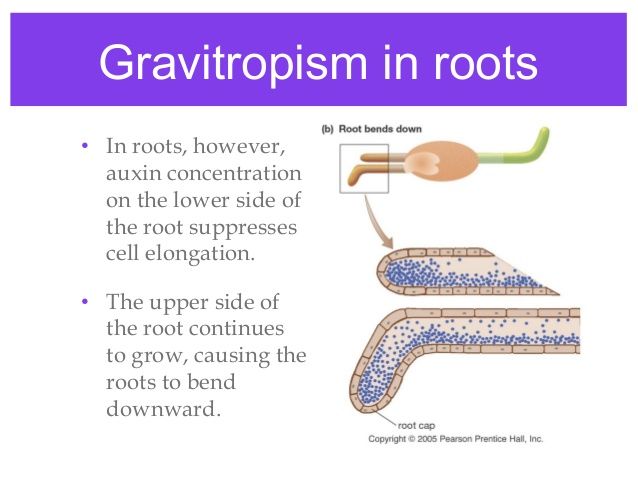
- Auxin is a plant hormone which controls how a plant grows.
- Gravitropism AKA Geotropism
- The growth of the root towards the ground
- The auxin settles on the bottom (because of gravity) and forces the shoot to grow down
- Phototropism
- The growth of the shoot towards the sun
- The auxin settles on the dark side, forcing the shoot to grow upwards
- Gravitropism AKA Geotropism
- Plants compete for
- Nutrients
- Water
- Sunlight
- Auxin is not the only plant hormone, they are often used in agriculture eg:
- Ethylene
- Used to force fruits to ripen
- Giberellins
- Promotes cell division and elongation
- Ethylene
- Auxin is a plant hormone which controls how a plant grows.
The Brain
- Images of the brain
- MRI Scans
- Uses magnetic fields and radio waves
- Completely safe, uses radiology
- Electronic stimulation
- Electrotherapy used to stimulate cell membranes.
- Both detect strokes, traumas, dementia, infections, internal bleeding and brain damage.
- MRI Scans
- Different parts of the brain
- The purple is the Cerebral Cortex
- Planning, reasoning, language, memory, recognising sounds and images
- Pink- The brain stem
- Regulates heart rate, sleeping patterns, breathing and emotions
- Red- The Corpus Callosum
- Connects the left hemisphere with the right hemisphere
- Blue- Cerebellium
- Precision, timing and movement
- The purple is the Cerebral Cortex
- Images of the brain
Eyes
- Short sightedness
- The eyeball is too long
- The eyeball is too long, so instead of projecting the image on the retina it is projected a little behind in the vitreous fluid, making things closer clearer and things further away blurrier.
- Myophia
- The eyeball is too long
- Long sightedness
- The eyeball is too short
- The eyeball is too short, so the image is projected a little in front of the retina. This makes things far away seem more clearer than images closer.
- Hyperopia
- The eyeball is too short
- Short sightedness
Imágenes y archivos del mapa


Información
- Descripción
- Nervous systems, cell hierarchy, composting, ecosystems, homeostasis, plant hormones, cell structure, eyes, brain :)
- Creado por
- Carmen Trinh
- Visitas
- 28
- Etiquetas
- Valoración