
Mapa mental
Haemopoiesis
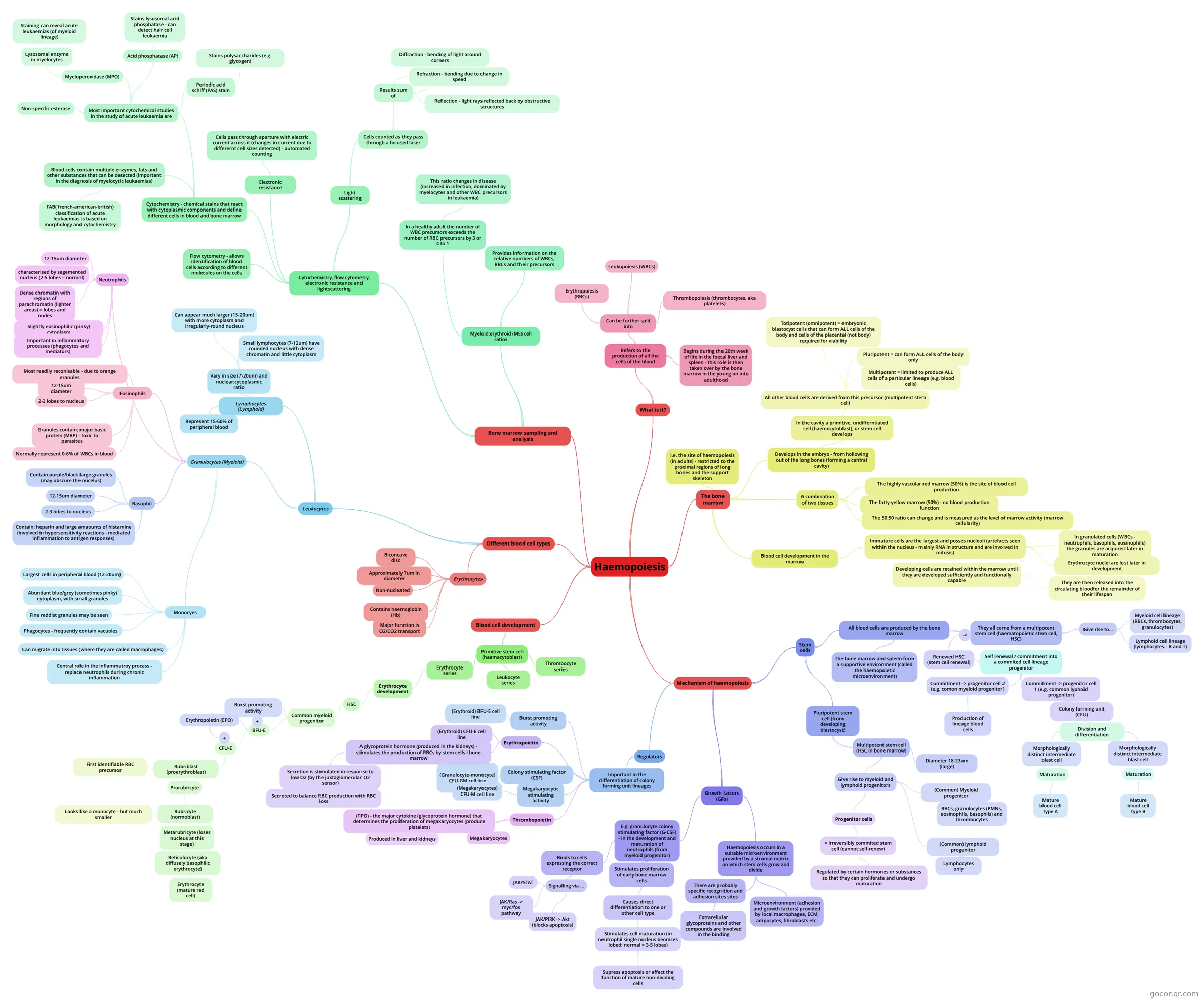
Mind map: haemopoiesis
Contenido del mapa
Haemopoiesis
What is it?
- Refers to the production of all the cells of the blood
- Can be further split into
- Erythropoiesis (RBCs)
- Leukopoiesis (WBCs)
- Thrombopoiesis (thrombocytes, aka platelets)
- Begins during the 20th week of life in the foetal liver and spleen - this role is then taken over by the bone marrow in the young on into adulthood
- Can be further split into
- Refers to the production of all the cells of the blood
The bone marrow
- i.e. the site of haemopoiesis (in adults) - restricted to the proximal regions of long bones and the support skeleton
- Develops in the embryo - from hollowing out of the long bones (forming a central cavity)
- In the cavity a primitive, undifferntiated cell (haemocytoblast), or stem cell develops
- All other blood cells are derived from this precursor (multipotent stem cell)
- Totipotent (omnipotent) = embryonic blastocyst cells that can form ALL cells of the body and cells of the placental (not body) required for viability
- Pluripotent = can form ALL cells of the body only
- Multipotent = limited to produce ALL cells of a particular lineage (e.g. blood cells)
- All other blood cells are derived from this precursor (multipotent stem cell)
- In the cavity a primitive, undifferntiated cell (haemocytoblast), or stem cell develops
- A combination of two tissues
- The highly vascular red marrow (50%) is the site of blood cell production
- The fatty yellow marrow (50%) - no blood production function
- The 50:50 ratio can change and is measured as the level of marrow activity (marrow cellularity)
- Blood cell development in the marrow
- Immature cells are the largest and posses nucleoli (artefacts seen within the nucleus - mainly RNA in structure and are involved in mitosis)
- In granulated cells (WBCs - neutrophils, basophils, eosinophils) the granules are acquired later in maturation
- Erythrocyte nuclei are lost later in development
- Developing cells are retained within the marrow until they are developed sufficiently and functionally capable
- They are then released into the circulating bloodfor the remainder of their lifespan
- Immature cells are the largest and posses nucleoli (artefacts seen within the nucleus - mainly RNA in structure and are involved in mitosis)
Mechanism of haemopoiesis
- Stem cells
- All blood cells are produced by the bone marrow
- They all come from a multipotent stem cell (haematopoietic stem cell, HSC)
- Give rise to...
- Myeloid cell lineage (RBCs, thrombocytes, granulocytes)
- Lymphoid cell lineage (lymphocytes - B and T)
- Self renewal / commitment into a commited cell lineage progenitor
- Commitment -> progenitor cell 1 (e.g. common lyphoid progenitor)
- Colony forming unit (CFU)
- Division and differentiation
- Morphologically distinct intermediate blast cell
- Maturation
- Mature blood cell type B
- Maturation
- Morphologically distinct intermediate blast cell
- Maturation
- Mature blood cell type A
- Maturation
- Morphologically distinct intermediate blast cell
- Division and differentiation
- Colony forming unit (CFU)
- Renewed HSC (stem cell renewal)
- ->
- Commitment -> progenitor cell 2 (e.g. comon myeloid progenitor)
- Production of lineage blood cells
- Commitment -> progenitor cell 1 (e.g. common lyphoid progenitor)
- Give rise to...
- The bone marrow and spleen form a supportive environment (called the haemopoietic microenvironment)
- They all come from a multipotent stem cell (haematopoietic stem cell, HSC)
- Pluripotent stem cell (from developing blastocyst)
- Multipotent stem cell (HSC in bone marrow)
- Diameter 18-23um (large)
- Give rise to myeloid and lymphoid progenitors
- (Common) Myeloid progenitor
- RBCs, granulocytes (PMNs, eosinophils, basophils) and thrombocytes
- (Common) lymphoid progenitor
- Lymphocytes only
- Progenitor cells
- = irreversibly commited stem cell (cannot self-renew)
- Regulated by certain hormones or substances so that they can proliferate and undergo maturation
- = irreversibly commited stem cell (cannot self-renew)
- (Common) Myeloid progenitor
- Multipotent stem cell (HSC in bone marrow)
- All blood cells are produced by the bone marrow
- Growth factors (GFs)
- Haemopoiesis occurs in a suitable microenvironment provided by a stromal matrix on which stem cells grow and divide
- There are probably specific recognition and adhesion sites sites
- Extracellular glycoproteins and other compounds are involved in the binding
- Microenvironment (adhesion and growth factors) provided by local macrophages, ECM, adipocytes, fibroblasts etc.
- There are probably specific recognition and adhesion sites sites
- E.g. granulocyte colony stimulating factor (G-CSF) - in the development and maturation of neutrophils (from myeloid progenitor)
- Stimulates proliferation of early bone marrow cells
- Causes direct differentiation to one or other cell type
- Stimulates cell maturation (in neutrophil single nucleus beomces lobed; normal = 3-5 lobes)
- Supress apoptosis or affect the function of mature non-dividing cells
- Stimulates cell maturation (in neutrophil single nucleus beomces lobed; normal = 3-5 lobes)
- Causes direct differentiation to one or other cell type
- Binds to cells expressing the correct receptor
- Signalling via ...
- JAK/STAT
- JAK/Ras -> myc/fos pathway
- JAK/PI3K -> Akt (blocks apoptosis)
- Signalling via ...
- Stimulates proliferation of early bone marrow cells
- Haemopoiesis occurs in a suitable microenvironment provided by a stromal matrix on which stem cells grow and divide
- Regulators
- Important in the differentiation of colony forming unit lineages
- Burst promoting activity
- (Erythroid) BFU-E cell line
- Erythropoietin
- (Erythroid) CFU-E cell line
- A glycoprotein hormone (produced in the kidneys) - stimulates the production of RBCs by stem cells i bone marrow
- Secretion is stimulated in response to low O2 (by the juxtaglomerular O2 sensor)
- Secreted to balance RBC production with RBC loss
- Secretion is stimulated in response to low O2 (by the juxtaglomerular O2 sensor)
- Colony stimulating factor (CSF)
- (Granulocyte-monocyte) CFU-GM cell line
- Megakaryocytic stimulating activity
- (Megakaryocytes) CFU-M cell line
- Thrombopoietin
- Megakaryocytes
- (TPO) - the major cytokine (glycoprotein hormone) that determines the proliferation of megakaryocytes (produce platelets)
- Produced in liver and kidneys
- Burst promoting activity
- Important in the differentiation of colony forming unit lineages
- Stem cells
Blood cell development
- Primitive stem cell (haemacytoblast)
- Erythrocyte series
- Erythrocyte development
- HSC
- Common myeloid progenitor
- Burst promoting activity
- +
- BFU-E
- CFU-E
- Rubriblast (proerythroblast)
- First identifiable RBC precursor
- Prorubricyte
- Rubricyte (normoblast)
- Looks like a monocyte - but much smaller
- Metarubricyte (loses nucleus at this stage)
- Reticulocyte (aka diffusely basophilic erythrocyte)
- Erythrocyte (mature red cell)
- Reticulocyte (aka diffusely basophilic erythrocyte)
- Rubricyte (normoblast)
- Rubriblast (proerythroblast)
- Erythropoietin (EPO)
- +
- CFU-E
- Burst promoting activity
- Common myeloid progenitor
- HSC
- Erythrocyte development
- Leukocyte series
- Thrombocyte series
- Erythrocyte series
- Primitive stem cell (haemacytoblast)
Different blood cell types
- Erythrocytes
- Biconcave disc
- Approximately 7um in diameter
- Non-nucleated
- Contains haemoglobin (Hb)
- Major function is O2/CO2 transport
- Leukocytes
- Granulocytes (Myeloid)
- Neutrophils
- 12-15um diameter
- characterised by segemented nucleus (2-5 lobes = normal)
- Dense chromatin with regions of parachromatin (lighter areas) = lobes and nodes
- Slightly eosinophilic (pinky) cytoplasm
- Important in inflammatory processes (phagocytes and mediators)
- Eosinophils
- Most readily reconisable - due to orange granules
- 12-15um diameter
- 2-3 lobes to nucleus
- Normally represent 0-6% of WBCs in blood
- Granules contain; major basic protein (MBP) - toxic to parasites
- Basophil
- Contain purple/black large granules (may obscure the nucelus)
- 2-3 lobes to nucleus
- 12-15um diameter
- Contain; heparin and large amaounts of histamine (involved in hypersensitivity reactions - mediated inflammation to antigen responses)
- Monocyes
- Largest cells in peripheral blood (12-20um)
- Abundant blue/grey (sometimes pinky) cytoplasm, with small granules
- Fine reddist granules may be seen
- Phagocytes - frequently contain vacuoles
- Can migrate into tissues (where they are called macrophages)
- Central role in the inflammatroy process - replace neutrophils during chronic inflammation
- Neutrophils
- Lymphocytes (Lymphoid)
- Vary in size (7-20um) and nuclear:cytoplasmic ratio
- Small lymphocytes (7-12um) have rounded nucleus with dense chromatin and little cytoplasm
- Can appear much larger (15-20um) with more cytoplasm and irregularly-round nucleus
- Represent 15-60% of peripheral blood
- Vary in size (7-20um) and nuclear:cytoplasmic ratio
- Granulocytes (Myeloid)
- Erythrocytes
Bone marrow sampling and analysis
- Myeloid:erythroid (ME) cell ratios
- Provides information on the relative numbers of WBCs, RBCs and their precursors
- In a healthy adult the number of WBC precursors exceeds the number of RBC precursors by 3 or 4 to 1
- This ratio changes in disease (increased in infection, dominated by myelocytes and other WBC precursors in leukaemia)
- Cytochemistry, flow cytometry, electronic resistance and lightscattering
- Cytochemistry - chemical stains that react with cytoplasmic components and define different cells in blood and bone marrow
- Blood cells contain multiple enzymes, fats and other substances that can be detected (important in the diagnosis of myelocytic leukaemias)
- FAB( french-american-british) classification of acute leukaemias is based on morphology and cytochemistry
- Most important cytochemical studies in the study of acute leukaemia are
- Myeloperoxidase (MPO)
- Lysosomal enzyme in myelocytes
- Staining can reveal acute leukaemias (of myeloid lineage)
- Lysosomal enzyme in myelocytes
- Non-specific esterase
- Acid phosphatase (AP)
- Stains lysosomal acid phosphatase - can detect hair cell leukaemia
- Periodic acid schiff (PAS) stain
- Stains polysaccharides (e.g. glycogen)
- Myeloperoxidase (MPO)
- Blood cells contain multiple enzymes, fats and other substances that can be detected (important in the diagnosis of myelocytic leukaemias)
- Flow cytometry - allows identification of blood cells according to different molecules on the cells
- Electronic resistance
- Cells pass through aperture with electric current across it (changes in current due to differernt cell sizes detected) - automated counting
- Light scattering
- Cells counted as they pass through a focused laser
- Results sum of
- Diffraction - bending of light around corners
- Refraction - bending due to change in speed
- Reflection - light rays reflected back by obstructive structures
- Results sum of
- Cells counted as they pass through a focused laser
- Cytochemistry - chemical stains that react with cytoplasmic components and define different cells in blood and bone marrow
- Myeloid:erythroid (ME) cell ratios
Información
- Descripción
- Blood Science Mapa Mental sobre Haemopoiesis, creado por maisie_oj el 29/04/2013.
- Creado por
- maisie_oj
- Visitas
- 522
- Etiquetas
- Valoración