
Mapa mental
Biological Approach of Abnormality
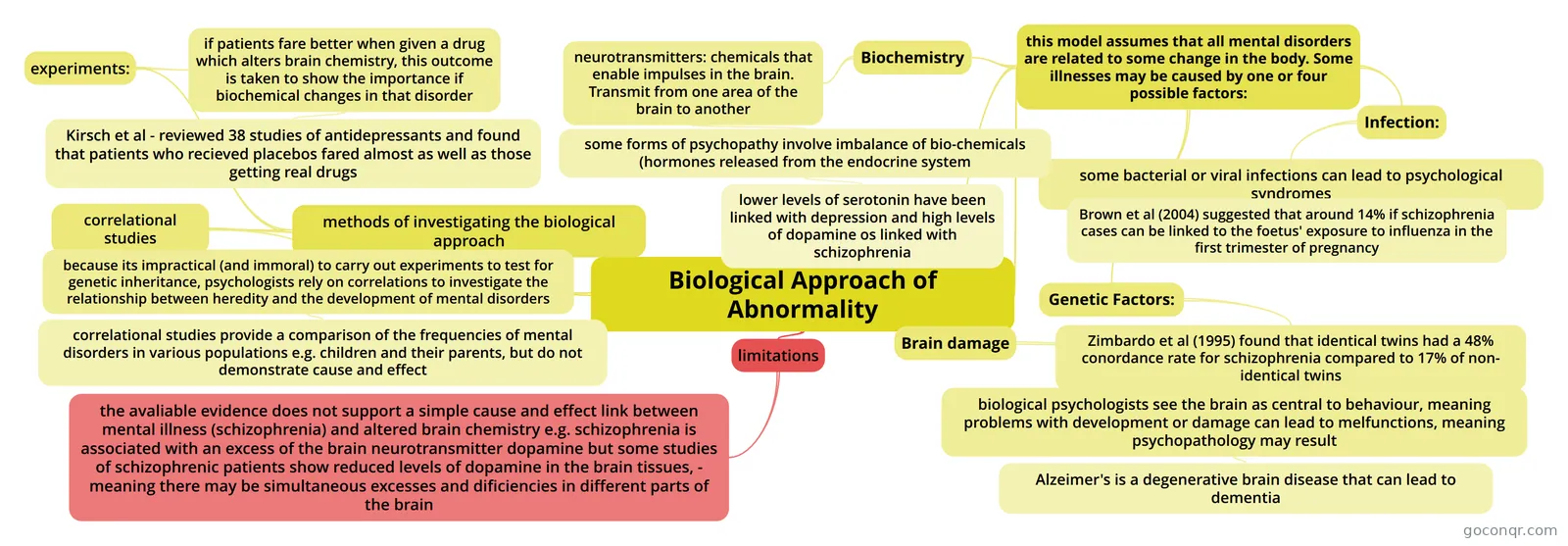
Mind map: Biological approach of abnormality
Contenido del mapa
Biological Approach of Abnormality
this model assumes that all mental disorders are related to some change in the body. Some illnesses may be caused by one or four possible factors:
- Infection:
- some bacterial or viral infections can lead to psychological syndromes
- Brown et al (2004) suggested that around 14% if schizophrenia cases can be linked to the foetus' exposure to influenza in the first trimester of pregnancy
- some bacterial or viral infections can lead to psychological syndromes
- Genetic Factors:
- Zimbardo et al (1995) found that identical twins had a 48% conordance rate for schizophrenia compared to 17% of non- identical twins
- Biochemistry
- neurotransmitters: chemicals that enable impulses in the brain. Transmit from one area of the brain to another
- some forms of psychopathy involve imbalance of bio-chemicals (hormones released from the endocrine system
- lower levels of serotonin have been linked with depression and high levels of dopamine os linked with schizophrenia
- some forms of psychopathy involve imbalance of bio-chemicals (hormones released from the endocrine system
- neurotransmitters: chemicals that enable impulses in the brain. Transmit from one area of the brain to another
- Brain damage
- biological psychologists see the brain as central to behaviour, meaning problems with development or damage can lead to melfunctions, meaning psychopathology may result
- Alzeimer's is a degenerative brain disease that can lead to dementia
- biological psychologists see the brain as central to behaviour, meaning problems with development or damage can lead to melfunctions, meaning psychopathology may result
- Infection:
methods of investigating the biological approach
- experiments:
- if patients fare better when given a drug which alters brain chemistry, this outcome is taken to show the importance if biochemical changes in that disorder
- Kirsch et al - reviewed 38 studies of antidepressants and found that patients who recieved placebos fared almost as well as those getting real drugs
- if patients fare better when given a drug which alters brain chemistry, this outcome is taken to show the importance if biochemical changes in that disorder
- correlational studies
- because its impractical (and immoral) to carry out experiments to test for genetic inheritance, psychologists rely on correlations to investigate the relationship between heredity and the development of mental disorders
- correlational studies provide a comparison of the frequencies of mental disorders in various populations e.g. children and their parents, but do not demonstrate cause and effect
- because its impractical (and immoral) to carry out experiments to test for genetic inheritance, psychologists rely on correlations to investigate the relationship between heredity and the development of mental disorders
- experiments:
limitations
- the avaliable evidence does not support a simple cause and effect link between mental illness (schizophrenia) and altered brain chemistry e.g. schizophrenia is associated with an excess of the brain neurotransmitter dopamine but some studies of schizophrenic patients show reduced levels of dopamine in the brain tissues, - meaning there may be simultaneous excesses and dificiencies in different parts of the brain
Información
- Descripción
- (Abnormality) Psychology Mapa Mental sobre Biological Approach of Abnormality, creado por samantha_x el 26/03/2014.
- Creado por
- samantha_x
- Visitas
- 90
- Etiquetas
- Valoración