
Mapa mental
Behaviourist Explanation To Abnormality
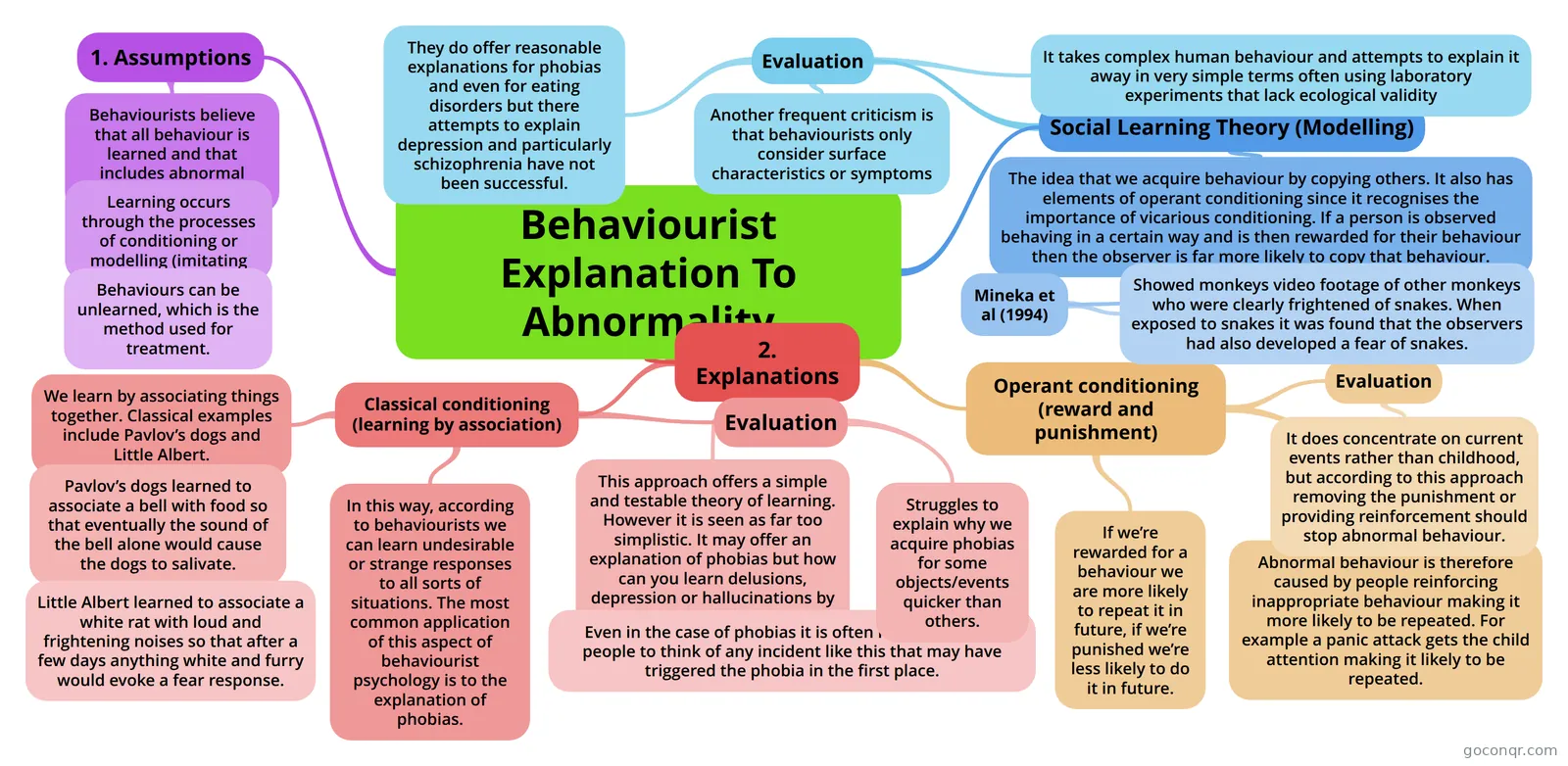
Mind map: behaviourist explanation to abnormality
Contenido del mapa
Behaviourist Explanation To Abnormality
1. Assumptions
- Behaviourists believe that all behaviour is learned and that includes abnormal behaviour
- Learning occurs through the processes of conditioning or modelling (imitating
- Behaviours can be unlearned, which is the method used for treatment.
- Learning occurs through the processes of conditioning or modelling (imitating
- Behaviourists believe that all behaviour is learned and that includes abnormal behaviour
2. Explanations
- Classical conditioning (learning by association)
- We learn by associating things together. Classical examples include Pavlov’s dogs and Little Albert.
- Pavlov’s dogs learned to associate a bell with food so that eventually the sound of the bell alone would cause the dogs to salivate.
- Little Albert learned to associate a white rat with loud and frightening noises so that after a few days anything white and furry would evoke a fear response.
- Pavlov’s dogs learned to associate a bell with food so that eventually the sound of the bell alone would cause the dogs to salivate.
- In this way, according to behaviourists we can learn undesirable or strange responses to all sorts of situations. The most common application of this aspect of behaviourist psychology is to the explanation of phobias.
- Evaluation
- This approach offers a simple and testable theory of learning. However it is seen as far too simplistic. It may offer an explanation of phobias but how can you learn delusions, depression or hallucinations by association?
- Even in the case of phobias it is often not possible for people to think of any incident like this that may have triggered the phobia in the first place.
- Struggles to explain why we acquire phobias for some objects/events quicker than others.
- This approach offers a simple and testable theory of learning. However it is seen as far too simplistic. It may offer an explanation of phobias but how can you learn delusions, depression or hallucinations by association?
- We learn by associating things together. Classical examples include Pavlov’s dogs and Little Albert.
- Operant conditioning (reward and punishment)
- If we’re rewarded for a behaviour we are more likely to repeat it in future, if we’re punished we’re less likely to do it in future.
- Abnormal behaviour is therefore caused by people reinforcing inappropriate behaviour making it more likely to be repeated. For example a panic attack gets the child attention making it likely to be repeated.
- Evaluation
- It does concentrate on current events rather than childhood, but according to this approach removing the punishment or providing reinforcement should stop abnormal behaviour.
- Classical conditioning (learning by association)
Social Learning Theory (Modelling)
- The idea that we acquire behaviour by copying others. It also has elements of operant conditioning since it recognises the importance of vicarious conditioning. If a person is observed behaving in a certain way and is then rewarded for their behaviour then the observer is far more likely to copy that behaviour.
- Mineka et al (1994)
- Showed monkeys video footage of other monkeys who were clearly frightened of snakes. When exposed to snakes it was found that the observers had also developed a fear of snakes.
- Mineka et al (1994)
- Evaluation
- It takes complex human behaviour and attempts to explain it away in very simple terms often using laboratory experiments that lack ecological validity
- Another frequent criticism is that behaviourists only consider surface characteristics or symptoms
- They do offer reasonable explanations for phobias and even for eating disorders but there attempts to explain depression and particularly schizophrenia have not been successful.
- The idea that we acquire behaviour by copying others. It also has elements of operant conditioning since it recognises the importance of vicarious conditioning. If a person is observed behaving in a certain way and is then rewarded for their behaviour then the observer is far more likely to copy that behaviour.
Información
- Descripción
- A Levels (Unit 2 - Abnormality) Psychology Mapa Mental sobre Behaviourist Explanation To Abnormality, creado por danny-hudson97 el 08/04/2014.
- Creado por
- danny-hudson97
- Visitas
- 71
- Etiquetas
- Valoración