
Mapa mental
The Subsystems
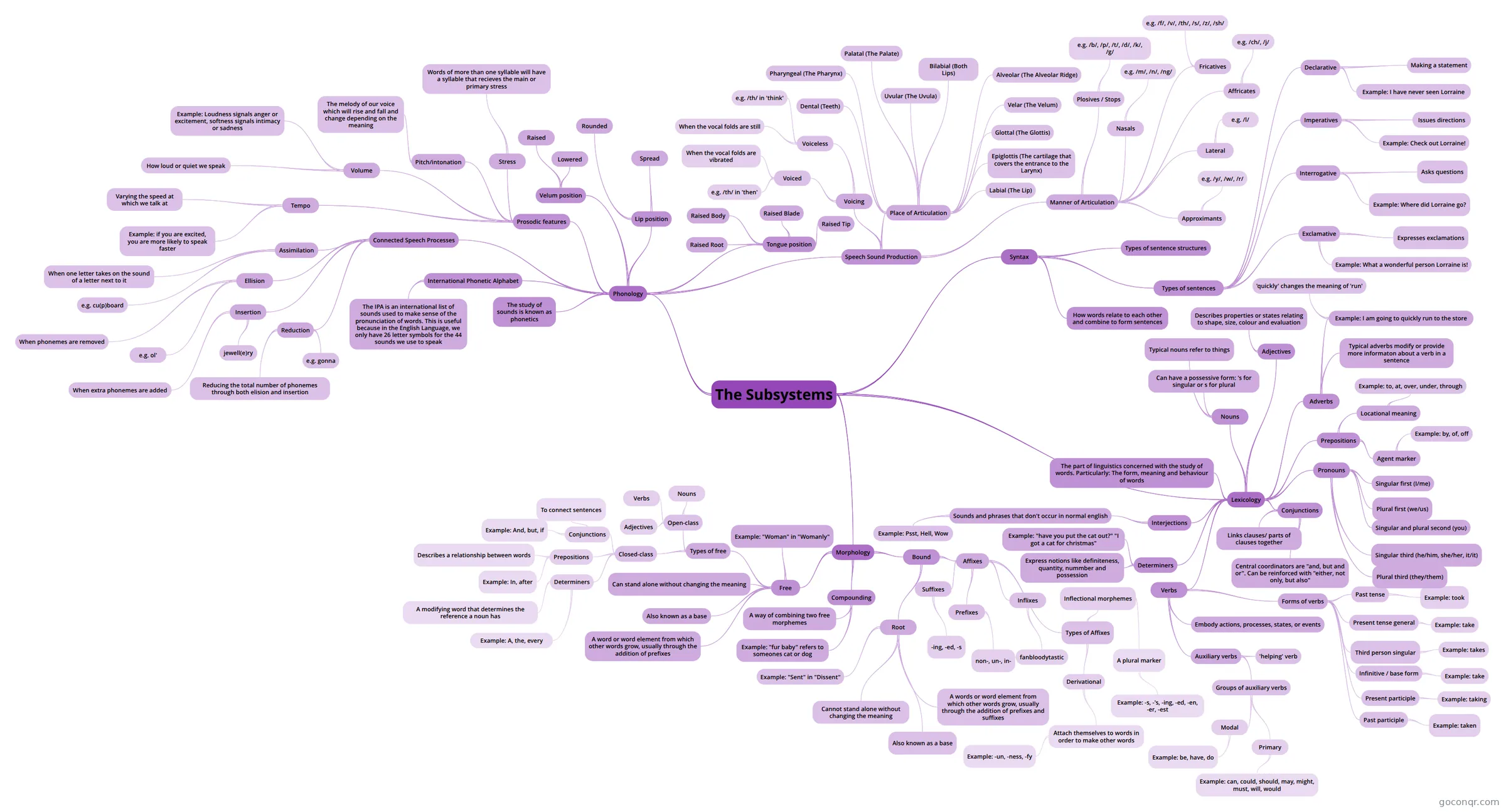
Mind map: the subsystems of language
Contenido del mapa
The Subsystems
Syntax
- How words relate to each other and combine to form sentences
- Types of sentences
- Declarative
- Making a statement
- Example: I have never seen Lorraine
- Imperatives
- Issues directions
- Example: Check out Lorraine!
- Interrogative
- Asks questions
- Example: Where did Lorraine go?
- Exclamative
- Expresses exclamations
- Example: What a wonderful person Lorraine is!
- Declarative
- Types of sentence structures
Lexicology
- The part of linguistics concerned with the study of words. Particularly: The form, meaning and behaviour of words
- Nouns
- Typical nouns refer to things
- Can have a possessive form: 's for singular or s for plural
- Verbs
- Embody actions, processes, states, or events
- Forms of verbs
- Past tense
- Example: took
- Present tense general
- Example: take
- Third person singular
- Example: takes
- Infinitive / base form
- Example: take
- Present participle
- Example: taking
- Past participle
- Example: taken
- Past tense
- Auxiliary verbs
- 'helping' verb
- Groups of auxiliary verbs
- Primary
- Example: can, could, should, may, might, must, will, would
- Modal
- Example: be, have, do
- Primary
- Adjectives
- Describes properties or states relating to shape, size, colour and evaluation
- Adverbs
- Typical adverbs modify or provide more informaton about a verb in a sentence
- Example: I am going to quickly run to the store
- 'quickly' changes the meaning of 'run'
- Prepositions
- Locational meaning
- Example: to, at, over, under, through
- Agent marker
- Example: by, of, off
- Locational meaning
- Pronouns
- Singular first (I/me)
- Plural first (we/us)
- Singular and plural second (you)
- Singular third (he/him, she/her, it/it)
- Plural third (they/them)
- Conjunctions
- Links clauses/ parts of clauses together
- Central coordinators are "and, but and or". Can be reinforced with "either, not only, but also"
- Determiners
- Express notions like definiteness, quantity, nummber and possession
- Example: "have you put the cat out?" "I got a cat for christmas"
- Interjections
- Sounds and phrases that don't occur in normal english
- Example: Psst, Hell, Wow
- Sounds and phrases that don't occur in normal english
Morphology
- Bound
- Affixes
- Suffixes
- -ing, -ed, -s
- Prefixes
- non-, un-, in-
- Inflixes
- fanbloodytastic
- Types of Affixes
- Inflectional morphemes
- A plural marker
- Example: -s, -'s, -ing, -ed, -en, -er, -est
- A plural marker
- Derivational
- Attach themselves to words in order to make other words
- Example: -un, -ness, -fy
- Attach themselves to words in order to make other words
- Inflectional morphemes
- Suffixes
- Root
- A words or word element from which other words grow, usually through the addition of prefixes and suffixes
- Also known as a base
- Cannot stand alone without changing the meaning
- Example: "Sent" in "Dissent"
- Affixes
- Free
- A word or word element from which other words grow, usually through the addition of prefixes
- Also known as a base
- Can stand alone without changing the meaning
- Example: "Woman" in "Womanly"
- Types of free
- Open-class
- Nouns
- Verbs
- Adjectives
- Closed-class
- Conjunctions
- To connect sentences
- Example: And, but, if
- Prepositions
- Describes a relationship between words
- Example: In, after
- Determiners
- A modifying word that determines the reference a noun has
- Example: A, the, every
- Conjunctions
- Open-class
- Compounding
- A way of combining two free morphemes
- Example: "fur baby" refers to someones cat or dog
- Bound
Phonology
- The study of sounds is known as phonetics
- Prosodic features
- Only in spoken language
- Tempo
- Varying the speed at which we talk at
- Example: if you are excited, you are more likely to speak faster
- Volume
- How loud or quiet we speak
- Example: Loudness signals anger or excitement, softness signals intimacy or sadness
- Pitch/intonation
- The melody of our voice which will rise and fall and change depending on the meaning
- Stress
- Words of more than one syllable will have a syllable that recieves the main or primary stress
- International Phonetic Alphabet
- The IPA is an international list of sounds used to make sense of the pronunciation of words. This is useful because in the English Language, we only have 26 letter symbols for the 44 sounds we use to speak
- Speech Sound Production
- Voicing
- Voiced
- When the vocal folds are vibrated
- e.g. /th/ in 'then'
- Voiceless
- When the vocal folds are still
- e.g. /th/ in 'think'
- Voiced
- Place of Articulation
- Dental (Teeth)
- Palatal (The Palate)
- Uvular (The Uvula)
- Pharyngeal (The Pharynx)
- Labial (The Lip)
- Bilabial (Both Lips)
- Alveolar (The Alveolar Ridge)
- Velar (The Velum)
- Glottal (The Glottis)
- Epiglottis (The cartilage that covers the entrance to the Larynx)
- Manner of Articulation
- Plosives / Stops
- e.g. /b/, /p/, /t/, /d/, /k/, /g/
- Nasals
- e.g. /m/, /n/, /ng/
- Fricatives
- e.g. /f/, /v/, /th/, /s/, /z/, /sh/
- Affricates
- e.g. /ch/, /j/
- Lateral
- e.g. /l/
- Approximants
- e.g. /y/, /w/, /r/
- Plosives / Stops
- Voicing
- Tongue position
- Raised Tip
- Raised Blade
- Raised Body
- Raised Root
- Velum position
- Raised
- Lowered
- Lip position
- Rounded
- Spread
- Connected Speech Processes
- Assimilation
- When one letter takes on the sound of a letter next to it
- e.g. cu(p)board
- Ellision
- When phonemes are removed
- e.g. ol'
- Insertion
- When extra phonemes are added
- jewell(e)ry
- Reduction
- Reducing the total number of phonemes through both elision and insertion
- e.g. gonna
- Assimilation
Información
- Descripción
- (HIGHSCHOOL) Linguistics Mapa Mental sobre The Subsystems, creado por Ashleigh Hollins el 02/03/2017.
- Creado por
- Ashleigh Hollins
- Visitas
- 0
- Valoración
Más sobre Levels and Subsystems of Language