
Mapa mental
Speciation
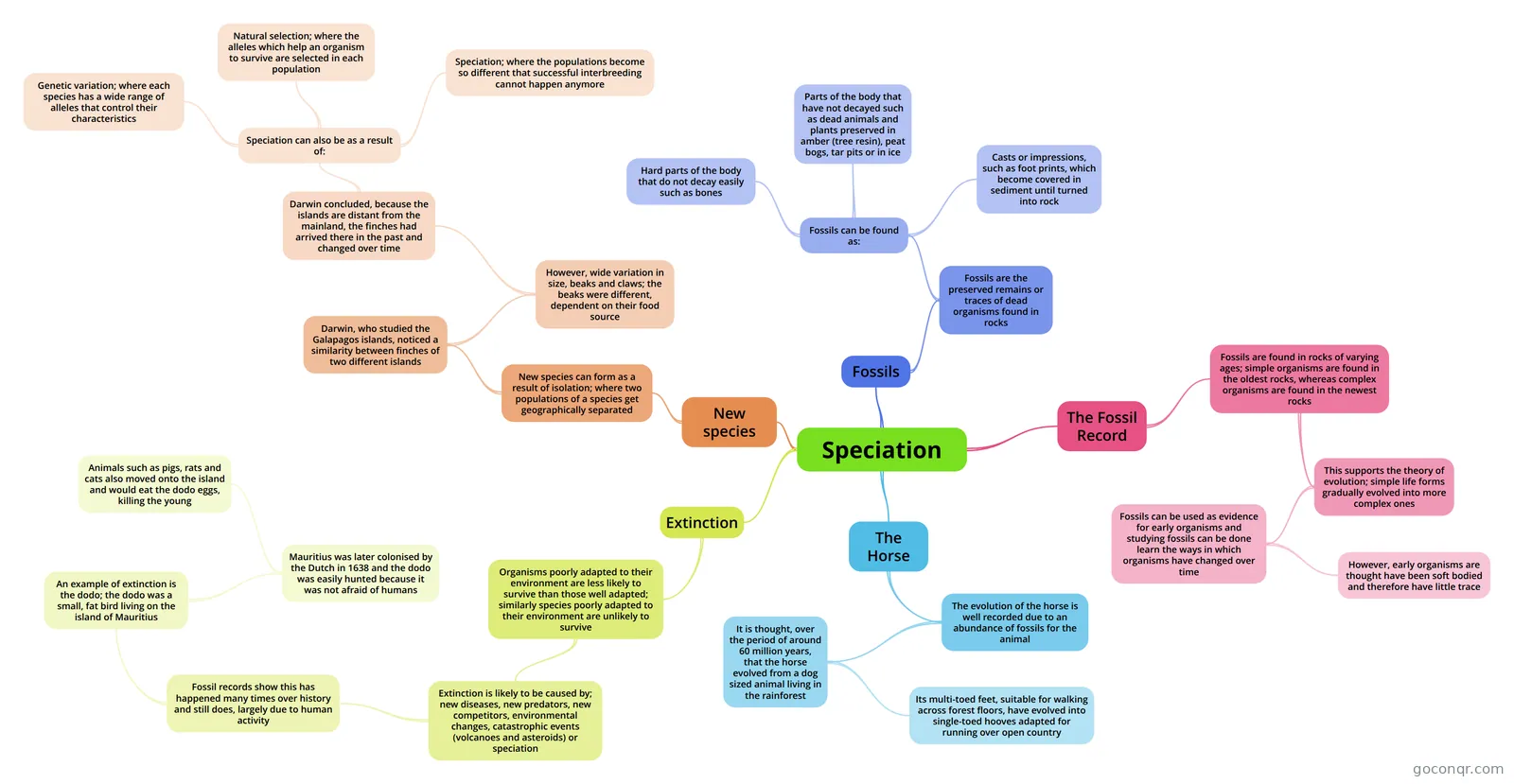
Mind map: Speciation
Contenido del mapa
Speciation
Fossils
- Fossils are the preserved remains or traces of dead organisms found in rocks
- Fossils can be found as:
- Hard parts of the body that do not decay easily such as bones
- Parts of the body that have not decayed such as dead animals and plants preserved in amber (tree resin), peat bogs, tar pits or in ice
- Casts or impressions, such as foot prints, which become covered in sediment until turned into rock
- Fossils can be found as:
- Fossils are the preserved remains or traces of dead organisms found in rocks
The Fossil Record
- Fossils are found in rocks of varying ages; simple organisms are found in the oldest rocks, whereas complex organisms are found in the newest rocks
- This supports the theory of evolution; simple life forms gradually evolved into more complex ones
- Fossils can be used as evidence for early organisms and studying fossils can be done learn the ways in which organisms have changed over time
- However, early organisms are thought have been soft bodied and therefore have little trace
- Fossils can be used as evidence for early organisms and studying fossils can be done learn the ways in which organisms have changed over time
- This supports the theory of evolution; simple life forms gradually evolved into more complex ones
- Fossils are found in rocks of varying ages; simple organisms are found in the oldest rocks, whereas complex organisms are found in the newest rocks
The Horse
- The evolution of the horse is well recorded due to an abundance of fossils for the animal
- It is thought, over the period of around 60 million years, that the horse evolved from a dog sized animal living in the rainforest
- Its multi-toed feet, suitable for walking across forest floors, have evolved into single-toed hooves adapted for running over open country
- It is thought, over the period of around 60 million years, that the horse evolved from a dog sized animal living in the rainforest
- The evolution of the horse is well recorded due to an abundance of fossils for the animal
Extinction
- Organisms poorly adapted to their environment are less likely to survive than those well adapted; similarly species poorly adapted to their environment are unlikely to survive
- Extinction is likely to be caused by; new diseases, new predators, new competitors, environmental changes, catastrophic events (volcanoes and asteroids) or speciation
- Fossil records show this has happened many times over history and still does, largely due to human activity
- An example of extinction is the dodo; the dodo was a small, fat bird living on the island of Mauritius
- Mauritius was later colonised by the Dutch in 1638 and the dodo was easily hunted because it was not afraid of humans
- Animals such as pigs, rats and cats also moved onto the island and would eat the dodo eggs, killing the young
- Mauritius was later colonised by the Dutch in 1638 and the dodo was easily hunted because it was not afraid of humans
- An example of extinction is the dodo; the dodo was a small, fat bird living on the island of Mauritius
- Fossil records show this has happened many times over history and still does, largely due to human activity
- Extinction is likely to be caused by; new diseases, new predators, new competitors, environmental changes, catastrophic events (volcanoes and asteroids) or speciation
- Organisms poorly adapted to their environment are less likely to survive than those well adapted; similarly species poorly adapted to their environment are unlikely to survive
New species
- New species can form as a result of isolation; where two populations of a species get geographically separated
- Darwin, who studied the Galapagos islands, noticed a similarity between finches of two different islands
- However, wide variation in size, beaks and claws; the beaks were different, dependent on their food source
- Darwin concluded, because the islands are distant from the mainland, the finches had arrived there in the past and changed over time
- Speciation can also be as a result of:
- Genetic variation; where each species has a wide range of alleles that control their characteristics
- Natural selection; where the alleles which help an organism to survive are selected in each population
- Speciation; where the populations become so different that successful interbreeding cannot happen anymore
- Speciation can also be as a result of:
- Darwin concluded, because the islands are distant from the mainland, the finches had arrived there in the past and changed over time
- However, wide variation in size, beaks and claws; the beaks were different, dependent on their food source
- Darwin, who studied the Galapagos islands, noticed a similarity between finches of two different islands
- New species can form as a result of isolation; where two populations of a species get geographically separated
Información
- Descripción
- (Additional GCSE) GCSE Biology Mapa Mental sobre Speciation, creado por seth.bragg el 06/05/2014.
- Creado por
- seth.bragg
- Visitas
- 23
- Valoración
Más sobre Evidence for Evolution