
Mapa mental
Vicarious Liability
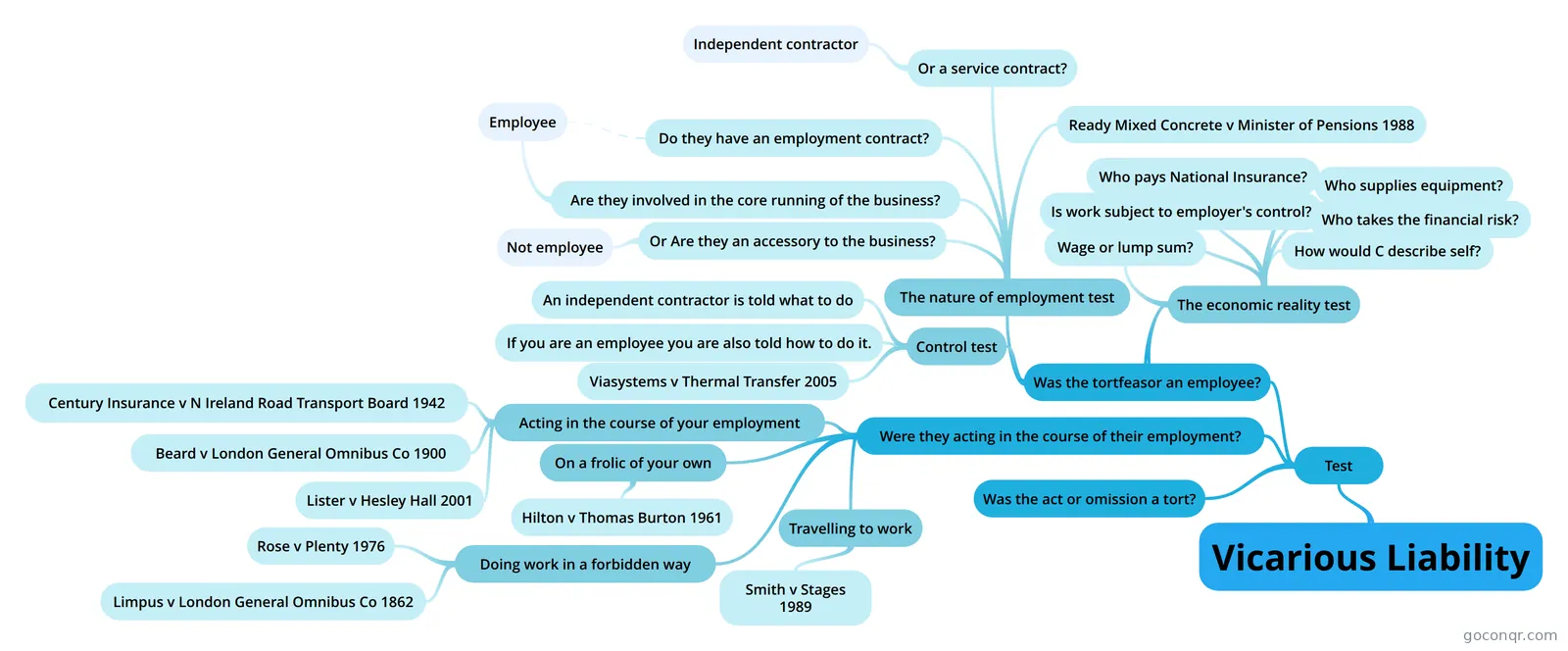
Mind map: Vicarious liability
Contenido del mapa
Vicarious Liability
Test
- Was the tortfeasor an employee?
- Control test
- An independent contractor is told what to do
- If you are an employee you are also told how to do it.
- Viasystems v Thermal Transfer 2005
- - C hired Thermal Transfer to install air con. They subcontracted to DA who hired CAT. - CAT negligently caused a flood which damaged property. - TT was liable under contract, CAT also liable. - CAT appealed and appeal failed, but also found DA liable.
- The nature of employment test
- Are they involved in the core running of the business?
- Employee
- Or Are they an accessory to the business?
- Not employee
- Do they have an employment contract?
- Or a service contract?
- Independent contractor
- Ready Mixed Concrete v Minister of Pensions 1988
- - Drivers buy their own lorries - In their contract: only for the company's use, company can hire different drivers, must maintain the company's standards, choose own work hours. - Court: drivers are independent! - service contract = independent - employment contract = employee
- Are they involved in the core running of the business?
- The economic reality test
- Wage or lump sum?
- Is work subject to employer's control?
- Who pays National Insurance?
- Who supplies equipment?
- Who takes the financial risk?
- How would C describe self?
- Control test
- Were they acting in the course of their employment?
- Acting in the course of your employment
- Century Insurance v N Ireland Road Transport Board 1942
- Vicarious liability applied, where the lighting of a match to light a cigarette and throwing it on the floor while transferring petrol from a lorry to a tank was held to be in the scope of employment.
- Beard v London General Omnibus Co 1900
- One of the defendant’s conductors, in order to save time, drove the bus quickly around some side streets, negligently injuring the plaintiff, who now sought damages against the bus company. Held: The plaintiff had failed to provide any evidence that the conductor had been authorised to drive the bus, and therefore failed to establish that they had any resonsibility in negligence for his acts. The action failed.
- Lister v Hesley Hall 2001
- A school board employed staff to manage a residential school for vulnerable children. The staff committed sexual abuse of the children. The school denied vicarious liability for the acts of the teachers. Held: ‘Vicarious liability is legal responsibility imposed on an employer, although he is himself free from blame, for a tort committed by his employee in the course of his employment.’ ‘Vicarious liability is a species of strict liability. It is not premised on any culpable act or omission on the part of the employer; an employer who is not personally at fault is made legally answerable for the fault of his employee. It is best understood as a loss-distribution device’ (Lord Millett) The court overruled earlier decisions to hold that the school was vicariously liable. The test is not just whether the abuse was an unauthorised way of carrying out tasks authorised as part of the employment. These acts had been committed on the premises and during the time when the staff should have been complying with their duty to care for the children. The connection of time and place, and the inextricable link between the acts of abuse and the employment, were sufficiently close to establish liability. Wrongful conduct must be so closely connected with acts the partner or employee was authorised to do that, for the purpose of the liability of the firm or the employer to third parties, the wrongful conduct may fairly and properly be regarded as done by the partner while acting in the ordinary course of the firm’s business or the employee’s employment.
- Century Insurance v N Ireland Road Transport Board 1942
- On a frolic of your own
- Hilton v Thomas Burton 1961
- Hilton went for a drink one lunchtime with some of his colleagues. They drove to the pub in the work van belonging to the company they worked for. On leaving the pub the van crashed due to the negligence of the driver and Hilton, one of the passengers, was killed. Hilton's wife sued the company on the basis that they were vicariously liable for the van driver's negligence. The employer was held not liable as Hilton and his colleagues had been on a “frolic of their own" at the time of the accident and were not acting in the course of their employment.
- Hilton v Thomas Burton 1961
- Doing work in a forbidden way
- Limpus v London General Omnibus Co 1862
- The driver of an omnibus, seeking to disturb the omnibus of another company, drove his own across the path of another. His employers had furnished him and other drivers with a card saying they ‘must not on any account race with or obstruct another omnibus.’ Baron Martin had directed the jury that, if the defendant’s driver did it for the purposes of his employer, the defendants were liable: but if it was an act of his own, and in order to effect a purpose of his own, the defendants were not responsible. The jury found for the plaintiff. Held: The employer was liable for the ensuing accident despite written instructions to the driver to exercsie care. The employer was liable because the injury resulted from an act done by the driver in the course of his service and for his master’s purposes; it was not done by the servant for his own purposes, but for his master’s purposes. Lord Blackburn said: ‘A footman might think it for the interest of his master to drive the coach, but no one could say that it was within the scope of the footman’s employment, and that the master would be liable for damage resulting from the wilful act of the footman in taking charge of the horses.’
- Rose v Plenty 1976
- Contrary to his employers orders, a milkman allowed children to assist him in his milkround. One was injured, and sued the milkman’s employer. Held: The milkman had not gone so far outside the activities for which he was employed for the employer to escape liability. ‘The servant was, of course, employed at the time of the accident to do a whole number of operations. He was certainly not employed to give the boy a lift, and if one confines one’s analysis of the facts to the incident of injury to the plaintiff, then no doubt one would say that carrying the boy on the float – giving him a lift – was not in the course of the servant’s employment.’ After referring to Ilkiw. ‘he was employed as a roundsman to drive his float round his round and to deliver milk, to collect empties and to obtain payment. That was his job. . . He chose to disregard the prohibition and to enlist the assistance of the plaintiff. As a matter of common sense, that does seem to me to be a mode, albeit a prohibited mode, of doing the job with which he was entrusted. Why was the plaintiff being carried on the float when the accident occurred? Because it was necessary to take him from point to point so that he could assist in delivering milk, collecting empties and, on occasions obtaining payment.’
- Limpus v London General Omnibus Co 1862
- Travelling to work
- Smith v Stages 1989
- Two employees were sent from Staffordshire to South Wales to do urgent work for their employer. They were paid for travelling time due to the long distance. On the return journey the driver crashed, injuring himself and the other employee.
- Smith v Stages 1989
- Acting in the course of your employment
- Was the act or omission a tort?
- Was the tortfeasor an employee?
Información
- Descripción
- A level LAW Mapa Mental sobre Vicarious Liability, creado por Ash Dixon el 04/05/2017.
- Creado por
- Ash Dixon
- Visitas
- 3
- Valoración