
Mapa mental
Inherited Change - chapter 17
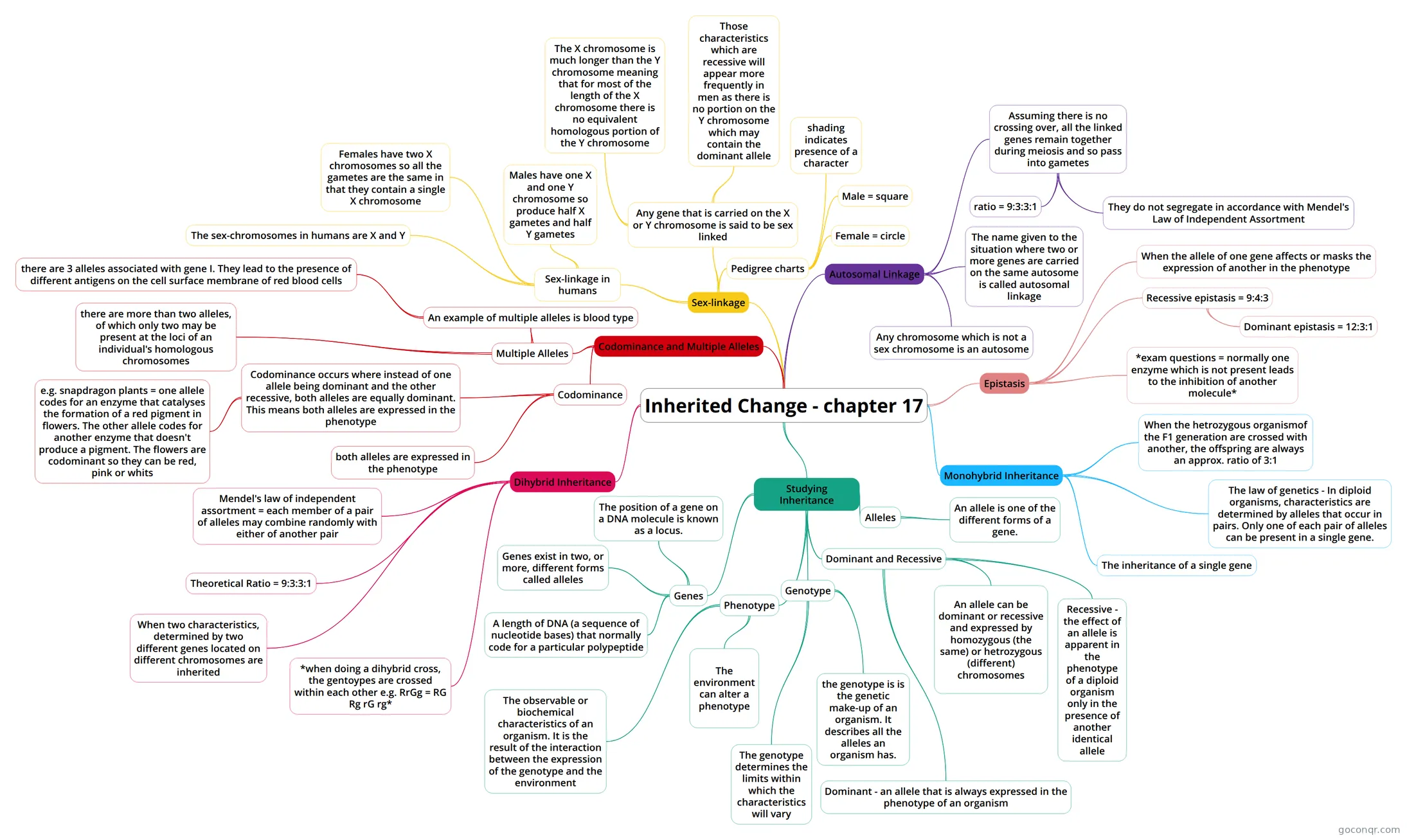
Mind map: inherited change
Contenido del mapa
Inherited Change - chapter 17
Studying Inheritance
- Genotype
- the genotype is is the genetic make-up of an organism. It describes all the alleles an organism has.
- The genotype determines the limits within which the characteristics will vary
- Phenotype
- The observable or biochemical characteristics of an organism. It is the result of the interaction between the expression of the genotype and the environment
- The environment can alter a phenotype
- Genes
- A length of DNA (a sequence of nucleotide bases) that normally code for a particular polypeptide
- Genes exist in two, or more, different forms called alleles
- The position of a gene on a DNA molecule is known as a locus.
- Alleles
- An allele is one of the different forms of a gene.
- Dominant and Recessive
- An allele can be dominant or recessive and expressed by homozygous (the same) or hetrozygous (different) chromosomes
- Dominant - an allele that is always expressed in the phenotype of an organism
- Recessive - the effect of an allele is apparent in the phenotype of a diploid organism only in the presence of another identical allele
- Genotype
Monohybrid Inheritance
- The inheritance of a single gene
- The law of genetics - In diploid organisms, characteristics are determined by alleles that occur in pairs. Only one of each pair of alleles can be present in a single gene.
- When the hetrozygous organismof the F1 generation are crossed with another, the offspring are always an approx. ratio of 3:1
Dihybrid Inheritance
- When two characteristics, determined by two different genes located on different chromosomes are inherited
- *when doing a dihybrid cross, the gentoypes are crossed within each other e.g. RrGg = RG Rg rG rg*
- Theoretical Ratio = 9:3:3:1
- Mendel's law of independent assortment = each member of a pair of alleles may combine randomly with either of another pair
Codominance and Multiple Alleles
- Codominance
- both alleles are expressed in the phenotype
- Codominance occurs where instead of one allele being dominant and the other recessive, both alleles are equally dominant. This means both alleles are expressed in the phenotype
- e.g. snapdragon plants = one allele codes for an enzyme that catalyses the formation of a red pigment in flowers. The other allele codes for another enzyme that doesn't produce a pigment. The flowers are codominant so they can be red, pink or whits
- Multiple Alleles
- there are more than two alleles, of which only two may be present at the loci of an individual's homologous chromosomes
- An example of multiple alleles is blood type
- there are 3 alleles associated with gene I. They lead to the presence of different antigens on the cell surface membrane of red blood cells
- Codominance
Sex-linkage
- Sex-linkage in humans
- The sex-chromosomes in humans are X and Y
- Females have two X chromosomes so all the gametes are the same in that they contain a single X chromosome
- Males have one X and one Y chromosome so produce half X gametes and half Y gametes
- Any gene that is carried on the X or Y chromosome is said to be sex linked
- The X chromosome is much longer than the Y chromosome meaning that for most of the length of the X chromosome there is no equivalent homologous portion of the Y chromosome
- Those characteristics which are recessive will appear more frequently in men as there is no portion on the Y chromosome which may contain the dominant allele
- Pedigree charts
- Male = square
- Female = circle
- shading indicates presence of a character
- Sex-linkage in humans
Autosomal Linkage
- Any chromosome which is not a sex chromosome is an autosome
- The name given to the situation where two or more genes are carried on the same autosome is called autosomal linkage
- Assuming there is no crossing over, all the linked genes remain together during meiosis and so pass into gametes
- They do not segregate in accordance with Mendel's Law of Independent Assortment
- ratio = 9:3:3:1
Epistasis
- When the allele of one gene affects or masks the expression of another in the phenotype
- Recessive epistasis = 9:4:3
- Dominant epistasis = 12:3:1
- *exam questions = normally one enzyme which is not present leads to the inhibition of another molecule*
Información
- Descripción
- A level (Section 7) Biology Mapa Mental sobre Inherited Change - chapter 17, creado por Orlagh Bonser el 18/01/2018.
- Creado por
- Orlagh Bonser
- Visitas
- 181
- Etiquetas
- Valoración